
Standard & Custom Light Load Anti-Vibration Isolators
Engineered for high-mix low-to-medium payload machinery, automated laboratory platforms, robotic arms, and electronic enclosures requiring exact natural frequency tuning.






Elastomeric Mechanics in Light Load Shock & Vibration Isolation
A rigorous examination of viscoelastic behavior, dynamic stiffness modulation, and shear-compression mechanics in precision instrument design.
In low-payload precision systems—ranging from automated optical inspection (AOI) stages to medical fluid analyzers and airborne optronic payloads—vibration mitigation presents unique engineering challenges. Unlike heavy industrial machinery, where thousands of kilograms generate high static deflection across stiff helical springs, light load systems (0.5 kg to 120 kg total mass) exhibit low mechanical inertia. Standard damping materials often remain uncompressed, behaving essentially as rigid structural links that transmit high-frequency harmonics, acoustic noise, and residual stepper motor resonance directly into sensitive components.
As an ISO 9001:2015 certified manufacturer with 37 proprietary patents and over 13 years of specialized dynamics experience, our factory approaches custom light-load rubber dampers via finite element elastomeric analysis (FEA) and customized molecular compounding. By controlling polymer crosslink density, carbon black dispersion, and synthetic plasticizer ratios, we balance static load capacity with dynamic compliance, preventing the high-frequency stiffening typical of commercial elastomers.
Frequency Ratio: r = f_d / f_n
Transmissibility: T = √[ (1 + (2*ζ*r)²) / ((1 - r²)² + (2*ζ*r)²) ]
Dynamic Ratio: q = K_d / K_s (Targeted: 1.15 ≤ q ≤ 1.45 for linear light damping)
To achieve meaningful isolation efficiency (T < 0.1, representing >90% reduction), the disturbing frequency f_d must exceed the natural frequency f_n by a ratio r ≥ √2. Because light loads cannot produce large deflections without risking structural instability, our engineering team optimizes geometric shear-to-compression stress ratios. Utilizing parabolic, conical, and waist-tapered profiles, our dampers allow shear deformation at low strain amplitudes—delivering a lower natural frequency (down to 6 Hz - 10 Hz) under minimal deadweight—while transitioning gracefully into compression under extreme shock loads to absorb up to 5G mechanical accelerations.
| Elastomeric Compound | Shore A Hardness | Loss Factor (η = tan δ) | Operating Temp Range | Chemical & Environmental Resistance | Ideal Application Scenario |
|---|---|---|---|---|---|
| High-Damping Natural Rubber (NR) | 35 – 65 ±5 | 0.15 – 0.35 | -40°C to +80°C | Moderate oils; excellent mechanical fatigue & creep life | Laboratory scales, micro-pumps, laser metrology |
| Low-Creep Neoprene (CR) | 40 – 75 ±5 | 0.10 – 0.22 | -35°C to +100°C | Superior weather, ozone, and refrigerant resistance | Compact HVAC blowers, marine avionics, valve blocks |
| Fluorosilicone & Silicone (VMQ/FVMQ) | 25 – 70 ±5 | 0.08 – 0.30 | -60°C to +200°C | Inert, non-outgassing, chemical, and cleanroom compliant | Medical diagnostic devices, satellites, wafer robotics |
| Formulated Nitrile Rubber (NBR) | 45 – 80 ±5 | 0.12 – 0.28 | -25°C to +120°C | Exceptional fuel, hydrocarbon, and hydraulic oil resistance | Fuel delivery pumps, robotic end effectors, automotive ECUs |
| Thermoplastic Polyurethane (TPU) | 50 – 85 ±5 | 0.18 – 0.40 | -30°C to +90°C | High abrasion, extreme tear resistance, zero oil-swell | Wearable automation, high-speed sorting arms, drones |
Precision Vulcanization & Vertical Supply Chain Agility
Operating a modernized 2,000 m² production facility in Kunshan, China—integrating automated injection molding, FEA mold flow analysis, and closed-loop testing.
In-House Tooling & Rapid Prototyping
Equipped with high-precision CNC tool centers and wire-EDM cutting, our Kunshan factory designs and machines mold cavities within 3 working days. This rapid-turnaround capability enables rapid testing of custom durometers, parabolic geometry variants, and integrated threaded insert configurations.
- CNC mold tolerance within ±0.01 mm
- 3-day rapid tooling & sample prototyping
- Low upfront NRE cost structures
Vacuum Compression & Injection Tech
Air entrapment and micro-voids in light load dampers can compromise dynamic stiffness consistency. Our vacuum vulcanization presses maintain chamber vacuums below -0.098 MPa during injection, eliminating internal bubbles and ensuring density homogeneity throughout the elastomeric core.
- Automated thermal cure cycle logging
- 900-hour Dacromet salt spray surface treating
- Chemlok chemical bonding for 100% rubber tear
100% In-Line Dynamic Rig Testing
Every custom damper batch undergoes dynamic mechanical analysis (DMA), evaluating dynamic-to-static stiffness ratios (Kd/Ks), loss factors (tan δ), and creep compliance under sustained loads. Comprehensive test reports are provided with all international shipments.
- Servo-hydraulic dynamic stiffness testers
- Multi-axis vibration spectrum verification
- Full batch trace code marking
Purpose-Built Solutions for Critical Applications
Addressing structural harmonic excitation, resonant amplifying nodes, and shock transmissibility across advanced industrial sectors.
SMT & Electronics Assembly
Surface-mount technology (SMT) pick-and-place equipment accelerates at up to 10G, inducing high-frequency chassis reverberations. Our custom BK-DSR and matrix mounts decouple the feeder deck from internal optics, reducing component placement errors and settling cycle times.
Target: 15 – 35 kg per mountMedical Diagnostics & Centrifuges
High-speed benchtop micro-centrifuges and blood chemistry analyzers suffer from rotary unbalance. Bellking light load silicone/CR dampers isolate parasitic rotational modes without transferring high-frequency noise into sensitive optical spectrometers or patient-facing environments.
Target: 0.8 – 12 kg per mountRobotics & Drone Payloads
Unmanned aerial vehicles (UAVs) and collaborative robotic limbs generate complex multi-axis harmonics from high-RPM brushless DC motors. Our compact cylindrical BKP and BKM units decouple gimbaled camera sensors, eliminating image blur and sensor saturation.
Target: 0.5 – 6 kg per mountTelecom & Edge Computing
Mounted in remote telecom base stations and 5G enclosures, embedded fans and hard drives generate ongoing structural humming. Bellking rubber dampers insulate circuit cards and chassis frames from vibration-induced fatigue failure while meeting UL94 V-0 flame-retardant standards.
Target: 4 – 25 kg per mountEngineering Sizing Matrix for Light Load Applications
A reference calculation guide for equipment designers and procurement engineers selecting isolators for 0.5 kg to 120 kg payloads.
1. Load Distribution & CG Alignment
Always calculate static load per mounting point based on the unit's actual Center of Gravity (CG). For asymmetric systems (such as compressors offset inside an enclosure), assign varying durometers (e.g., 45 Shore A on light side, 60 Shore A on heavy side) to maintain an even horizontal plane.
2. Static Deflection Target (δ_st)
For low natural frequencies, aim for at least 1.5 mm to 4.5 mm of static deflection under deadweight. With elastomeric mounts, ensure static strain remains within 10% to 18% of nominal height to avoid accelerated long-term compression set.
3. Dynamic Amplification at Resonance
During startup and shutdown cycles, the excitation frequency sweeps through resonance (r = 1.0). Our compounded formulations supply a controlled loss factor (η ≥ 0.20), capping transmissibility amplification to ≤3.5×, avoiding damage to sensitive sensors.
Technical Roadmap: Next-Gen Elastomeric Damping
Strategic R&D priorities driving Bellking's vibration engineering from 2026 through 2035.
Smart Magnetorheological Elastomers (MRE)
Developing micro-load responsive MRE dampers capable of dynamically altering stiffness under an applied magnetic field. Enables real-time resonance shifting in variable-speed surgical robotics and agile pick-and-place systems.
Bio-Based & Low-VOC Polymers
Targeting 45% bio-derived monomer substitution across non-critical polymer matrices by 2028. Formulations aim for near-zero outgassing compliant with NASA SP-R-0022A and ESA cleanroom requirements for optical bench isolation.
Embedded MEMS Health Monitoring
Integrating passive RFID strain sensors and micro-MEMS within vulcanized rubber geometries to enable continuous predictive health monitoring, detecting mechanical fatigue and creep saturation before physical failure occurs.
Localized Engineering Support & International Standards
Eliminating supply chain and customs risks with certified environmental and flammability compliance.
RoHS 3 & REACH SVHC Free
All polymer batches, adhesives, and metal surface treatments are independently certified by SGS to be free of polycyclic aromatic hydrocarbons (PAHs), heavy metals, and all substances on the ECHA Candidate List of Substances of Very High Concern (SVHC).
UL94 V-0 & Anti-Corrosion Options
For electronic enclosures and public transit equipment, we offer silicone and synthetic rubber compounds certified to UL94 V-0 flame retardancy. Metal hardware features 900-hour salt spray tested Dacromet or passivated 304/316 stainless steel.
Direct Global Logistics & DDP Terms
Exporting to over 40 countries across Europe, North America, and the Asia-Pacific. We offer full DDP (Delivered Duty Paid) door-to-door delivery with standardized palletizing, moisture-barrier packaging, and customs clearance support.
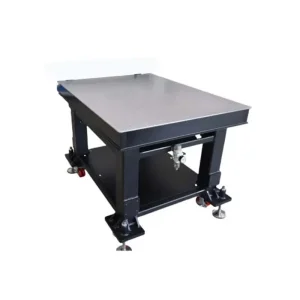
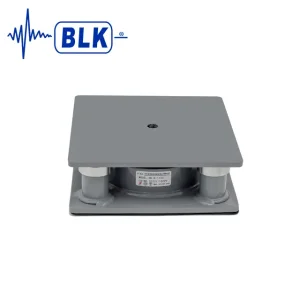
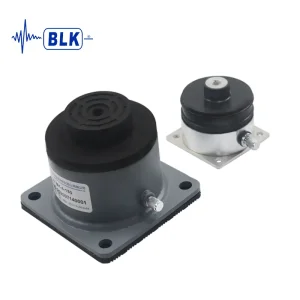
Precision Damped Platforms, Pneumatic Air Mounts & Industrial Isolators
Complementing our light-load rubber mounts with low-frequency air suspension, optical test benches, and modular damping pads.





Technical & Procurement FAQ for Engineers
In-depth responses to frequent technical queries on elastomer behavior, testing, and system sizing.
What defines a "light load" rubber damper compared to conventional vibration isolators?
Why is dynamic stiffness (Kd) often higher than static stiffness (Ks) in rubber mounts?
How does Bellking guarantee the bonding strength between metal inserts and rubber?
What parameters must I provide to obtain a custom damper sizing calculation?
- Total operating mass and center of gravity (CG) coordinates.
- Number and planned locations of mounting points.
- Excitation frequency spectrum (e.g., motor RPM, pump cycle rate, fan blade pass frequency).
- Target isolation efficiency or maximum permissible transmitted force/displacement.
- Environmental conditions: operating temperature range, oil/chemical contact, cleanroom or flame retardancy requirements (e.g., UL94 V-0).
What is the typical service life and creep rate of Bellking light load rubber dampers?
Can you support custom non-standard geometries and low minimum order quantities (MOQ)?
Consult with Bellking Dynamics Engineers
Submit your equipment mass, excitation frequencies, and spatial envelope. Our engineering department will simulate transmissibility curves and return a tailored vibration isolation plan within 24 hours.