
Featured Precision Shock Absorption Mounts & Systems
Engineered for high isolation efficiency (>95%), long structural fatigue life, and compliance with severe industrial vibration specifications.







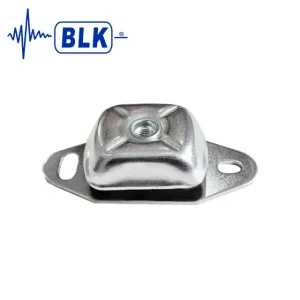
Executive Technical Whitepaper: Modern Industrial Shock Absorption
In high-precision manufacturing, energy generation, cleanroom operations, and heavy industrial plant environments, unmitigated kinetic shock and harmonic vibration represent major sources of structural fatigue, dimensional inaccuracy, and equipment downtime. Shock absorption technology has transitioned from simple elastomeric isolation pads to mathematically modeled, multi-degree-of-freedom (MDOF) vibration control platforms capable of damping dynamic forces up to 99% efficiency.
As equipment footprints become denser and operating speeds increase, custom shock absorption solutions are required to isolate ambient ground vibrations, absorb internal reciprocating forces, and prevent acoustic noise transmission across structural floor slabs. This technical document provides engineering procurement managers, structural designers, and plant operations leaders with an authoritative breakdown of mechanical damping physics, custom OEM manufacturing considerations, global price dynamics, and application frameworks.
The Mechanics of Vibration Control: Transmissibility & Natural Frequency
To properly specify a custom shock absorber or anti-vibration mount, engineers must evaluate the system's forcing frequency ($f_d$) generated by the operating machine (such as a pump at 1450 RPM or a compressor at 3000 RPM) against the isolator's natural frequency ($f_n$).
The Frequency Ratio Rule
Isolation occurs only when the ratio $f_d / f_n > \sqrt{2} \approx 1.414$. When $f_d / f_n = 1$, the system reaches resonance, amplifying force and causing severe mechanical damage. Optimal design dictates an $f_d / f_n$ ratio between 3.0 and 5.0 for maximum kinetic energy attenuation.
Damping Factor & Energy Dissipation
Damping ($\zeta$) controls the height of the resonance peak during start-up and transient shutdown conditions. Viscous fluid damping, high-durometer specialized synthetic rubbers, and mechanical friction elements convert kinetic shock energy into negligible thermal energy, suppressing secondary bounce.
Deflection Physics
Static deflection ($\delta$) directly determines natural frequency through the equation $f_n = 4.98 / \sqrt{\delta}$ (where $\delta$ is measured in cm). Achieving low natural frequencies (3–5 Hz for standard springs, 1.7 Hz for pneumatic air mounts) requires precise spring rate calculations based on accurate center-of-gravity loading.
Technical Comparison Matrix: Isolator Technology vs. Operational Parameters
| Technology Class | Natural Frequency Range | Isolation Efficiency | Primary Industrial Application | Corrosion Resistance |
|---|---|---|---|---|
| Spring Mounts (Open/Housed) | 3.0 Hz – 5.0 Hz | 90% – 98% | Chillers, Pumps, Generators, Heavy HVAC | Dacromet / Galvanized (900h Salt Spray) |
| Pneumatic Air Mounts | 1.7 Hz – 2.5 Hz | 95% – 99.5% | Semiconductor Probing, Optical Tables, CMMs | Anodized Aluminum / Stainless Steel |
| Neoprene / Elastomeric Mounts | 6.0 Hz – 12.0 Hz | 75% – 92% | High-speed Motors, Compressors, Cabinets | High Chemical & Oil Resistance Synthetic Rubber |
| Inertia Base Systems | Coupled with Springs (2.5 Hz) | 95% – 99% | High-eccentricity Pumps, Variable Load Systems | Heavy Steel Frame / Concrete Infill Ready |
Global Procurement Analysis: Pricing Drivers & Cost Engineering
When global B2B buyers evaluate Custom Shock Absorption Technology Manufacturers and Prices, unit price is only one component of the Total Cost of Ownership (TCO). Pricing models vary based on material science, custom engineering labor, load ratings, and certification requirements.
1. Metallurgy & Elastomer Grade
Low-cost commodity isolators use recycled rubber compounds and un-inspected spring wire prone to high stress-relaxation and early cracking. Enterprise-grade mounts utilize high-tensile spring steel (ASTM A229/A227) treated with Dacromet surface anti-corrosion processes (capable of passing 900-hour neutral salt spray tests) and high-density neoprene formulation.
2. Customization Engineering (1:1 Fit)
Standard catalog isolators cost significantly less up front but often fail when equipment exhibits uneven weight distribution or high center-of-gravity dynamic rocking. 1:1 tailored damping designs require Finite Element Analysis (FEA) and load testing to configure non-standard mounting plates and spring rates, adding engineering value.
3. Seismic Restraint & Wind Snubbing
For rooftop installations or earthquake-prone zones, shock absorbers require built-in multidirectional limit stops (seismic snubbers). Incorporating high-strength cast iron housings, internal limit pins, and certified shear forces increases manufacturing complexity and material mass, influencing total price per unit.
Macro Industry Solutions: Targeted Application Frameworks
Industrial shock absorption cannot be approached with a one-size-fits-all product strategy. Diverse engineering sectors present distinct harmonic profiles, environmental stresses, and isolation requirements:
Semiconductor & Precision Metrology
Sub-micron lithography tools, scanning electron microscopes (SEMs), and laser coordinate measuring machines require active-ready pneumatic isolation platforms reaching 1.7 Hz natural frequency to eliminate micro-seismic background floor vibrations.
Power Generation & Transformers
Electrical transformers emit persistent 100 Hz / 120 Hz core hum. Customized transformer anti-vibration spring mounts suppress structural hum transmission into civil building structures while accommodating extreme thermal expansion cycles.
Heavy MEP & HVAC Plant Rooms
High-tonnage centrifugal chillers, cooling towers, and end-suction water pumps create high dynamic start-up torque. Heavy-duty inertia bases coupled with caged spring mounts absorb rotational shock and prevent pipe flange fatigue.
Building Acoustics & Retrofit
Suspended piping networks and ceiling-mounted air handling units (AHUs) transmit low-frequency acoustic energy across structural beams. Custom spring and neoprene hangers effectively isolate ductwork and piping systems.
Global Compliance & Quality Assurance
To satisfy international project specifications, custom shock absorption technology manufacturers must operate strict factory QA procedures under ISO 9001 certification. All load-bearing springs and elastomer components undergo 100% tension-compression testing, fatigue verification, and dynamic spectrum testing prior to shipment.
Key international standards met include ASHRAE guidelines for HVAC vibration isolation, International Building Code (IBC) seismic restraint criteria, and environmental compliance standards (RoHS and REACH) ensuring non-hazardous raw materials during production.
Technology Roadmap & Smart Damping
The next evolution in industrial vibration isolation centers on real-time health monitoring and hybrid active-passive response systems. Future product roadmaps integrate IoT-enabled micro-electromechanical sensors (MEMS accelerometers) directly within spring mounts and pneumatic chambers.
These smart shock absorbers measure live vibration spectra, detecting bearing wear or unbalance in connected machinery before structural damage occurs, enabling predictive maintenance schedules in Industry 4.0 automated factories.
Complete Enterprise Anti-Vibration Product Line
Comprehensive factory-direct mounting solutions engineered for industrial machinery, transformers, air handling systems, and micro-vibration testing.







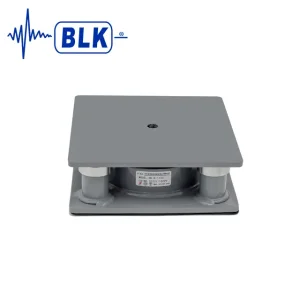
Frequently Asked Technical Questions (Engineering FAQ)
How do I choose between spring, rubber, and pneumatic vibration isolators?
What technical data is required to size a custom shock absorber?
- Total operating weight of the equipment (including fluid or workpieces).
- Center of Gravity (CG) location and exact support point geometry.
- Operating frequency (RPM or Hz) and dynamic forcing vector direction.
- Environmental factors (temperature, outdoor oil/corrosive chemical exposure).
- Seismic or wind-load restraint requirements (if mounted on roof or building perimeters).
What factors influence the manufacturer unit price for custom mounts?
What is the expected service life of industrial spring and rubber isolators?
How fast can custom shock absorption prototypes be designed and manufactured?
Request a Customized Shock Absorption Engineering Plan
Send our technical team your equipment weight, center of gravity, and operating speed. Receive a complete engineering calculation sheet and factory-direct quote within 24 hours.
Contact Application Engineers