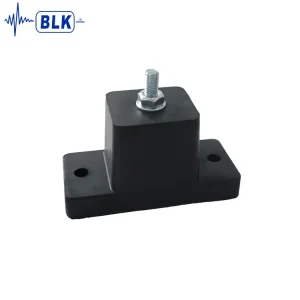
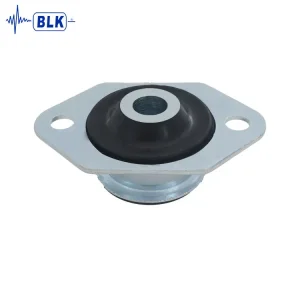
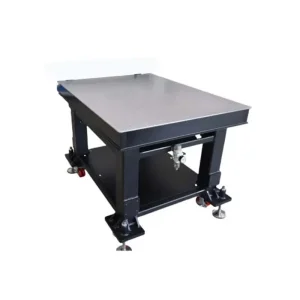
High-Efficiency Anti-Vibration Mounts & Systems
Explore specialized industrial isolation systems engineered for dynamic chillers, pumps, optical tables, and ceiling-hung mechanical systems.

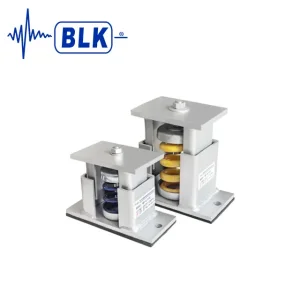
Executive Summary: The Role of Custom Spring Vibration Isolation Hangers in Structural Dynamics
In modern industrial, commercial, and micro-electronics facility construction, controlling structure-borne noise and mechanical vibration transmission is critical to structural safety, operational precision, and regulatory acoustic compliance. Mechanical systems—including high-pressure HVAC piping, inline centrifugal pumps, air-handling units (AHUs), exhaust ducts, and suspended chillers—generate significant dynamic forces during operation. When these dynamic forces couple directly with structural ceiling slabs via rigid threaded rods, they convert into low-frequency structure-borne noise that propagates through concrete slabs, radiating into adjacent occupied spaces.
A specialized Custom Spring Vibration Isolation Hangers Factory serves as an essential engineering partner to HVAC consulting engineers, acoustic consultants, EPC contractors, and OEM equipment manufacturers worldwide. Spring vibration isolation hangers decouple suspended dynamic equipment from building structures by introducing a compliant helical spring and elastomer interface. This interface drastically reduces the mechanical energy transmitted into structural elements by manipulating the natural frequency of the suspended isolation system relative to the disturbing frequency of the rotating machinery.
Key Engineering Principle: Natural Frequency vs. Disturbing Frequency Ratio
For effective vibration isolation, the ratio of disturbing frequency ($f_d$) to system natural frequency ($f_n$) must exceed $\sqrt{2} \approx 1.414$. To achieve an isolation efficiency above 90% to 98%, mechanical specifications typically mandate an $f_d / f_n$ ratio of 3.0 or higher. Custom spring isolation hangers allow precision tuning of static deflection ($\delta_s$) to target precise natural frequencies down to 3.0 Hz.
Physics of Spring Hanger Isolation Mechanics
The core mechanical behavior of a helical spring vibration isolator is dictated by classical single-degree-of-freedom (SDOF) dynamic isolation dynamics. The system's natural frequency ($f_n$, expressed in Hz) is directly proportional to the static deflection ($\delta_s$, in millimeters or inches) under actual operating gravity load:
Transmissibility ($T$), defined as the ratio of transmitted dynamic force to applied disturbing force, is governed by the relation:
When custom spring isolation hangers are manufactured with precise spring rates ($k$), engineers can ensure that the static deflection under actual pipe or duct load lands precisely in the optimal isolation zone, preventing dynamic resonance ($f_d \approx f_n$) where force transmission amplification occurs.
Manufacturing Excellence: Metallurgy, Spring Coiling & Corrosion Protection
Inside a leading China Custom Spring Vibration Isolation Hangers Factory: End-to-end processing from raw material alloy selection to surface conversion coatings.
Alloy Selection & Shot Peening
Spring elements are wound from high-tensile chrome-silicon steel (ASTM A401 / 60Si2Mn) or oil-tempered spring wire. Cold-coiled or CNC hot-coiled springs undergo stress-relieving tempering and precision shot peening to introduce compressive residual stress, extending high-cycle fatigue durability beyond 10,000,000 continuous displacement cycles.
High-Frequency Acoustic Decoupling
Steel springs are excellent at isolating low frequencies (3–10 Hz) but can exhibit internal acoustic surge, transmitting high-frequency structure-borne sound along the wire coil. Premium Chinese factories integrate high-density neoprene or EPDM elastomeric acoustic cups into the hanger frame to break high-frequency acoustic bridging.
Dacromet & 900-Hour Salt Spray Finishes
For corrosive coastal, industrial, or mechanical plant room environments, hanger housings and spring coils are treated with Dacromet (zinc-aluminum flake) or hot-dip galvanizing (HDG) coating systems capable of exceeding 900 to 1,200 hours of neutral salt spray testing under ASTM B117 protocols without red rust.
| Hanger Series / Parameter | Nominal Deflection | Load Range (kgf / lbs) | Natural Frequency ($f_n$) | Primary Target Applications |
|---|---|---|---|---|
| Light-Duty Spring Hanger (SH-25) | 25 mm (1.0 in) | 15 – 350 kgf (33 – 770 lbs) | 3.1 – 4.5 Hz | Inline exhaust fans, small HVAC ductwork, FCUs |
| Heavy-Duty Spring Hanger (SH-50) | 50 mm (2.0 in) | 100 – 1,800 kgf (220 – 3,960 lbs) | 2.2 – 3.2 Hz | Chilled water mains, heavy pumps, suspended AHUs |
| Combination Spring & Rubber Hanger (SRH-Dual) | 25 mm + 8 mm Rubber Pad | 30 – 1,200 kgf (66 – 2,640 lbs) | 3.0 – 5.0 Hz | Acoustically sensitive spaces, broadcast studios, auditoriums |
| Pre-Compressed / Pre-Loaded Hanger (PSH Series) | 25 mm to 75 mm | 200 – 3,500 kgf (440 – 7,700 lbs) | 1.8 – 3.5 Hz | Large steam piping, boilers, high-expansion hot water mains |
Why Global Enterprise Procurement Prefers Chinese Spring Hanger OEM Factories
Combining complete industrial supply chains, rapid prototyping, scale efficiency, and rigorous international quality assurance.
End-to-End Vertical Integration
China's advanced manufacturing clusters in Jiangsu, Zhejiang, and Guangdong house fully integrated supply ecosystems. Spring wire draw mills, laser-cutting stamping facilities, rubber vulcanization plants, and electro-plating facilities operate within close proximity, dramatically shortening production lead times.
Unmatched Cost-to-Performance Ratio
By leveraging automated robotic welding, CNC spring coiling, and high-volume batch processing, Chinese manufacturing factories deliver custom spring isolation hangers meeting ASHRAE standard specifications at a total cost of ownership 30% to 50% lower than Western regional suppliers.
Rapid 1:1 Engineering Customization
Global projects frequently encounter non-standard pipe loads, restricted ceiling plenum heights, or severe seismic code requirements. Leading OEM factories offer 3D BIM model generation (Revit / STEP files) and custom sample turnarounds within as few as 3 to 5 business days.
Navigating International Standards & Regional Compliance Protocols
A whitepaper breakdown on matching spring isolation hanger designs to global building codes and environmental specifications.
Deploying spring vibration hangers in international markets requires compliance with local structural codes, fire safety rules, environmental material bans, and acoustic design guidelines. Modern China spring hanger factories design products directly against these core global standards:
ASHRAE Guidelines & SMACNA
North American HVAC specifications typically mandate ASHRAE HVAC Applications Chapter 48 standards. Spring hangers must feature a minimum 50% over-travel reserve capacity beyond rated load and horizontal stiffness equal to at least 0.8 times the vertical spring rate ($k_h / k_v \ge 0.8$) to prevent lateral instability.
Seismic Restraint & IBC Standards
In earthquake-prone regions (such as California, Japan, or the Middle East), suspended pipes require seismic cable snubbers or pre-compressed seismic spring hangers designed in accordance with International Building Code (IBC) dynamic loading standards and ASCE 7 qualification parameters.
Material Traceability & RoHS/REACH
European projects mandate raw material traceability (EN 10204 3.1 inspection certificates) and strict prohibition of heavy metal toxins under EU RoHS and REACH legislation. Elastomeric components utilize non-gassing, fire-retardant EPDM or neoprene formulations certified under UL 94 V-0 flame spread ratings.
Future Innovations in Spring Vibration Isolation Technology
How IoT sensing, green building rating systems (LEED), and offsite prefabrication are reshaping hanger manufacturing.
IoT-Enabled Smart Load Hangers
The integration of strain-gauge micro-sensors and wireless BLE mesh telemetry into spring hanger top plates allows real-time dynamic load monitoring. Maintenance engineers can detect thermal growth binding, fluid overload, or spring fatigue remotely via facility management dashboards.
Prefabricated Modular Pipe Racks
Offsite construction and Modular MEP (Mechanical, Electrical, and Plumbing) distribution demand compact, multi-pipe trapeze spring hangers that arrive pre-calibrated to specific site weight matrices, accelerating installation speeds by over 60%.
Eco-Vibration & Sustainable Acoustics
With LEED v4.1 and WELL Building Standard emphasizing acoustic comfort, low-emission vibration dampening materials and 100% recyclable alloy steel springs enable building owners to earn valuable green building certification credits.
Localized Application Scenarios & Field Case Studies
Real-world execution examples of custom spring vibration hangers across demanding mechanical environments.
Scenario A: Hyperscale Data Center Chilled Water Header Mains
In modern hyperscale data center facilities, high-capacity chilled water distribution pipes (DN500 to DN900 steel headers) run along overhead ceiling spaces above sensitive server rack rows. Dynamic water pressure surges, transient water hammer, and pump vibration risk inducing micro-fractures or acoustic noise in data halls.
Solution: Custom pre-loaded heavy-duty spring hangers (SH-50 Series) engineered with 50 mm static deflection and integrated EPDM acoustic cups. Pre-load locking pins maintained spring height during dry installation and pressure testing, unlocking automatically once the pipe filled with operating water. Transmitted vibration was reduced by 96.4%, fully satisfying NC-30 ambient acoustic requirements.
Scenario B: Supertall Commercial Tower Mechanical Transfer Floors
Supertall towers feature central mechanical plant rooms located on mid-building refuge and transfer floors. Suspended high-pressure inline booster pumps and air compressors generate strong mechanical vibration that directly threatens luxury residential units located on lower floors.
Solution: Dual-combination spring and rubber hangers featuring 25 mm deflection springs resting in heavy neoprene cups. The hybrid configuration addressed low-frequency pump rotational speeds (1,450 RPM / 24.1 Hz) while stopping high-frequency structure-borne hydraulic whine from penetrating multi-story floor slabs.
Frequently Asked Questions by Technical Engineering Teams
Direct answers from application engineers regarding sizing, selection, spring compression, and factory customization.
What is the main difference between spring hangers and rubber hangers?
Spring hangers provide large static deflections (typically 25 mm to 75 mm or higher), resulting in low natural frequencies (2 Hz to 4.5 Hz). They are required for low-speed equipment (under 1,200 RPM) or critical acoustic applications. Rubber hangers offer smaller deflections (3 mm to 8 mm) and higher natural frequencies (8 Hz to 15 Hz), making them suitable for high-speed equipment (above 1,800 RPM) or light-duty ductwork without severe low-frequency disturbance.
How do I calculate the required static deflection for a custom spring isolation hanger?
First, determine the lowest operating speed ($RPM$) of the suspended equipment to find the disturbing frequency ($f_d = RPM / 60$). Next, establish the target isolation efficiency (e.g., 90% or 95%). Using transmissibility curves, calculate the maximum allowable natural frequency ($f_n$). Finally, use $f_n = 15.8 / \sqrt{\delta_s \text{ (mm)}}$ to derive the required static deflection ($\delta_s$). Our factory engineers can perform these calculations within 24 hours of receiving your equipment load layout.
Why is pre-compression or pre-loading recommended for large steam or water piping hangers?
During installation and dry alignment, empty pipes weigh significantly less than filled, operating pipes. Un-restrained springs would compress excessively as water fills the system, causing pipe movement, joint stress, and ceiling misalignment. Pre-compressed spring hangers feature internal locking screws that hold the spring at operating height until the full liquid load is applied, eliminating vertical pipe travel during commissioning.
Can custom spring hangers handle thermal expansion in hot water or steam lines?
Yes. Custom spring hangers can be equipped with angular rod swing travel capability (up to $\pm 15^\circ$ swing angle) or integrated slide plates to accommodate longitudinal pipe expansion without inducing bending moments into the hanger rod or upper attachment clevis.
What surface treatment is best for highly corrosive marine or outdoor cooling tower environments?
For outdoor, humid, or marine salt air installations, standard electro-galvanizing is insufficient. We recommend Dacromet coating or hot-dip galvanizing for hanger steel housings, paired with powder-coated or Dacromet-coated springs. These surface systems routinely pass 900 to 1,200 hours of ASTM B117 salt spray testing without red rust formation.
What lead times and OEM support does your China spring hanger factory provide?
Standard catalog hangers ship within 24 to 48 hours. Custom engineering solutions (modified load ratings, custom frame dimensions, or specialized corrosion coatings) require 3 to 5 business days for CAD drawing confirmation and sample fabrication. Mass production runs generally ship within 12 to 18 days depending on batch order size.
Comprehensive Vibration & Noise Decoupling Lineup
Explore additional precision mounts, specialized rubber dampers, cone mounts, matrix platforms, and hanger solutions.