
High-Efficiency HVAC & Industrial Spring Isolators
Direct factory engineered anti-vibration solutions designed to suppress high-amplitude structure-borne noise, harmonic resonance, and mechanical strain across commercial and industrial infrastructure.
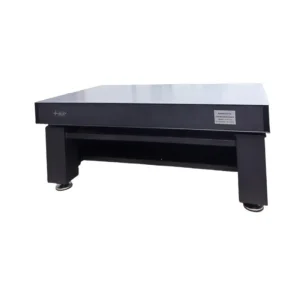
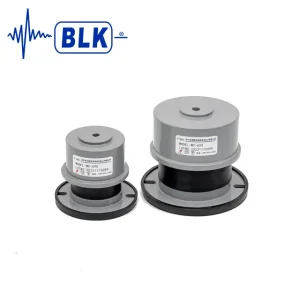
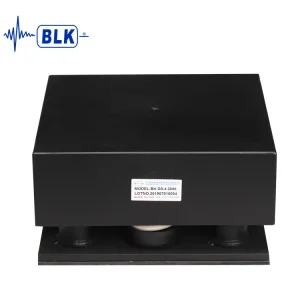
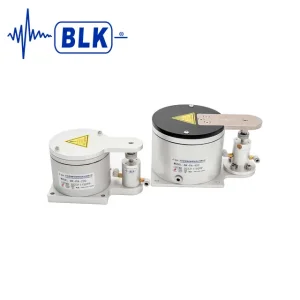

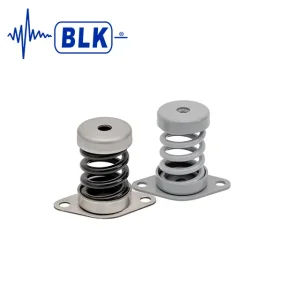
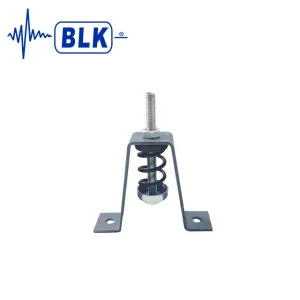
Global HVAC & Industrial Spring Vibration Isolator Market Dynamics
In modern building architecture and heavy industrial facilities, mechanical HVAC infrastructure—comprising heavy-duty centrifugal chillers, air handling units (AHUs), cooling towers, high-pressure booster pumps, and exhaust axial fans—serves as the primary operational backbone. However, these dynamic machines generate significant mechanical vibration forces during operation. Uncontrolled vibrational energy propagates through physical support structures, converting into audible structure-borne noise (low-frequency hums) and causing dangerous structural fatigue over time.
The global demand for high-performance custom spring vibration isolators for HVAC applications is experiencing unprecedented expansion. Driven by modern architectural trends such as lightweight steel-frame construction, ultra-high-rise vertical density, stringent urban noise ordinances, and rigorous environmental acoustic regulations (such as ASHRAE guidelines and ISO 3744 acoustic criteria), industrial acoustic control is no longer an afterthought—it is a mandatory engineering parameter.
Commercial HVAC Systems
Chillers, cooling towers, and rooftop AHUs operating in high-rise commercial centers demand low-frequency isolation (3–5 Hz natural frequency) to prevent vibration transmission into multi-story tenant spaces.
Industrial Plant Utilities
Heavy motor drives, industrial air compressors, and hydraulic power units require high-deflection spring mounts engineered to withstand thermal expansion and dynamic operational shocks.
Data Centers & Mission-Critical
Hyperscale data facilities utilize custom-damped spring isolators to protect delicate server racks and hard drive arrays from micro-vibrations induced by emergency diesel generators and chillers.
Engineering Principles: Deflection, Natural Frequency & Transmissibility
To achieve maximum vibration isolation efficiency, mechanical systems must be uncoupled from structural floors using spring mounts designed according to exact physical equations. The core physics of vibration isolation relies on the dynamic relationship between the equipment's disturbing excitation frequency ($f_d$) and the isolator's natural frequency ($f_n$).
Vibration Transmissibility ($T$): The efficiency of an isolator is governed by the formula:
$$T = \left| \frac{1}{(f_d / f_n)^2 - 1} \right|$$
To achieve positive vibration attenuation ($T < 1$), the frequency ratio $f_d / f_n$ must strictly exceed $\sqrt{2} \approx 1.414$. For high-efficiency commercial HVAC applications (>95% efficiency), engineers target a frequency ratio of $f_d / f_n \ge 3.0$ to $4.0$.
Because steel springs exhibit high linear elasticity across wide operational temperature ranges, they provide substantial static deflection ($\delta$) unattainable by elastomeric or rubber pads alone. Static deflection directly dictates the isolator's natural frequency:
| Static Deflection ($\delta$) | System Natural Frequency ($f_n$) | Isolation Efficiency at 1200 RPM (20 Hz) | Isolation Efficiency at 1800 RPM (30 Hz) | Primary HVAC Application |
|---|---|---|---|---|
| 6 mm (0.25 in) | ~6.4 Hz | 88.5% | 95.2% | High-speed small pumps, cabinet fans |
| 25 mm (1.0 in) | ~3.1 Hz | 97.4% | 98.9% | Standard chillers, AHUs, inline pumps |
| 50 mm (2.0 in) | ~2.2 Hz | 98.7% | 99.4% | Low-speed rooftop chillers, critical acoustic zones |
| 75 mm (3.0 in) | ~1.8 Hz | 99.1% | 99.6% | Vibration-sensitive cleanrooms, heavy inertia bases |
China Factory Manufacturing Advantages & Cost Optimization
Sourcing industrial-grade spring vibration isolators directly from specialized OEM factories in China—specifically within established advanced manufacturing hubs like Kunshan, Jiangsu—delivers monumental economic and engineering advantages to global engineering contractors, procurement managers, and MEP system integrators.
1. Vertical Manufacturing & Materials Precision
Bellking's Kunshan production base houses state-of-the-art automated CNC spring coiling machines, robotic MIG/TIG welding cells, and eco-compliant powder-coating lines. By utilizing high-fatigue 60Si2Mn alloy spring steel and precision-machined ductile iron housings, complete structural integrity is guaranteed under high dynamic loads.
Every spring coil undergoes shot-peening, stress-relieving heat treatment, and color-coded load grading to prevent spring sag or structural fatigue over 15+ year operational cycles.
2. Advanced Anti-Corrosion (Dacromet 900h)
Rooftop cooling towers and coastal plant equipment are subjected to harsh atmospheric exposure, salt spray, and chemical humidity. Bellking spring isolators incorporate heavy-duty hot-dip galvanizing and proprietary Dacromet coating surface treatments.
Validated through 900-hour neutral salt spray corrosion testing (ASTM B117 standards), these coatings completely outperform traditional oil-based painting, eliminating rust, seizing, or structural cracking.
Rapid Prototyping (3 Days)
Custom non-standard engineering designs, unusual mounting footprints, and custom spring stiffness ratios are designed, simulated via FEA, and prototyped in as fast as 3 working days.
ISO 9001 Quality Verification
Every batch undergoes strict tension-compression stiffness calibration, dynamic fatigue testing, and dynamic load cell testing, ensuring 100% compliance with client RFQ specifications.
Unrivaled Factory Pricing
By eliminating intermediary distribution markups and leveraging automated scale production (100,000+ units annual capacity), buyers achieve 30%–50% direct procurement savings.
Localized Applications: From Commercial HVAC to Precision Cleanrooms
Different mechanical environments present unique vibration spectra and structural conditions. Bellking provides purpose-built, highly customized vibration control hardware designed specifically for complex localized mounting scenarios:
Hospital & Healthcare HVAC Isolation
Strict Acoustic Standards (NC-25 to NC-30)
Medical operating theaters and intensive care units require absolute quietness. Heavy rooftop chillers and medical gas compressors are mounted on damped spring isolators with viscous fluid snubbers and high-deflection spring hangers, effectively arresting structural hums before they conduct into surgical suites.
Data Centers & Server Infrastructure
Continuous Vibration Mitigation
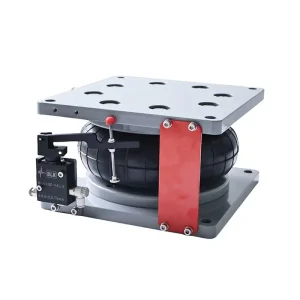
Constant vibration from Computer Room Air Conditioning (CRAC) units and cooling water pumps can cause read/write head instabilities in high-density magnetic storage arrays. Bellking matrix anti-vibration mounts and low-frequency pneumatic isolators decouple server room raised floors from mechanical room vibration.
Commercial Skyscrapers & High-Rises
Seismic & Wind Load Restraints
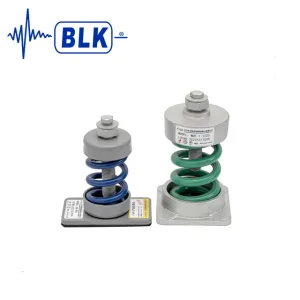
In high-rise structures, upper-floor mechanical rooms experience both equipment vibration and dynamic building sway. Bellking seismic-restrained spring isolators (MC & ME series) limit equipment movement during earthquake events or severe wind shear while delivering continuous 98% isolation during normal operation.
Power Substations & Transformers
Low-Frequency Magnetostrictive Hum
Electrical transformers generate intense low-frequency core hum at 100 Hz / 120 Hz due to magnetostriction. Bellking specialized transformer anti-vibration mounts withstand heavy static oil tank weights while isolating magnetic hum from concrete pad foundations and surrounding structures.
Global HVAC Industry Trends (2025–2030)
The mechanical acoustic and vibration isolation landscape is undergoing rapid technological transition driven by global net-zero initiatives, smart building automation, and advanced material sciences:
1. Integration of Smart IoT Vibration Sensors
Modern predictive maintenance strategies require real-time health monitoring. Next-generation spring mounts are increasingly retrofitted or manufactured with integrated wireless accelerometers that stream continuous FFT spectrum data to Cloud BMS platforms to predict bearing failure or spring collapse.
2. Green Building Certifications (LEED v4.1 & WELL)
Acoustic comfort is now explicitly evaluated in green building certification systems. Eliminating mechanical noise pollution improves occupant productivity and well-being, earning crucial acoustic performance credits in luxury residential and institutional projects.
3. Composite Damping & Hybrid Elastomers
Combining high-tensile steel coil springs with viscoelastic damping inserts allows isolators to suppress both high-amplitude low-frequency startup surges (0–10 Hz) and high-frequency acoustic harmonics (100–1000 Hz) simultaneously.
Global Enterprise Procurement, Customization & Pricing Factors
When evaluating supplier RFQs for large-scale infrastructure projects, procurement managers must analyze more than just the baseline unit price. Total Cost of Ownership (TCO), engineering compliance, dynamic load ratings, and anti-corrosion life expectancies are pivotal parameters.
Key Price Determinants for Custom Spring Isolators:
- Rated Load Capacity & Deflection Rating: Standard 25mm deflection open spring mounts cost significantly less than heavy-duty 50mm deflection seismic-restrained mounts supporting 5,000+ kg static loads.
- Surface Finish & Environmental Grade: Standard spray enamel painting suits indoor air-conditioned mechanical rooms. Outdoor, coastal, or chemical cleanroom installations requiring Dacromet 900-hour salt spray coating or 316 stainless steel housings carry a slight material premium offset by long operational lifespan.
- Integrated Viscous Damping & Seismic Snubbing: Equipment subject to severe transient dynamic thrust or wind uplift (e.g., rooftop cooling towers) requires internal neoprene snubbers or viscous fluid dampers to control motion during startup/shutdown cycles.
- Order Volume & OEM Batching: Direct factory orders scaling above 500 units unlock automated production cost-efficiencies, reducing unit costs by up to 35% compared to small batch orders.
Procurement Quality Verification Checklist: Always request ISO 9001 quality certificates, spring rate deflection curves, static/dynamic load test reports, salt spray test validation, and FEA stress analysis models when submitting RFQs for mission-critical infrastructure projects.
Frequently Asked Questions: Technical & Procurement Clarifications
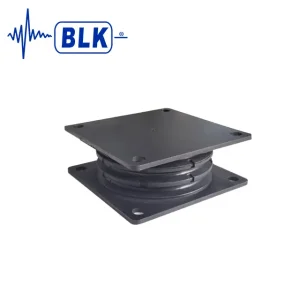
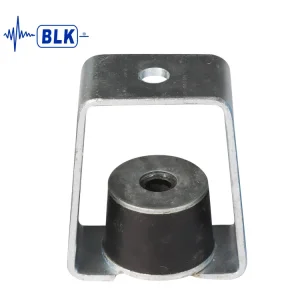
Precision Dampers, Rubber Buffers & Suspension Hangers
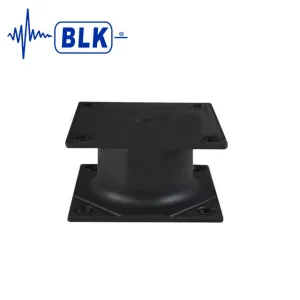
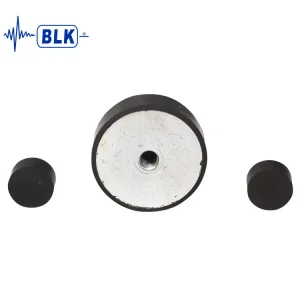
Complete the acoustic isolation system with suspended duct/pipe hangers, multi-layer polymer damping pads, and specialized rubber buffer isolators.


Request Your Engineering Sizing & Price Quote Today
Submit your equipment operating parameters (weight, CG, RPM, support points) to receive a customized vibration isolation engineering plan and direct factory pricing within 24 hours.