
High-Efficiency Anti-Vibration Mounts & Dampers
Explore our core ISO 9001 certified vibration isolators engineered for suspended load protection, HVAC attenuation, and structural acoustic control.

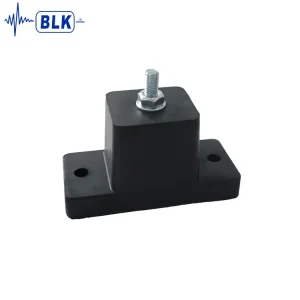
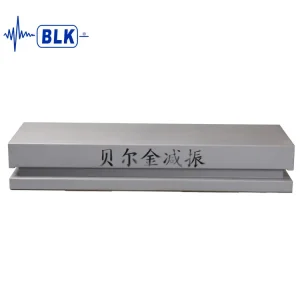
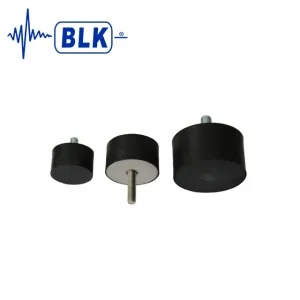
Engineering Fundamentals of Threaded Rod Vibration Dampers
A rigorous review of dynamic mechanical behavior, harmonic structure-borne energy dissipation, and threaded rod failure prevention in suspended installations.
1. Dynamic Resonance & Transmissibility Mechanics in Suspended Systems
In modern industrial facilities, HVAC mechanical rooms, semiconductor cleanrooms, and high-rise commercial structures, suspended piping, ductwork, and suspended equipment rely heavily on threaded rod hanging assemblies. However, unisolated threaded rods act as direct acoustic and mechanical conduits. Operating equipment—such as centrifugal pumps, air handling units (AHUs), chillers, and inline fans—generates mechanical excitation frequencies ($f_e$). Without dedicated threaded rod vibration dampers, these dynamic forces transfer directly into the building substrate, causing structural resonance, airborne acoustic noise, and premature metal fatigue in the supporting rods.
The core physics governing vibration isolation relies on maintaining a favorable ratio between the disturbing frequency ($f_e$) and the natural frequency ($f_n$) of the isolator system. The theoretical isolation efficiency ($I$) and transmissibility ($T$) are represented mathematically by:
Vibration Transmissibility Equation ($T$)
$$T = \left| \frac{1}{1 - (f_e / f_n)^2} \right|$$
To achieve meaningful isolation, the system frequency ratio ($f_e / f_n$) must exceed $\sqrt{2} \approx 1.414$. At ratios below 1.414, the system enters a amplification zone where structural vibrations increase. Premium engineered threaded rod dampers manufactured by Bellking Vibration Reduction Equipment Manufacturing (Kunshan) Co., Ltd. target natural frequencies ($f_n$) between 3.0 Hz and 8.0 Hz, yielding vibration isolation efficiencies of 95% to 99% at standard industrial motor operating speeds (1200 RPM – 3600 RPM).
Furthermore, elastomeric and spring elements integrated into custom threaded rod vibration dampers introduce a key mechanical damping loss factor ($\eta$). This internal damping absorbs dynamic kinetic energy, converting it to harmless thermal energy and suppressing catastrophic transient resonant spikes during equipment start-up and coast-down cycles.
2. The Risk of Fatigue Shear Failure in Overhead Threaded Rods
Overhead threaded rods are designed primarily to withstand static tensile loads. When subject to high-frequency continuous cyclic bending stresses and micro-vibrations, threaded rods undergo mechanical work hardening. Thread roots—acting as severe stress concentration points—develop micro-cracks that propagate rapidly under unmitigated dynamic loads. This phenomenon leads to sudden structural fatigue failure, jeopardizing building safety and operational continuity. Custom threaded rod vibration dampers act as mechanical low-pass filters, isolating the rigid rod assembly from lateral, torsional, and axial shear stresses.
Global Industrial Demand & Regional Sourcing Drivers
Analyzing procurement mandates, acoustic standards, and global infrastructure growth across key international sectors.
Semiconductor FABs & Cleanrooms
Micro-vibration control is mandatory in advanced wafer fabrication plants. Suspended process piping (ultrapure water, gas, exhaust) must meet stringent Vibration Criterion (VC-C to VC-E) curves. Custom threaded rod dampers prevent ambient machinery vibrations from degrading sub-micron photolithography precision.
Hyperscale Data Centers
Data center cooling infrastructures utilize extensive suspended chilled water loops overhead server racks. Unmitigated vibration can cause pipe joint weeping, structural harmonic noise, and hard drive acoustic degradation. Specialized threaded rod dampers eliminate high-frequency acoustic feedback into server halls.
Commercial High-Rise HVAC & Building Services
Strict local noise pollution codes (e.g., ASHRAE Chapter 48, European EN 12236) require ceiling-suspended equipment—such as variable air volume (VAV) boxes, fans, and hydronic lines—to maintain noise criteria levels below NC-30 in luxury residential and office towers.
Why Sourcing Custom Dampers from Kunshan, China Offers Unmatched Edge
Combining end-to-end industrial supply chain velocity, rigorous ISO quality control, and advanced material science.
1. Vertical Supply Chain Integration & Automated Scale
Situated in Kunshan, Jiangsu Province—China’s premier high-tech manufacturing hub—Bellking Vibration Reduction Equipment Manufacturing Co., Ltd. operates a state-of-the-art 2,000 m² facility. Our vertically integrated production spans automated CNC machining, robotic welding, precision elastomeric vulcanization, and specialized spring coiling. This proximity to raw material producers allows us to achieve superior cost efficiency without compromising material purity or structural tolerances.
2. Rapid Custom Prototyping & Technical Verification
Unlike traditional overseas distributors that suffer from lengthy custom lead times, Bellking’s engineering team offers bespoke OEM/ODM design response within 24 hours and delivers physical custom prototypes in as little as 3 working days. Utilizing advanced Finite Element Analysis (FEA) and dynamic simulation software, we validate load capacity, dynamic spring rates, and stress concentrations prior to tool production.
Emerging Trends in Threaded Rod Vibration Isolation
Key technological shifts reshaping overhead support infrastructure across next-generation industrial facilities.
1. Hybrid Compound Elastomers
Transitioning from pure natural rubber to proprietary polymer compounds (EPDM, Fluoroelastomer, Silicone-damped matrices) designed to resist atmospheric ozone, high ambient duct temperatures (up to 150°C), oil misting, and chemical corrosion in heavy industrial plants.
2. Integrated Seismic Restraint Engineering
Modern building codes increasingly mandate that threaded rod dampers incorporate all-directional seismic restraints (compliance with IBC / ASCE 7). Dual-acting dampers feature internal limit stops to absorb lateral earthquake shear loads while providing continuous vertical anti-vibration damping.
3. Dacromet & Eco-Coat Anti-Corrosion
Demands for extended outdoor and humid facility service life (15+ years) have made traditional electro-galvanizing obsolete. Bellking’s implementation of Dacromet coating technology withstands 900+ hours of continuous salt spray testing per ASTM B117 standards without red rust.
Technical Specification Criteria for Procurement Directors
A reference matrix for engineering specification, quality audits, and custom model selection.
| Performance Parameter | Standard Commercial Grade | Bellking Industrial Custom Grade | Engineering Benefit |
|---|---|---|---|
| Natural Frequency ($f_n$) | 12.0 Hz – 18.0 Hz | 3.0 Hz – 6.0 Hz | Deeper low-frequency noise & vibration attenuation. |
| Static Deflection Range | 2 mm – 5 mm | 15 mm – 50 mm | Greater dynamic displacement absorption under load shifts. |
| Corrosion Resistance | 96 Hours (Electro-zinc) | 900+ Hours (Dacromet) | Long-term durability in outdoor, coastal & chemical settings. |
| Overload Safety Factor | 150% Static Load | 300% to 500% Static Load | Prevents catastrophic drop failure during dynamic shock. |
| Operating Temperature | -10°C to +60°C | -40°C to +120°C (Custom Silicone) | Suitable for cryogenic lines, steam pipes, or desert ambient. |
Advanced Isolation & Damping Systems
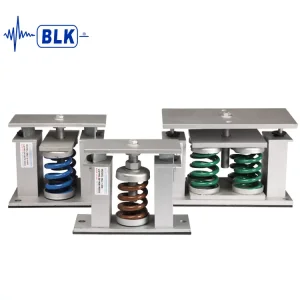
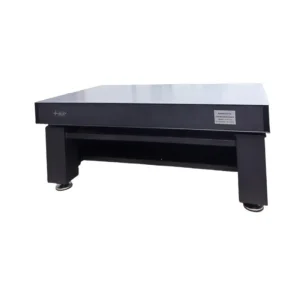
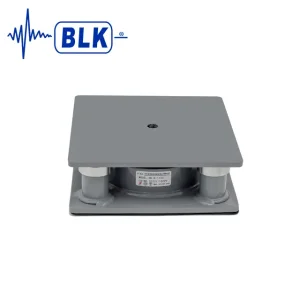
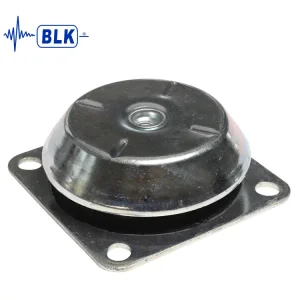
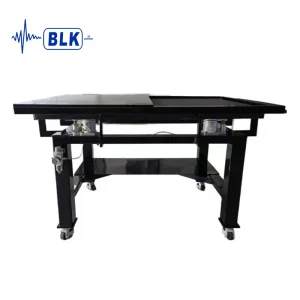
Additional custom-engineered solutions including spring hangers, pneumatic platforms, air mounts, and specialized transformer mounts.

Frequently Asked Questions (FAQ)
In-depth technical answers from Bellking application engineers regarding threaded rod dampers and overhead isolation design.
How do I correctly calculate load rating requirements for custom threaded rod dampers?
To accurately size a threaded rod damper, calculate the total operating weight of the suspended system—including pipe dry weight, fluid content weight, insulation, and attached fittings. Divide the total weight by the total number of rod hanging points to establish the point load ($P$). Always apply a minimum safety margin of 1.25x to 1.50x to account for fluid dynamic transients, water hammer, thermal expansion load shifts, and installation misalignments. Bellking engineers provide complete structural loading schedule calculations upon receiving site layout drawings.
What is the difference between rubber-in-shear and steel spring threaded rod isolators?
Rubber-in-shear dampers are compact, highly durable, and excel at absorbing high-frequency structure-borne acoustic noise and motor hum (above 18 Hz / 1080 RPM). However, their static deflection is limited (typically 3mm to 8mm). Steel spring dampers provide significantly higher static deflections (25mm to 50mm) and deliver low natural frequencies (3.0 Hz to 5.0 Hz), making them essential for low-speed equipment (such as slow fans or heavy chillers below 1200 RPM) where deep vibration attenuation is required.
How does preloading affect the damping effectiveness of a threaded rod damper?
Preloading compresses the internal elastomeric or spring element prior to equipment startup. Proper preloading ensures that the damper operates within its linear dynamic stiffness curve. Over-tightening or excessive preloading can cause the elastomer to bottom out, dramatically increasing dynamic stiffness and creating a rigid bridge that transfers vibration directly into the threaded rod. Bellking threaded rod dampers feature built-in height adjustment mechanisms and visual deflection indicators to ensure optimum installed preloading.
Can Bellking manufacture custom non-standard threaded rod dampers for extreme environments?
Yes. Bellking specializes in 1:1 OEM/ODM customization. For outdoor, corrosive chemical, or marine applications, we utilize 316 stainless steel housings, high-grade Dacromet coatings (900+ hour salt spray testing), and custom fluoroelastomer or silicone damping inserts rated for temperature extremes from -40°C up to +150°C. Custom dimensions, thread sizes (M6 to M36, UNF/UNC imperial threads), and custom spring rates can be developed in as fast as 3 working days.
What quality assurance certifications and test reports accompany Bellking shipments?
Bellking operates under an ISO 9001 quality management framework. Every custom production batch undergoes 100% factory inspection, including dynamic stiffness verification, static load-deflection testing, and salt spray testing. Shipments can be provided with material test certificates (MTC), third-party laboratory test reports, and compliance certificates for global project audits.