Precision Anti-Vibration Mountings & Platforms
Explore standard and 1:1 engineered custom isolators designed for high-load industrial, HVAC, and micro-vibration applications.


Executive Summary: The Mechanics of Modern Industrial Vibration Control
Understanding mechanical dynamics, energy dissipation, dynamic stiffness, and high-performance isolation media.
In modern industrial manufacturing, civil building acoustics, and micro-precision metrology, dynamic structural disturbance represents one of the most critical threats to equipment longevity, process repeatability, and occupational safety. Unchecked structural resonance and mechanical vibration accelerate mechanical wear, induce fatigue failure in rigid piping, compromise structural integrity, and introduce disruptive low-frequency acoustic noise into high-value cleanroom or commercial environments.
Custom Vibration Mountings And Controls Inc solutions—manufactured at state-of-the-art facilities like Bellking Vibration Reduction Equipment Manufacturing (Kunshan) Co., Ltd.—provide advanced passive and pneumatic isolation systems capable of attenuating kinetic energy vectors by up to 99%. Attaining this degree of mechanical decoupling demands a multi-disciplinary approach blending physical elastomeric polymer engineering, helical spring fatigue analysis, viscous fluid damping dynamics, and pneumatic auto-leveling algorithms.
Where: r = Frequency Ratio (f_d / f_n), f_d = Disturbing Frequency, f_n = Natural Frequency of Mount, ζ = Damping Ratio (c / c_c).
To achieve meaningful isolation efficiency (T < 1, corresponding to >85% energy attenuation), the ratio of the disturbing frequency ($f_d$) generated by equipment (such as rotary compressors, centrifugal chillers, or stamping presses) to the natural frequency ($f_n$) of the vibration mount must strictly exceed $\sqrt{2} \approx 1.414$. In optimal engineering practice, dynamic designers target a ratio of $r \ge 3.0$, yielding high-efficiency isolation zones where transmissibility drops to minimal fractions.
Global Procurement Demand & Enterprise Pricing Architecture
Analyzing the cost metrics, material grade selections, and factory tooling overheads that govern custom vibration mounting pricing worldwide.
Enterprise procurement teams overseeing multi-facility global installations frequently encounter massive price variances across anti-vibration mount suppliers. Understanding the underlying pricing drivers requires evaluating raw material formulations, precise manufacturing tolerances, dynamic validation testing, and structural safety margins.
Key Factors Influencing Factory Pricing
Elastomer & Alloy Grade
Raw natural rubber (NR), Neoprene (CR), EPDM, and fluorocarbon elastomers vary significantly in shore hardness stability, compression set, and ozone resistance. High-stress springs require premium 60Si2Mn or 50CrVa chromium-vanadium steel alloys to prevent stress relaxation and spring sag under prolonged compression.
Surface Finish & Anti-Corrosion
Standard zinc electroplating fails under harsh industrial marine or outdoor rooftop environments. Factory application of Dacromet hot-dip zinc/aluminum coating or specialized powder coatings provides up to 900 hours of salt-spray resistance, increasing initial unit costs while drastically reducing lifetime replacement overheads.
Custom Tooling & Testing Certification
Custom 1:1 OEM engineering requires non-standard mold fabrication, finite element analysis (FEA) dynamic stress modeling, dynamic dynamic stiffness testing ($K_d$), and third-party ISO 2017 / ASHRAE certification, affecting small-batch vs. mass-production pricing structure.
| Mount Category | Primary Material Formulation | Natural Freq (f_n) | Dynamic Load Range | Relative Unit Cost Tier | Best Cost-Efficiency Use Case |
|---|---|---|---|---|---|
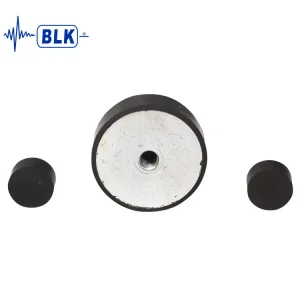
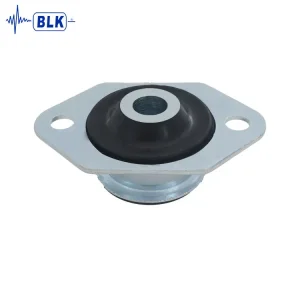
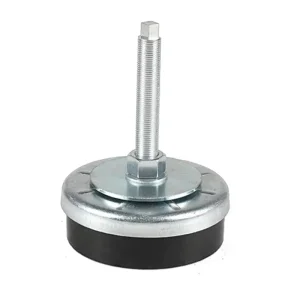
| Rubber Pad / Feet (BKAL, BKDJ) | Vulcanized NR / NBR Compound | 10 - 20 Hz | 50 kg - 5,000 kg | Economic ($) | High-speed rotary motors, benchtop tools, HVAC ducting |
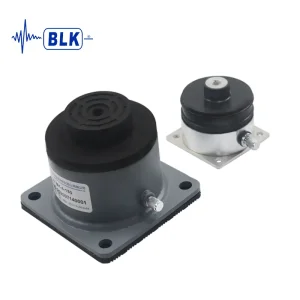
| Rubber Mounts (BKDD, BKDR, BKVV) | High-Damping Elastomer + Steel Plate | 7 - 12 Hz | 200 kg - 12,000 kg | Moderate ($$) | Compressors, internal combustion engines, marine gensets |
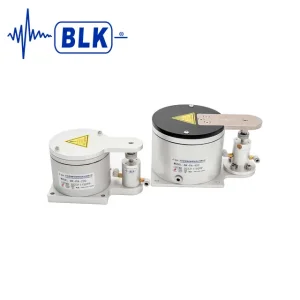
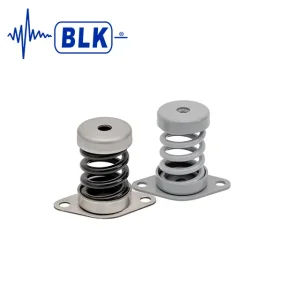
| Open/Housed Spring Mounts (ME, MB) | 60Si2Mn Spring Steel + Dacromet | 3 - 5 Hz | 100 kg - 50,000 kg | Mid to High ($$$) | Chillers, cooling towers, heavy transformers, power plants |
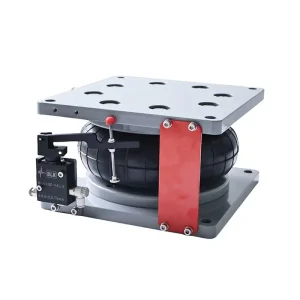
| Pneumatic Air Mounts (BK-A, BK-PF) | Reinforced Elastomeric Bladder + Auto Valve | 1.7 - 3 Hz | 100 kg - 20,000 kg | Premium ($$$$) | Semiconductor lithography, CMMs, optical laser benches |
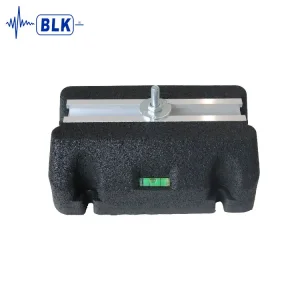
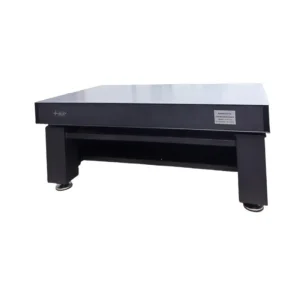
| Precision Platforms (BK-RT) | Granite/Steel Composite + Damped Mounts | 1.5 - 2.5 Hz | Custom Platform | High Tier Enterprise ($$$$$) | Cleanroom metrology, nano-scale inspection laboratories |
Macro Industry Solutions & Application Engineering
Deploying targeted anti-vibration technologies across critical global infrastructure and precision high-tech sectors.
1. HVAC, MEP Infrastructure & Commercial Buildings
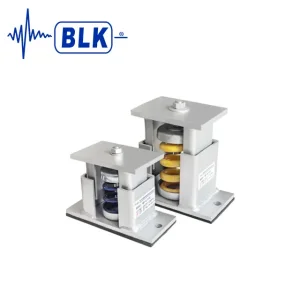
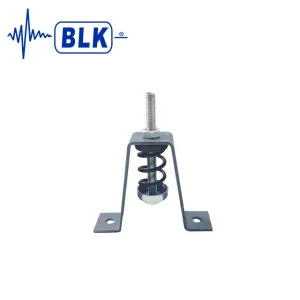
Large-scale building cooling towers, centrifugal water chillers, air handling units (AHUs), and booster pumps transmit structure-borne noise throughout concrete slabs. By combining ME Type open spring mounts or HV Type spring hangers with concrete-filled inertia bases, low-frequency motor hum and structural resonance are attenuated before entering structural steel frames.
- Spring deflections matched from 25mm to 75mm static travel.
- Viscous damping elements integrated to eliminate start-up transient rocking.
- Fully seismic-restrained housing designs available for earthquake zones.
2. Power Generation & High-Voltage Transformers
Electrical power transformers generate relentless 100Hz / 120Hz magnetostrictive hum. Mounting heavy oil-immersed or dry-type transformers on specialized anti-vibration mounts dampens core vibration, prevents acoustic radiation into surrounding substations, and protects delicate cooling fins from stress cracking.
- High static load ratings capable of bearing upwards of 50 metric tons per corner.
- Oil-resistant, fire-retardant synthetic elastomeric seals.
- 15+ year maintenance-free lifecycle engineered for utility substations.
3. Semiconductor Probing & Precision Optical Metrology
Sub-micron lithography platforms, atomic force microscopes (AFMs), and coordinate measuring machines (CMMs) fail if subjected to floor vibrations as minor as micro-g levels. BK-PF Type Precision Pneumatic Air Mounts dynamically adjust internal air pressure via level-sensing valves, creating a frictionless air cushion with natural frequencies as low as 1.7 Hz.
- Automatic height leveling accuracy within ±0.05 mm.
- Fast settling response time following motion-stage acceleration.
- Cleanroom Class 10 / ISO Class 4 compliant materials.
4. Heavy Stamping Presses & Industrial Automation
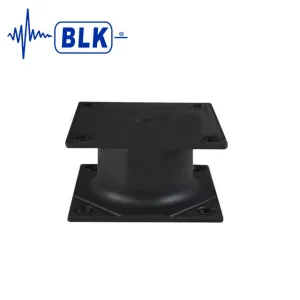
Reciprocating metal stamping, forging hammers, and large industrial punch presses produce extreme impact shock forces (3 to 5 Gs). Heavy-duty rubber-metal buffers like the BKSW Rubber Buffer absorb transient impact spikes, preventing structural damage to factory foundations and isolating neighboring equipment.
- High kinetic energy absorption capacity with controlled rebound.
- Shear-and-compression combined load capability.
- Custom mounting bolt configurations and structural steel reinforcing plates.
Technical Roadmap & Future Outlook (2025–2035)
Navigating the evolution toward smart, adaptive, active vibration control and sustainable green materials.
The global vibration control industry is undergoing a technological transition driven by Smart Industry 4.0 automation, extreme precision manufacturing requirements, and strict environmental ESG mandates. The engineering development roadmap over the next decade focuses on three key innovations:
1. IoT-Integrated Smart Mounts
Next-generation spring and air mounts feature embedded MEMS tri-axial accelerometers, load cells, and temperature sensors. By streaming real-time operational vibration spectrums to AI diagnostic platforms, system operators can detect bearing wear, shaft misalignment, or spring fatigue weeks before catastrophic equipment failure.
2. Active Magnetorheological Damping
Where passive mounts face trade-offs between low-frequency isolation and resonance amplification during startup, hybrid active systems utilizing Magnetorheological (MR) fluid adjust dynamic damping coefficients in milliseconds via electromagnetic field variations, completely suppressing startup resonance spikes.
3. Sustainable Elastomers & Eco-Coating
Future manufacturing shifts away from petroleum-derived polymers to bio-based elastomers and fully recyclable bio-rubbers with zero volatile organic compound (VOC) off-gassing. Non-hexavalent chromium protective finishes like advanced Dacromet ensure compliance with global REACH and RoHS directives.
Factory Direct Manufacturing, ISO Quality & Global Compliance
Inside the Bellking Kunshan manufacturing base: automated robotic fabrication, dynamic validation, and complete technical support.
Located in Kunshan, Jiangsu Province, Bellking Vibration Reduction Equipment Manufacturing Co., Ltd. spans over 2,000 square meters of high-precision manufacturing space. As a designated National High-Tech Enterprise holding 37 patents (including 16 national invention patents), Bellking bridges theoretical structural dynamics and reliable volume production.
Precision Production Infrastructure
- Robotic Plasma & Welding: CNC laser cutters and robotic arc welders maintain zero-defect structural welds on heavy-duty housing steel frames.
- In-House Rubber Vulcanization: Fully automated injection molding presses yield consistent elastomer density and optimal cross-linking density.
- Automated Surface Treatment: Multi-stage Dacromet coating line provides uniform 900-hour salt spray corrosion resistance.
- Annual Production Output: Over 100,000 precision vibration isolation assemblies manufactured annually.
Verification & Quality Control
- Tension & Compression Testing: Every spring lot undergoes computerized static load-deflection verification to validate spring rate ($K$).
- Dynamic Spectrum Analyzers: Dynamic frequency sweep testing verifies natural frequencies ($f_n$) and loss factors ($\eta$).
- Salt Spray & Environmental Chambers: Accelerated corrosion testing ensures survivability in aggressive chemical/coastal air.
- Traceability & Certification: ISO 9001 quality management with mill test reports and factory inspection certificates for every shipment.
Frequently Asked Questions (FAQ) & Buyer Guidance
Technical and procurement advice from senior application engineers for optimal vibration mount selection.
Specialized Buffers, Pads & High-Frequency Isolators
Explore specialized polymer pads, rubber buffers, cone mounts, and precision spring hangers for comprehensive facility coverage.