
Factory-Direct Anti Vibration Components: Series I
Explore high-performance passive and pneumatic vibration mitigation components engineered for ultra-sensitive semiconductor tools, rotating machinery, and building mechanical systems.


Global Procurement Architecture for Industrial Anti-Vibration Components
Strategic engineering guidelines for plant operators, EPC contractors, and OEM equipment specifiers navigating complex dynamic resonance, vibration transmissibility, and asset longevity.
Dynamic Resonance & Transmissibility ($f_d / f_n$)
Vibration mitigation operates strictly within classical elastodynamic boundaries. Isolation begins only when the system disturbing frequency exceeds √2 times the isolator's natural frequency ($f_d / f_n > 1.41$). Tier-1 global industrial specifications mandate an optimal ratio of ≥ 3.0 to guarantee at least 90% to 99% transmissibility reduction, preventing catastrophic acoustic resonance in building substructures and machinery housings.
Total Cost of Ownership (TCO) Economics
Procuring anti-vibration components on initial purchase price rather than lifecycle dynamic stiffness leads to premature mechanical seal breakdown, bearing spalling, and unbudgeted plant downtime. High-durability helical springs coated in Dacromet (900-hour salt spray tested) maintain elastic moduli for over 15 years, mitigating secondary equipment overhaul expenses that frequently exceed initial component capital costs by 400%.
Seismic Qualification & Safety Redundancy
Modern engineering frameworks (such as IBC Chapter 13 and Eurocode 8) mandate dual-action isolation units equipped with integrated ductile iron housings and elastomeric snubbers. Systems must withstand multi-directional seismic forces and mechanical impact up to 3–5 G acceleration without yielding, protecting human life and municipal utility operations during severe transient loading events.
Engineering Solutions Across Mission-Critical Applications
Tailored isolation architectures addressing structural dynamics, micro-vibrations, and extreme cyclic fatigue in global industrial processes.
Semiconductor & Cleanrooms
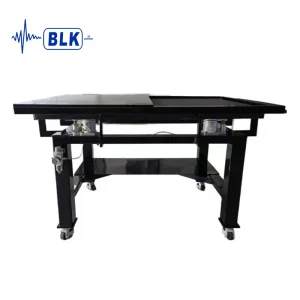
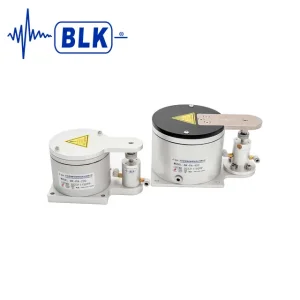
Sub-micron lithography and automated metrology require compliance with rigorous Vibration Criterion (VC-D through VC-G) curves. Bellking precision pneumatic air mounts provide ultra-low natural frequencies down to 1.7 Hz, decoupling coordinate measuring machines (CMMs) and optical benches from plant footfall and structural micro-tremors.
HVAC & MEP Decoupling
Roof-mounted chillers, large-capacity cooling towers, and centrifugal water pumps transmit structure-borne sound into occupied building volumes. Engineered MA-type helical spring isolators and CPB-type concrete inertia bases eliminate low-frequency tonal drone, lowering structure-borne noise well within standard ASHRAE NC-30 limits.
Power Transformers & Substations
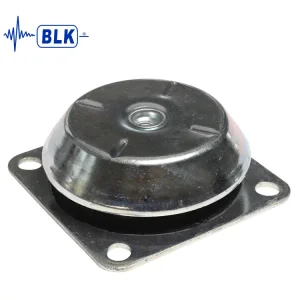
Magnetostrictive core hum in dry-type and oil-immersed transformers induces structural excitation at harmonics of 100 Hz and 120 Hz. Dedicated Bellking transformer anti-vibration mountings utilize vulcanized elastomer-metal composites engineered specifically to block continuous structural hum transmission into underlying slab networks.
Heavy Stamping & Dynamic Presses
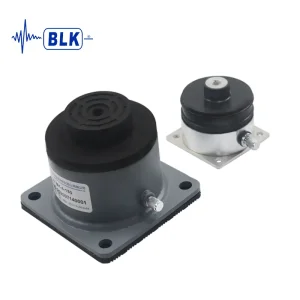
Forging hammers and stamping presses exert violent impact shocks that degrade building foundations and disrupt adjacent automated machinery. Heavy-duty damped spring mounts (BK-DS Series) combine viscous fluid damping mechanisms with high-capacity steel springs to safely absorb kinetic shocks up to 5 G acceleration.
Precision Production Facility & Metallurgical Integrity
Headquartered in Kunshan, China, Bellking operates advanced manufacturing infrastructure governed by rigorous ISO 9001 quality assurance frameworks.
37 Proprietary Patents & R&D
Officially recognized as a National High-Tech Enterprise and Jiangsu Private Technology Enterprise. Our technical assets encompass 16 national invention patents developed in joint collaboration with Chinese national university material research laboratories.
900-Hour Dacromet Protection
Industrial coastal and humid cooling tower conditions rapidly corrode conventional zinc-plated fasteners. Bellking spring isolators undergo an inorganic zinc-aluminum flaked Dacromet treatment surpassing 900 hours in continuous salt spray testing without red rust formation.
Robotic Precision Manufacturing
Operating across a dedicated 2,000 m² manufacturing floor equipped with robotic seam welding, automated CNC machining centers, electronic tension-compression test beds, and FFT spectral vibration analyzers ensuring consistent spring constants.
Engineering Sizing Matrix & Mechanical Selection Criteria
Compare mechanical characteristics, working frequency spectrums, and expected operational life across core isolator categories to select the correct component.
| Isolator Architecture | Natural Frequency ($f_n$) | Typical Static Deflection | Damping Ratio ($\zeta$) | Optimal Excitation Range | Service Life Expectancy |
|---|---|---|---|---|---|
| Pneumatic Air Mounts (BK-PA / BK-A) | 1.7 Hz – 3.0 Hz | Air column leveling | 0.04 – 0.08 | > 5 Hz (CMM, Metrology, Litho) | 6+ Years (Bellows replacement) |
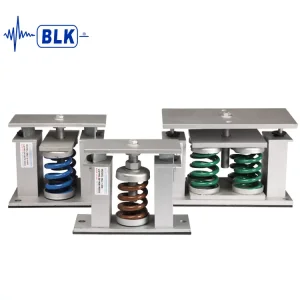
| Restrained Spring Isolators (MA Type) | 3.0 Hz – 5.0 Hz | 25 mm – 50 mm | 0.01 – 0.03 | > 10 Hz (Chillers, Cooling Towers) | 15+ Years (Dacromet coated) |
| Damped Spring Mounts (BK-DS Type) | 3.0 Hz – 4.5 Hz | 25 mm – 45 mm | 0.15 – 0.25 (Viscous) | Impact / Shock (Presses, Pumps) | 15+ Years |
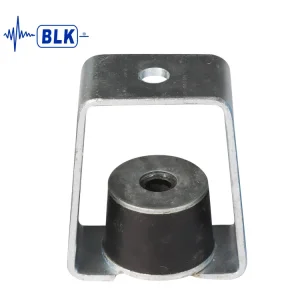
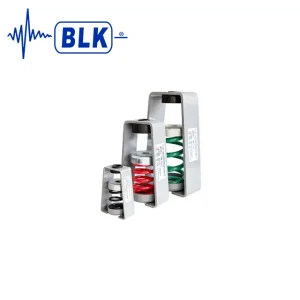
| Vibration Hangers (HR / Spring) | 3.5 Hz – 8.0 Hz | 15 mm – 35 mm | 0.05 – 0.12 | > 12 Hz (Suspended Ducts, AHUs) | 15+ Years |
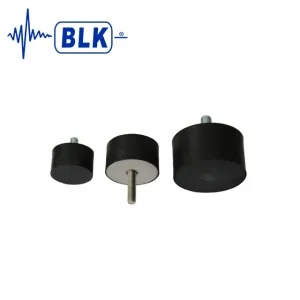
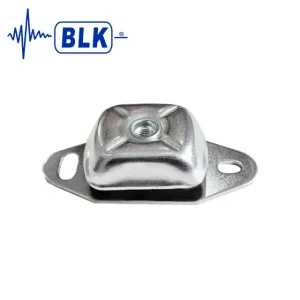
| Molded Elastomeric Mounts (BKH / BKVE) | 8.0 Hz – 15.0 Hz | 3 mm – 10 mm | 0.08 – 0.18 | > 25 Hz (Motors, Fans, Compressors) | 8–12 Years (Depending on oils) |
| Polymer Damping Pads (BK-PM / BKDJ) | 12.0 Hz – 25.0 Hz | 1 mm – 4 mm | 0.15 – 0.35 | High frequency acoustic decouple | 10+ Years |
Calculation Parameters
Accurate selection requires operating static weight per mounting point, total machine weight including dynamic liquid contents, center of gravity (CoG), lowest shaft excitation frequency (RPM / 60), and environmental conditions (such as oil spray, acid fumes, or coastal air).
Static Deflection Formula
For undamped linear spring systems, natural frequency is derived directly from static deflection ($\delta$ in cm): $f_n \approx \frac{5}{\sqrt{\delta}}$. Sizing a mount for a 25 mm static deflection establishes a natural frequency near 3.16 Hz, ensuring excellent structural attenuation at standard 1,450 RPM motor speeds.
Avoid Resonance Pitfalls
Selecting mounts with excessive stiffness creates a near-unity ratio ($f_d / f_n \approx 1$), producing critical resonance. In this condition, transmissibility spikes exponentially, amplifying structural vibration, increasing ambient noise, and threatening surrounding pipe joints.
Next-Generation Technology Roadmap in Vibration Mitigation
Emerging developments in hybrid active-passive control, smart magnetorheological fluids, and digital twin vibration monitoring.
Active-Passive Hybrid Systems
While passive spring and pneumatic units remain the benchmark for continuous mechanical vibration, extreme-precision semiconductor fabs moving to sub-2nm nodes face floor disturbances below 1 Hz. The Bellking future technology pipeline integrates piezo-electric actuators atop pneumatic bladders to eliminate low-frequency structural resonance via active real-time counter-force generation.
Magnetorheological Fluid Damping
Traditional viscous fluid dampers utilize static orifice designs with fixed damping ratios ($\zeta$). Next-generation Bellking prototypes incorporate magnetorheological (MR) fluids whose shear viscosity changes in milliseconds under variable magnetic fields, dynamically adapting damping resistance during transient machine run-ups.
IoT Sensor Integration & Digital Twins
Future industrial installations demand real-time health diagnostics. Bellking is embedding self-powered micro-electromechanical (MEMS) accelerometers directly within mounting housings. These smart nodes upload real-time spectrum data to cloud-based predictive maintenance systems, warning operators of bearing wear or elastomeric degradation well before mechanical failure occurs.
Global Logistics, Regulatory Compliance & Engineering Support
Factory-direct export fulfillment backed by international quality certifications, rapid non-standard prototyping, and comprehensive field documentation.
International Compliance
All Bellking elastomeric compounds, springs, and pneumatic bladder assemblies fully comply with RoHS and REACH directives, ensuring zero restricted hazardous substances or volatile toxic off-gassing during cleanroom installations.
Rapid 1:1 Customization
Our dedicated engineering department provides bespoke non-standard fabrication drawings within 24 hours and delivers turnkey physical prototypes within 3 working days based on your specific load requirements and geometric constraints.
24-Hour Express Dispatch
With an annual capacity exceeding 100,000 units, standard spring mounts, rubber hangers, and polymer pads ship from our Kunshan factory warehouse within 24 hours, supported by established international air and ocean logistics routes.
Traceable Quality Dossiers
Shipments include factory load-deflection test certificates, EN 10204 3.1 material chemical analyses, Dacromet salt spray reports, and bilingual installation guidelines, ensuring full compliance for engineering audits and commissioning inspections.
Frequently Asked Questions by Procurement & Engineering Teams
Technical guidance direct from Bellking application engineers, based on over 1,000 completed global vibration control installations.
How do I select between helical spring, molded elastomeric, and pneumatic air isolators?
The primary deciding factor is the lowest operating disturbance frequency ($f_d$) of your equipment. Rubber elastomeric mounts exhibit higher natural frequencies (8–15 Hz) and are best suited for high-speed equipment (>1,500 RPM) such as small fans, vane pumps, and small motors. Helical steel spring isolators achieve low natural frequencies of 3–5 Hz, making them optimal for low-to-medium speed rotating machinery (chillers, cooling towers, heavy compressors, and gensets). Pneumatic air mounts deliver natural frequencies down to 1.7 Hz, making them essential for ultra-low frequency micro-vibrations in semiconductor tools and coordinate measuring machines.
What specific mechanical data must be provided to size an isolator system?
Our engineering team requires total operating weight, dynamic fluid/refrigerant charge, exact center of gravity (CoG) coordinates, number and spacing of proposed support points, lowest equipment operating speed (RPM), whether the installation is ground-mounted or ceiling-suspended, site corrosive exposure, and any applicable seismic restraint codes (such as IBC or Eurocode 8). Based on these values, Bellking generates an engineered vibration isolation calculation plan within 24 hours.
What operational lifespan can be expected under demanding industrial plant conditions?
Under normal indoor and sheltered mechanical room conditions, Bellking helical spring isolators and transformer mounts maintain target dynamic stiffness for over 15 years. All steel components are protected with our Dacromet inorganic coating, verified by 900 hours of continuous salt-spray testing. Pneumatic air mount bladders maintain continuous leveling and elasticity for over 6 years, with modular replacement bellows available directly from factory inventory.
Can Bellking manufacture custom non-standard vibration isolators for unusual footprints?
Yes. Approximately 40% of our production supports custom configurations for international OEMs and retrofit projects. We provide 1:1 tailored design modifications covering bolt hole pitch, altered free heights, integrated limit-stops, and special coatings. Our standardized engineering workflow proceeds through initial requirement intake, technical validation, FEA simulation, CAD approval, and rapid physical production in as fast as 3 working days.
Why is a concrete inertia base required for end-suction and horizontal split-case pumps?
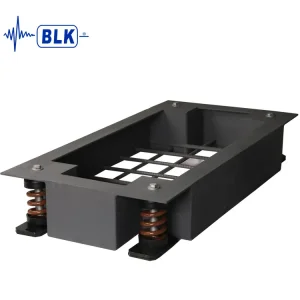
Directly mounting flexible-coupled pumps on individual spring isolators can cause structural flex, pipe misalignment, and high start-up rocking. Integrating a heavy concrete-filled CPB-type inertia base adds rigid mass, lowers the combined center of gravity, resists motor torque reaction, and stabilizes the assembly. This preserves pump shaft alignment and protects connected flexible pipe joints from cyclic shear fatigue.
What warranty terms, manufacturing certifications, and QC inspection reports are provided?
Every Bellking component includes a 1-year standard factory warranty, comprehensive technical documentation, and installation manuals. Operating under an audited ISO 9001 quality system, we supply batch spring load-deflection curves, EN 10204 raw material mill sheets, third-party acoustic performance testing certificates, and dimensional verification reports with every commercial shipment.
Factory-Direct Anti Vibration Components: Series II
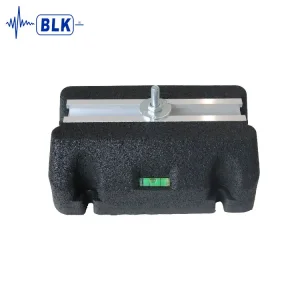
Complete your mechanical isolation specifications with heavy-duty inertia pump bases, industrial rubber cushions, air suspensions, and damped spring mountings.


Request an Engineered Sizing Plan for Your Facility
Send us your equipment operating weight, support geometry, and running speeds (RPM). Bellking engineering specialists will deliver a complete vibration isolation calculation report within 24 hours.