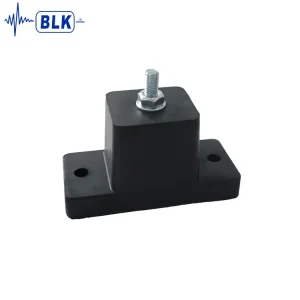
Featured Industrial Bolt-On & Precision Isolator Series
Engineered for extreme dynamic load damping, structural noise suppression, and high-frequency isolation.








1. Technical Fundamentals & Architecture of Bolt-On Vibration Isolators
In modern industrial engineering, controlling mechanical vibration is vital for machinery longevity, structural integrity, and acoustic compliance. Bolt-on vibration isolators serve as critical mechanical interfaces designed to decouple rotating, reciprocating, or impacting machinery from supporting substructures.
Unlike elastomeric pads or gravity-held leveling mounts, bolt-on vibration isolators provide positive mechanical anchoring through internal or external mounting flanges. This secure fixing handles multi-directional dynamic forces—including vertical compression, horizontal shear, and overturning moments caused by dynamic startup transients or seismic activity.
Mechanics of Damping & Isolation Transmissibility
The core performance of any bolt-on vibration isolator depends on its natural frequency ($f_n$) relative to the forced disturbing frequency ($f_d$) generated by the operating equipment. The theoretical isolation efficiency is defined by the Transmissibility ($T_r$) equation:
T_r = \sqrt{\frac{1 + (2 \zeta \frac{f_d}{f_n})^2}{(1 - (\frac{f_d}{f_n})^2)^2 + (2 \zeta \frac{f_d}{f_n})^2}}
Where $\zeta$ represents the damping ratio of the elastomeric compound or viscous spring assembly. For effective vibration isolation ($T_r < 1$), the frequency ratio $f_d / f_n$ must exceed $\sqrt{2} \approx 1.414$. Premium bolt-on isolators target a frequency ratio of $f_d / f_n \ge 3.0$, delivering isolation efficiencies over 88% to 99%.
Comparative Technology Matrix: Sourcing Considerations
| Isolator Mounting Type | Shear Load Handling | Installation Speed | Seismic & Wind Restraint | Typical Industrial Target |
|---|---|---|---|---|
| Bolt-On Flanged Mounts | High (Positive Fixation) | Fast (Standard Fasteners) | Excellent (Built-in Snubbers) | Chillers, Pumps, Gensets, Heavy Presses |
| Weld-On Steel Isolators | Extreme (Permanent) | Slow (Requires Field Welding) | High (Requires NDT Inspection) | Maritime Vessels, Structural Beams |
| Free-Standing Friction Mounts | Low (Friction Dependent) | Instant (Non-Anchored) | None (Slide Hazard) | Light Laboratory Instrument Benchtop |
2. Pricing Drivers & Procurement Cost Analysis for Global Buyers
Understanding the pricing structure of high-quality bolt-on vibration isolators requires evaluating the complete bill of materials, engineering customization, and environmental treatments. Industrial B2B buyers often evaluate unit costs versus long-term operational resilience.
Elastomeric & Alloy Formulation
High-grade Natural Rubber (NR), Neoprene (CR), or Fluoroelastomers (FKM) cost more upfront but prevent premature compression set, oil swelling, and thermal degradation, extending replacement intervals.
Corrosion Coatings & Finish
Standard zinc electroplating suits indoor HVAC. Outdoor industrial or off-shore applications require Dacromet or hot-dip galvanizing that withstands over 900 hours of salt spray testing.
Order Volume & Custom Tooling
Off-the-shelf standard models ship with zero tooling costs. Custom mounting hole dimensions, non-standard durometers, or specialized height adjusters involve initial mold costs amortized over volume.
Estimated B2B Wholesale Pricing Tiers (Global Benchmark)
| Isolator Category | Load Capacity (Per Mount) | Standard Surface Finish | Estimated Unit Price Range (USD) |
|---|---|---|---|
| Compact Rubber Bolt-On Footings (BKAL Series) | 10 kg – 300 kg | Zinc Plated / Stainless Insert | $2.50 – $12.00 |
| Heavy-Duty Industrial Rubber Mounts (BKVD / BKP) | 200 kg – 2,500 kg | Powder Coated / Dacromet | $15.00 – $65.00 |
| Seismic-Restrained Bolt-On Spring Mounts | 500 kg – 8,000 kg | Hot-Dip Galvanized / Dacromet | $45.00 – $220.00 |
| Precision Pneumatic Bolt-On Mounts (BK-PF) | 100 kg – 5,000 kg | Anodized Aluminum / Nickel Plated | $180.00 – $850.00+ |
3. The China Manufacturing Advantage: Why Source from Kunshan Supply Hubs?
China's Yangtze River Delta industrial cluster—specifically centered in locations like Kunshan, Jiangsu—has transformed global supply chains for advanced vibration isolation and shock attenuation equipment.
Fully Integrated Industrial Ecosystem
From raw elastomer compounding and precision mold design to robotic welding and automated surface treatment, the Kunshan manufacturing hub consolidates the complete supply chain within a 30-kilometer radius. This high density lowers transport overheads, shortens production cycles, and speeds up product delivery.
Rigorous Quality Assurance & Test Validation
Leading Chinese OEM/ODM factories operate strictly under ISO 9001:2015 quality management systems. Facilities feature in-house testing equipment, including dynamic stiffness test rigs, laser vibrometers, fatigue endurance benches (up to 5 million load cycles), and salt spray corrosion chambers.
4. Macro Industry Solutions & Technical Application Trends
As industrial automation speeds up and urban areas build denser, managing noise and vibration requires specialized, application-engineered isolator designs.
HVAC & Critical Data Centers
Central chillers, cooling towers, and rooftop air handlers generate low-frequency hums that travel through building frames. Bolt-on spring isolators feature elastomeric bases to stop high-frequency acoustic bypass, meeting stringent NC-30 noise limits.
Semiconductor Metrology & Cleanrooms
Wafer fabrication and electron microscopy rely on steady conditions. Bolt-on pneumatic isolators (BK-PF Series) maintain active level control within microns, preventing ambient floor vibrations from disturbing sub-nanometer processes.
Power Transformers & Electrical Grid
Magnetostriction causes transformers to hum continuously at 100Hz/120Hz harmonics. Specialized bolt-on transformer dampeners absorb shear stress while isolating electromagnetic rumble from concrete foundations.
Marine Engine & Power Generation
Marine propulsion engines operate under constant pitching, rolling, and high dynamic torque. Bolt-on mounts with integrated snubbers prevent excessive engine movement during rough sea conditions.
5. Global Procurement Guide: Key Specifications for Engineering Teams
When engineering and procurement teams source bolt-on vibration isolators internationally, confirming technical specifications prevents costly site retrofits and premature equipment failures.
Step-by-Step Engineering Selection Procedure
Step 1: Determine Total Operating Mass & Center of Gravity
Calculate the wet operating weight (including fluids, attached piping, and accessories). Identify asymmetric weight distribution to select correct, non-uniform spring rates across support points.
Step 2: Identify Disturbing Frequency ($f_d$)
Find the equipment's lowest operating speed (RPM). For example, a 1,750 RPM motor generates a primary forcing frequency of $1750 / 60 = 29.16\text{ Hz}$.
Step 3: Target Isolation Efficiency & Static Deflection
Select an isolator with a natural frequency low enough to achieve target isolation (typically $>90\%$). Calculate required static deflection ($\delta_s$) using:
f_n = \frac{1}{2\pi} \sqrt{\frac{g}{\delta_s}} \approx \frac{5}{\sqrt{\delta_s \text{ (cm)}}}
Step 4: Evaluate Environmental & Regulatory Compliance
Confirm the operating temperature, chemical or oil exposure, outdoor UV exposure, and local seismic acceleration requirements (e.g., IBC seismic compliance, ASHRAE guidelines).
6. Frequently Asked Questions (Engineering & Procurement Q&A)
Expert technical answers for procurement directors, MEP engineers, and industrial plant managers.
Heavy-Duty, Spring & Damped Vibration Control Products
Complete your equipment installation with factory-direct anti-vibration platforms, spring mounts, and dampeners.