
Standard & Custom Generator Isolation Products
Factory-direct industrial anti-vibration mounts engineered for power generation, heavy machinery, HVAC systems, and critical infrastructure.






Engineering Dynamics & Kinetic Physics of Generator Isolation
A comprehensive breakdown of structural vibration transmission, natural resonance management, and elastomeric vs. viscous damping physics for power generation systems.
Harmonic Excitation & Resonant Frequencies
Diesel and gas generator sets generate severe mechanical excitation forces due to reciprocating piston motion, shaft unbalance, and electromagnetic pulse torque. Without adequate isolation, continuous dynamic forces transmit directly to sub-structures, creating airborne structure-borne noise, accelerated fatigue failure of electrical components, and catastrophic structural degradation.
Where f_d = Disturbing Frequency (RPM / 60)
And f_n = Natural Frequency of Isolator (Hz)
To achieve an isolation efficiency higher than 95%, the disturbing-to-natural frequency ratio (f_d / f_n) must exceed 3.5:1. For standard 1500 RPM (25 Hz) or 1800 RPM (30 Hz) gensets, Bellking spring isolators target natural frequencies between 3.0 Hz and 5.0 Hz, ensuring minimal dynamic force transmission.
Viscous Fluid Damping vs. Elastomeric Shear
Standard coil springs provide exceptional static deflection and low natural frequency, but exhibit minimal internal damping. During generator transient startup and shutdown cycles, the engine speed passes directly through the system’s resonant natural frequency ($f_n$).
- Viscous Damped Springs: Integrate high-viscosity silicone fluid cavities to control resonant surge amplitudes by up to 80% without compromising steady-state isolation efficiency.
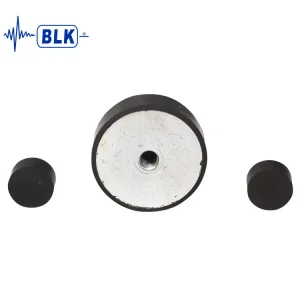
- Engineered Elastomers: High-durometer nitrile and neoprene compounds offer high internal hysteresis, making them ideal for high-frequency isolation and high shock-absorbance environments.
Industry Solution Architecture: Turnkey Applications
Tailored anti-vibration systems deployed across high-demand mission-critical environments.
Tier IV Hyperscale Data Centers
Data centers require zero-tolerance continuous power backup. Rooftop or basement backup generators operating near sensitivity-critical server racks can cause micro-vibration damage to solid-state drives and optical switches. Bellking supply matrix-mounted multi-directional spring mounts with seismic restraint housings to absorb both high-frequency engine harmonics and low-frequency structural lateral shocks.
Healthcare & Emergency Facilities
Hospitals mandate stringent acoustic compliance governed by standards such as HTM 08-01 and ASHRAE equipment guidelines. Generator vibration isolators must eliminate structure-borne hum in surgery theaters and diagnostic laboratories. Our BK-RT damped isolation platforms attenuate energy transfer down to non-detectable levels, preserving ultra-precise medical imaging clarity.
Offshore Marine & FPSO Vessels
Marine environments impose harsh salt-spray corrosion, multi-axis motion inertia, and heavy wave-slap shock loads. Bellking marine-grade generator vibration mounts combine heavy-duty ductile iron enclosures, stainless steel hardware, and Dacromet-coated springs passing 900-hour salt spray testing to withstand severe marine pitching and rolling.
Future Outlook: Next-Generation Vibration Mitigation (2025–2035)
Exploring emerging technological paradigms in smart material science, active electromagnetic damping, and predictive condition monitoring.
1. Smart Magnetorheological (MR) Dampers
Transitioning from passive elastomeric mounts to active MR-fluid dampers allowing dynamic viscosity adjustments in real-time. Embedded microcontrollers modify coil current within milliseconds to adapt damping factors ($\zeta$) instantly during load transient surges or engine start-up resonance.
2. IoT Edge Sensor Integration
Future Bellking generator mounts integrate self-powered piezoelectric sensors directly into the base plate. Real-time tri-axial vibration spectrum telemetry (velocity, displacement, acceleration) feeds straight into cloud AI platforms, enabling predictive failure alerts before structural fatigue occurs.
3. Advanced Bio-Polymer Alloys
Addressing international environmental regulations, R&D efforts prioritize zero-VOC, fully recyclable thermoplastic vulcanizates (TPVs) that offer high chemical resistance against diesel fuel oil, lubricating oils, and ozone exposure without elastic creep degradation over a 15-year lifecycle.
China Factory 4.0: Supply Chain Resilience & Precision Manufacturing
Located in Kunshan, Jiangsu, Bellking operates a state-of-the-art 2,000 m² smart manufacturing ecosystem dedicated to precision vibration isolation equipment.
Automated Production & Material Traceability
Our smart factory leverages robotic welding cells, CNC spring coiling machinery, and automated surface coating lines. Every batch of high-tensile spring steel (60Si2MnA) undergoes rigorous ultrasonic flaw detection, load deflection testing, and digital metallurgical analysis to prevent premature spring sagging or stress cracking.
Supply Chain Scale & Cost Efficiency
By controlling the entire production value chain—from raw metal stamping to elastomeric vulcanization and assembly—Bellking eliminates intermediate markups. Global OEM clients benefit from factory-direct pricing, 1:1 custom engineering modifications within 3 business days, and complete BOM transparency.
Technical Comparison Matrix for Generator Isolators
Compare mechanical properties, isolation efficiencies, and load capabilities across core product lines.
| Isolator Series Type | Natural Frequency (f_n) | Max Load Capacity per Mount | Damping Coefficient (ζ) | Primary Target Application | Corrosion Protection |
|---|---|---|---|---|---|
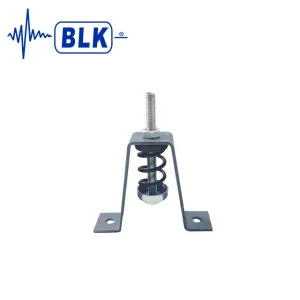
| MD Spring Mounts | 3.0 Hz – 5.0 Hz | Up to 3,500 kg | 0.05 – 0.12 | Heavy Diesel Gensets, Chillers | Dacromet / Galvanized |
| BK-RT Damped Platform | 2.5 Hz – 4.5 Hz | Up to 10,000 kg | 0.15 – 0.25 (Viscous) | Critical Emergency Power Platforms | Epoxy Powder Coat |
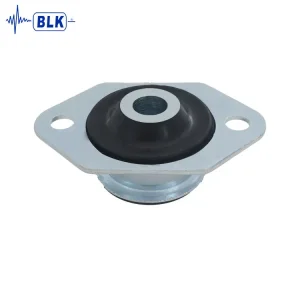
| BKCN Cone Mounts | 8.0 Hz – 12.0 Hz | Up to 800 kg | 0.10 – 0.18 | Mobile Power Trucks, Marine Engines | High-Grade Nitrile / Zinc Plated |
| BK-A Air Mounts | 1.7 Hz – 3.0 Hz | Up to 2,000 kg | 0.08 – 0.15 | Ultra-sensitive Optical & Precision Units | Anodized Aluminum Alloy |
| BKVE Rubber Mounts | 6.0 Hz – 10.0 Hz | Up to 1,200 kg | 0.12 – 0.20 | Small Gas Gensets, Compressors | Vulcanized Rubber / Steel |
Global Enterprise Sizing & Specification Blueprint
Step-by-step engineering calculation framework for procurement teams and consulting engineers when specifying generator anti-vibration mounts.
Step 1: Total Operational Load Calculation
Sum the dry weight of the engine, alternator, base skid, fuel oil (if wet base), and radiator coolant. Add a safety dynamic weight allowance of 20% to account for torque reaction during instantaneous load acceptance.
Step 2: Center of Gravity (CoG) Verification
Generators rarely feature a symmetrical mass distribution due to heavy alternator windings. Calculate individual mounting point loads ($P_i$) based on distance from the actual CoG to ensure equal deflection across all spring mounts.
Step 3: Deflection & Natural Frequency Matching
Select static spring deflection based on desired isolation efficiency. A static deflection ($d$) of 25 mm achieves a natural frequency of ~3.2 Hz, providing over 96% isolation against a 1500 RPM (25 Hz) engine speed.
Localized Support, Compliance & Regulatory Standards
Bellking products conform to international acoustic, vibration, and structural engineering codes for global jobsite deployment.
ISO 10816-3 & ISO 8528-9 Standards
Ensures generator mechanical vibration severity remains well within Class I-IV allowable velocity boundaries (mm/s RMS), reducing structural fatigue on engine crankcases and copper windings.
ASHRAE Equipment Isolation Compliance
Meets stringent American Society of Heating, Refrigerating and Air-Conditioning Engineers guidelines for minimum static deflection and seismic restraint housing requirements in critical commercial buildings.
DIN 4150 Structural Vibration Norms
Protects surrounding building masonry and reinforced concrete structures from long-term low-frequency vibration fatigue damage caused by continuous backup power operation.
Frequently Asked Questions (FAQ)
Expert responses from Bellking’s application engineering team regarding selection, installation, and performance maintenance.
Complete Damping & Isolation Product Line
Explore our full line of anti-vibration buffers, polymer pads, matrix mounts, and specialty platforms.




Optimize Your Power System's Vibration Control
Connect directly with Bellking’s senior acoustic engineers to request custom sizing calculations, 3D CAD models, or factory-direct quotations within 24 hours.
Request Technical Consultation