
Engineered Vibration Control Solutions
Explore our factory-direct industrial mounts, heavy-duty pads, and precision isolation platforms.







Global Industry Development Trends in Heavy-Duty Vibration Control
An engineering analysis of modern mechanical attenuation, material physics, and structural isolation demands.
Viscoelastic Polymers
Evolution from plain rubber mats to multi-tiered polymer matrices capable of managing dynamic high-amplitude impulse loads without permanent dynamic compression set.
Sub-Hz Attenuation
Increasing demand in micro-electronics and cleanroom facilities for sub-Hz vibration attenuation to prevent structural acoustic transfer to sensitive process tools.
Environmental Rigor
Shift towards eco-friendly elastomeric formulations resisting ozone degradation, harsh alkaline chemicals, extreme temperatures (-40°C to +120°C), and oils.
In modern industrial manufacturing, structural dynamic stability directly influences equipment precision, structural longevity, operational safety, and acoustic comfort. As dynamic heavy machinery—such as 1,000-ton hydraulic forging presses, high-capacity centrifugal chillers, industrial power transformers, and automated stamping systems—operates at elevated velocities, structure-borne shock waveforms travel into surrounding building infrastructures.
Historically, industrial facilities relied on rudimentary rubber sheets or basic cork layers. However, modern Industry 4.0 standards necessitate engineered Heavy Duty Anti Vibration Pads designed with quantifiable natural frequencies ($f_n$), calibrated dynamic stiffness ($K_d$), and minimal dynamic hysteresis loss. The market transition is accelerated by stringent international noise-pollution regulations, micro-vibration tolerances in high-precision manufacturing, and total-cost-of-ownership (TCO) considerations in asset protection.
Key Engineering Insight: Unmitigated mechanical vibration introduces fatigue stresses in machine anchor bolts, accelerates bearing spalling, degrades surrounding structural concrete foundations, and elevates sound pressure levels ($dB(A)$) beyond permissible OSHA / EU directives.
Material Science & Elastomeric Mechanical Mechanics
Understanding viscoelastic damping physics, static-to-dynamic stiffness ratios, and isolation efficiency formulas.
Viscoelastic Damping and the Mechanics of Polymeric Matrices
Heavy-duty anti-vibration pads operate by converting mechanical kinetic energy into localized thermal energy via viscoelastic shear loss. Polymeric elastomers exhibit both elastic solid characteristics (Hooke's Law compliance) and viscous fluid mechanics (Newtonian flow resistance). The loss factor ($\eta = \tan \delta$) defines the material's structural capacity to dissipate energy during dynamic deflection cycles.
When selecting elastomeric compounds for heavy industrial loads exceeding $50 \, \text{N/cm}^2$, engineers must evaluate three core material matrices:
- Nitrile Rubber (NBR): Formulated specifically for high oil, fuel, and grease resistance. Exhibits excellent compression-set resistance under continuous static preloads.
- Neoprene (Chloroprene Polymer): Exceptional environmental weathering, ozone resistance, and flame-retardant properties. Ideal for outdoor HVAC chillers and power substations.
- Engineered Polyurethane & Multi-Layer Dampers (e.g., BKSWA Series): Formulated for ultra-high load capacities up to $15 \, \text{MPa}$, providing non-linear deflection curves that prevent bottoming-out under severe shock loading.
Mathematical Modeling of Isolation Efficiency ($I_e$)
The system transmissibility ($T_r$) defines the ratio of force transmitted to the foundation versus the force generated by the operating equipment:
Where $f$ represents the disturbing frequency generated by machine RPM ($f = \text{RPM} / 60$), $f_n$ is the natural frequency of the anti-vibration pad, and $\zeta$ is the damping ratio. Vibration isolation occurs only when $f / f_n > \sqrt{2} \approx 1.414$. To achieve an isolation efficiency of $90\%$ to $99\%$, the frequency ratio should typically be engineered within $f / f_n \ge 3.0$ to $5.0$.
| Pad Material / Series | Static Load Capacity | Natural Frequency ($f_n$) | Damping Ratio ($\zeta$) | Primary Industrial Use-Case |
|---|---|---|---|---|
| BKTS Rubber Pad Series | $0.2 - 1.5 \, \text{MPa}$ | $8 - 12 \, \text{Hz}$ | $0.08 - 0.12$ | Motors, Pumps, Small Compressors, Stamping Tools |
| BK-PM Polymer Damping Pad | $1.0 - 5.0 \, \text{MPa}$ | $6 - 10 \, \text{Hz}$ | $0.15 - 0.22$ | Heavy Mechanical Presses, Generators, HVAC Plants |
| BKSWA Composite Dampers | $3.0 - 15.0 \, \text{MPa}$ | $4 - 8 \, \text{Hz}$ | $0.20 - 0.35$ | Transformer Foundations, Ultra-Heavy Forging Lines |
| BK-DT Optical Platform Series | Precision Micro-Load | $1.5 - 3.5 \, \text{Hz}$ | Active / Passive High Damping | Semiconductor Inspection, Metrology, Optical Benches |
Global Enterprise Procurement & Factory Price Drivers
A transparent procurement guide detailing manufacturing cost components, volume pricing models, and TCO optimization.
When procurement managers, EPC contractors, and structural engineers evaluate factory direct pricing for heavy-duty anti-vibration pads, looking solely at unit initial cost often leads to premature component fatigue and costly production downtime. Industrial procurement strategies must account for total operational life-cycle value.
Primary Unit Price Drivers
- Compound Purity & Elastomer Grade: High-grade virgin NBR and Neoprene vs. recycled filler-loaded polymers. Virgin polymers increase cost by 15-25% but extend operational lifespan by over 300%.
- Internal Steel Encapsulation & Surface Coating: Corrosion-resistant Dacromet or hot-dip galvanized steel plates (passing 900-hour salt spray tests) add manufacturing steps but prevent structural delamination in marine or chemical environments.
- Custom Tooling & Mold Design: Standard catalog dimensions offer zero-tooling cost, whereas custom 1:1 tailored dimensions involve initial tooling amortized over order volumes.
Volume Pricing & OEM Bulk Strategies
- Tier 1 Logistics & Packaging: Standardized palletizing and container-fill optimization reduce global shipping costs per kilogram by up to 40%.
- Scheduled Factory Releases (Blanket Orders): Enterprise buyers securing 12-month supply agreements lock in raw material pricing against elastomer commodity fluctuations.
- Full Traceability & QC Documentation: Factory Inspection Reports (FIR), ISO 9001 compliance, and third-party material test certification guarantee zero-defect site arrivals.
Macro Industry Solutions & Field Deployments
Customized vibration isolation strategies engineered for demanding global operating environments.
HVAC & Heavy Commercial Chillers
Large-scale cooling towers, centrifugal chillers, and primary water pumps generate low-frequency continuous rumble. Deploying BK-DS Spring Mounts combined with BKTS elastomer pads prevents acoustic flanking noise into commercial structures.
Power Transformers & Substations
Electrical magnetostriction causes continuous $100 \, \text{Hz} / 120 \, \text{Hz}$ humming in distribution transformers. BKSWA multi-layer composite dampers isolate foundation transmission while supporting massive deadweight loads.
Stamping & Forging Metal Presses
Transient shock impulse loads up to 5G accelerate mechanical press wear and shatter nearby floor slabs. High-damping BK-PM polymer pads cushion peak dynamic stress and stabilize floor deflection.
Quality Compliance & Localized Technical Engineering
Ensuring site safety, international certification, and rapid 24-hour engineering responses.
Rigorous Factory Quality Verification
Our manufacturing facility features automated vulcanization presses, laser-guided CNC cutting machines, dynamic fatigue testers, and precision spectrum analyzers. Every production run undergoes rigorous quality verification:
- Static & Dynamic Load Deflection Testing: Verifying exact spring rates and compression modulus values prior to dispatch.
- Salt Spray & Corrosion Resistance: Metals treated with Dacromet coatings pass 900-hour ASTM B117 salt spray testing.
- Non-Destructive Testing (NDT): Ultrasonic checking of elastomeric bonding to steel substrate plates to guarantee zero risk of delamination.
Global Engineering Support & Customization
Whether fitting out a new semiconductor fabrication line in Southeast Asia or retrofitting an HVAC plant room in Europe, our application engineering team delivers direct 1:1 consultation:
- 24-Hour Plan Generation: Send us your equipment weights, center of gravity (CG), and operating RPM, and our engineers return localized installation layouts within 24 hours.
- Custom Mold Tailoring: Rapid 3-day turnaround on non-standard geometry prototypes.
- Regulatory Documentation: Full compliance provided for ISO 9001, REACH, RoHS, and CE guidelines.
Technology Roadmap: The Future of Industrial Damping
A strategic look at smart anti-vibration materials and active-passive hybrid damping platforms.
Phase 1: Smart IoT-Enabled Condition Monitoring
Embedding micro-wireless MEMS accelerometers into heavy-duty pads to provide real-time foundation monitoring, predictive wear alerts, and automated maintenance scheduling.
Phase 2: Magnetorheological (MR) & Active Hybrid Damping
Integrating semi-active MR fluid elements within spring-pad mounts to continuously modulate damping coefficients ($\zeta$) in response to sudden transient power spikes or seismic shock events.
Phase 3: Bio-Based & Recyclable Viscoelastic Elastomers
Developing eco-friendly, zero-VOC bio-polymeric compounds that achieve identical compression-set durability while reducing product manufacturing carbon footprints by 45%.
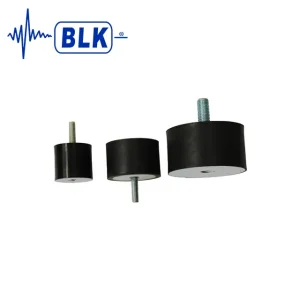
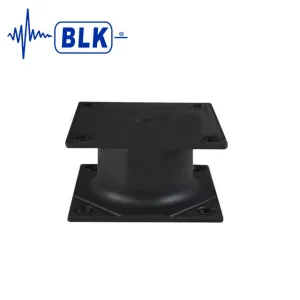
Full Series Heavy-Duty Anti Vibration Equipment
Comprehensive catalog of specialized rubber buffers, spring hangers, and multi-layer dampening units.






Engineering Procurement Q&A (FAQ)
Expert insights regarding anti-vibration pad selection, life expectancy, and customization options.