
Explore high-durability spring mounts, specialized rubber buffers, and low-frequency pneumatic isolators directly manufactured for heavy automation lines.
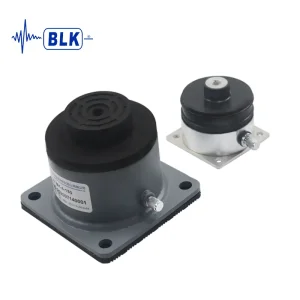
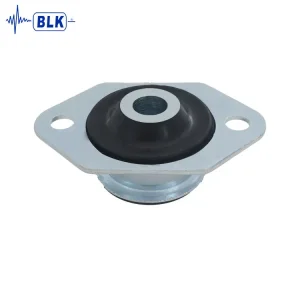
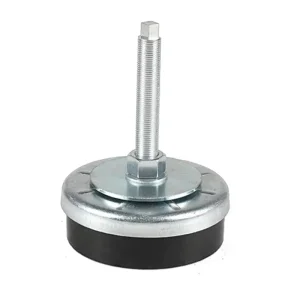
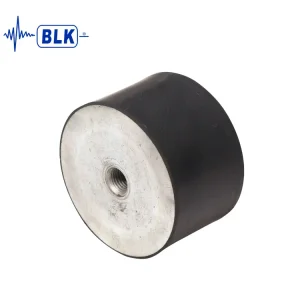
An analysis of micro-vibration challenges in modern smart factories, sub-micron machining, and multi-axis automated machinery.
In the era of Industry 4.0, industrial automation has transitioned from coarse mechanical throughput to sub-micron positioning accuracy, ultra-high-speed robotic pick-and-place routines, and continuous automated assembly. However, as mechanical speeds, motor torques, and structural resonance frequencies increase, unwanted mechanical vibration emerges as a critical failure mode. Unmitigated harmonic vibration induces premature mechanical fatigue, degrades sensor calibration, accelerates bearing wear, and introduces severe structural noise into manufacturing ecosystems.
According to global industrial asset performance research, over 38% of precision CNC tooling errors and up to 42% of optical inspection measurement variances are directly attributable to environmental and structure-borne vibrations. As global manufacturing demands higher yields in semiconductor fabrication, lithium battery automated winding, automotive robotic welding, and high-frequency HVAC operations, specifying high-performance industrial automation vibration control solutions has shifted from an operational luxury to a core engineering imperative.
Harmonic Resonance Suppression
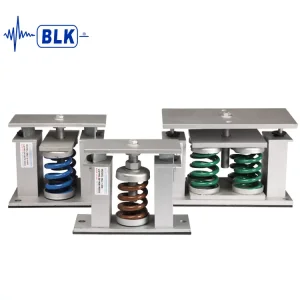
Engineered spring damping systems isolate forcing frequencies ($f_d$) generated by high-speed rotating equipment, preventing structural building resonance and mechanical fatigue.
Micro-Vibration Damping
Pneumatic air-mount isolators neutralize floor vibrations down to low single-digit Hertz levels, essential for coordinate measuring machines (CMM) and laser lithography systems.
Corrosion & Impact Resistance
Advanced elastomeric compounds and Dacromet-coated housing structures withstand oils, chemical spills, thermal fluctuations, and transient 3G–5G shock loads.
Selecting the optimal vibration isolator requires matching the equipment disturbing frequency ($f_d$) with the isolator natural frequency ($f_n$) to achieve a transmissibility ratio ($T$) well below 1.0.
Vibration isolation efficiency is governed by the mathematical relation between forcing frequency and system natural frequency:
Isolation begins only when $f_d / f_n > \sqrt{2} \approx 1.414$. To achieve commercial isolation efficiency exceeding 90% to 99%, the frequency ratio ($f_d / f_n$) must be designed between 3.0 and 5.0. Operating near $f_d / f_n = 1.0$ causes catastrophic resonance amplification!
| Isolator Technology Class | Natural Frequency Range ($f_n$) | Typical Damping Ratio ($\zeta$) | Primary Industrial Applications | Typical Isolation Efficiency |
|---|---|---|---|---|
| Steel Spring Mounts (MA / MC Types) | 2.5 Hz – 5.0 Hz | 0.01 – 0.05 (0.15+ with viscous damping) | Chillers, large HVAC pumps, diesel generators, heavy punch presses | 92% – 98% |
| Pneumatic Air Mounts (BK-A / BK-R) | 1.7 Hz – 3.5 Hz | 0.05 – 0.20 (auto-leveling regulated) | Semiconductor probers, optical tables, electron microscopes, CMMs | 96% – 99.5% |
| Industrial Rubber Mounts (BKHQ / BKVE) | 6.0 Hz – 15.0 Hz | 0.05 – 0.15 (elastomer internal hysteretic) | Electric motors, high-speed fans, air compressors, conveyor drives | 80% – 92% |
| Multi-Layer Dampers & Pads (BKSWA / BKDJ) | 8.0 Hz – 20.0 Hz | 0.10 – 0.25 (composite high-damping polymer) | Heavy foundation pads, transformer sub-bases, acoustic floor retrofits | 75% – 88% |
Understanding industrial vibration mount pricing dynamics, material costs, factory-direct OEM advantages, and Total Cost of Ownership (TCO).
When global procurement teams evaluate Industrial Automation Vibration Control Factories & Price, comparing unit price tags alone often leads to distorted procurement decisions. The true cost of vibration isolation components must be evaluated through a Total Cost of Ownership (TCO) model that accounts for operational lifespan, maintenance overhead, structural damage prevention, and production line uptime.
- Raw Material Metallurgy: High-tensile spring alloy steel (60Si2Mn / 55CrSi) versus standard carbon steel dictates long-term sag resistance and fatigue limits ($10^7$ cycle rating).
- Elastomer Formulation: Natural rubber durometer consistency, Neoprene, or EPDM compound purity determines resistance to oil, ozone, and compression set.
- Surface Treatment & Plating: Standard zinc electroplating vs. heavy-duty Dacromet (passing 900+ hour salt-spray testing) significantly impacts outdoor HVAC and marine application costs.
- Machining Precision & Testing: 100% dynamic stiffness testing, static load-deflection verification, and automated CNC housing tolerances elevate initial unit pricing but eliminate field failures.
Sourcing directly from integrated Chinese manufacturing centers eliminates multiple layers of distributor markup (often adding 30% to 60% in traditional Western supply channels). Factory-direct pricing allows engineering procurement teams to specify premium spring alloys, custom mounting flanges, and viscous damping mechanisms at a fraction of local distributor costs.
How localized supply chains, advanced CNC automation, and strict ISO 9001 quality management create world-class vibration control products.
China’s Yangtze River Delta—specifically the industrial manufacturing hub of Kunshan, Jiangsu—has evolved into the world's premier production cluster for precision mechanical components and vibration isolation equipment. The concentration of specialized raw material suppliers, automated spring-coiling factories, rubber vulcanization workshops, and surface treatment facilities within a 30-kilometer radius gives local factories unparalleled cost efficiency and manufacturing speed.
ISO 9001 Rigorous QC
100% factory inspection protocols including tensile-compression load testing, dynamic frequency spectrum analysis, and rubber hardness verification under international ASTM standards.
Rapid 1:1 OEM Customization
Non-standard structural dimensions, custom bolt hole patterns, specialized paint finishes, and tailored spring constant ratios designed and prototyped in as fast as 3 working days.
High-Capacity Supply Chain
2,000+ m² modernized facilities equipped with robotic welding cells, CNC machining centers, and automated spray lines delivering over 100,000 units annually with standard 24-hour dispatch.
Detailed operational examples showing how customized vibration isolators protect mission-critical equipment across diverse plant environments.
In semiconductor cleanrooms, foot traffic and HVAC duct vibration ruin wafer prober contact precision. Utilizing BK-A Type Pneumatic Air Mounts under optical inspection benches drops ambient floor vibration transmission below VC-E vibration criteria, stabilizing nanometer-level optical imaging.
Centrifugal chillers and large cooling tower water pumps transmit low-frequency hum throughout commercial structures. Installing MA Type Anti-Vibration Spring Mounts with viscous damping stops structure-borne acoustic transfer and absorbs startup torque shocks.
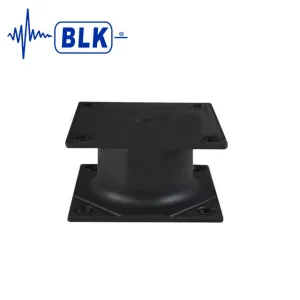
High-speed gantry CNC machines operating at 24,000 RPM suffer from chatter marks when adjacent stamping presses fire. Deploying BKHQ Type Heavy-Duty Rubber Mounts beneath machine beds decouples shock waves, ensuring smooth surface finish tolerances.
Core magnetostriction in power transformers produces continuous 100Hz/120Hz low-frequency noise. Specialized Transformer Anti-Vibration Base Dampers dissipate acoustic energy, preventing noise propagation into surrounding urban residential zones.
Emerging technological shifts shaping next-generation dampening equipment over the coming decade.
Integration of MEMS tri-axial wireless vibration sensors directly into spring and air mounts. Real-time telemetry predicts bearing wear, spring fatigue, and alignment shifts before cataclysmic downtime occurs.
Combining passive pneumatic air springs with active voice-coil piezoelectric actuators. This hybrid setup achieves zero settle time during rapid multi-axis robotic acceleration.
Transitioning to eco-compliant, bio-based elastomers with enhanced thermal stability and zero toxic off-gassing, complying with global REACH and RoHS 3 environmental directives.
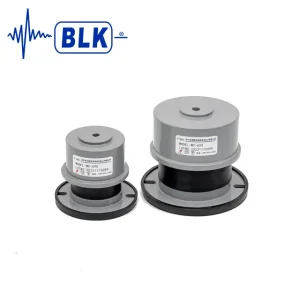
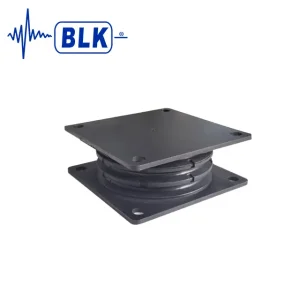
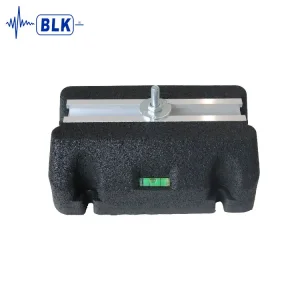
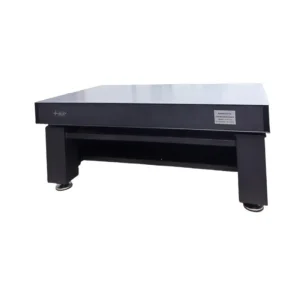
Explore specialized multi-layer dampers, damped isolation platforms, and heavy-duty rubber pads engineered for custom industrial setups.

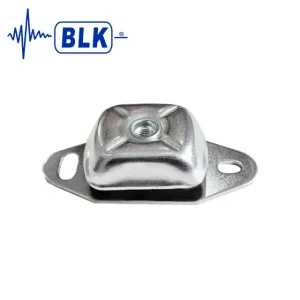
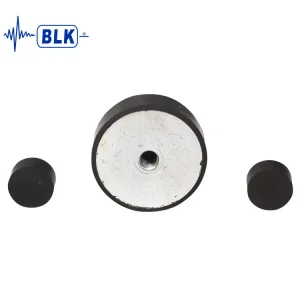
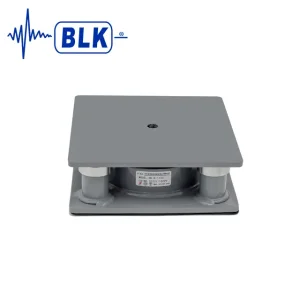
Direct engineering answers to the most common questions regarding sizing, factory lead times, pricing metrics, and installation protocols.
How do I accurately calculate and select between spring, rubber, and pneumatic isolators?
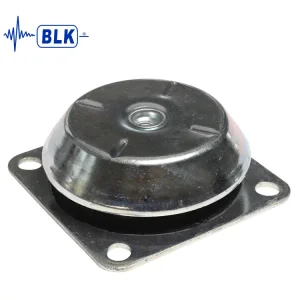
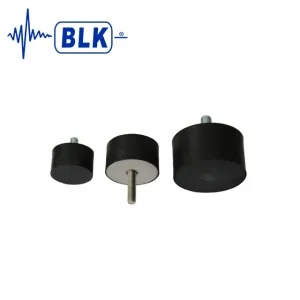
• Rubber Mounts (BKHQ/BKVE): Best suited for higher-speed equipment (>1,200 RPM) where compact size and low cost are prioritized.
• Spring Mounts (MA/MC): Ideal for low-speed heavy HVAC chillers, pumps, and generators (300 to 1,800 RPM) requiring natural frequencies down to 3–5 Hz.
• Pneumatic Air Mounts (BK-A/BK-R): Necessary for ultra-sensitive metrology, CMMs, or semiconductor tools requiring $f_n$ down to 1.7 Hz.
What engineering parameters are required to obtain a accurate factory price quotation?
1. Total wet operating weight of the machinery.
2. Number and layout geometry of support mounting points.
3. Position of the center of gravity (if weight distribution is asymmetrical).
4. Machine operating speed range (RPM or Hz).
5. Installation environment conditions (indoor, outdoor corrosive atmosphere, chemical exposure).
6. Seismic restraint or wind load requirements (for rooftop HVAC installations).