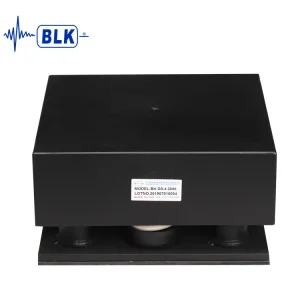
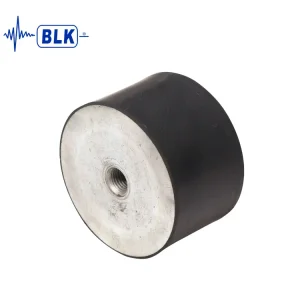
Featured Precision Isolation Mounts & Dampers
High-performance elastomeric pads, heavy-duty spring mounts, and damped anti-vibration hardware certified for rigorous industrial operations.







Engineering Fundamentals of Modern Vibration Control Manufacturing
In contemporary industrial manufacturing, mechanical vibration represents one of the most persistent threats to process precision, asset longevity, structural integrity, and acoustic compliance. Unchecked oscillatory forces generated by heavy rotating equipment—such as centrifugal chillers, industrial pumps, air handlers, punch presses, and power transformers—propagate as kinetic energy through building structures. This structure-borne vibration manifests not only as destructive mechanical fatigue but also converts into low-frequency airborne acoustic noise, causing severe environmental issues and equipment alignment degradation.
To overcome these challenges, global procurement directors and structural engineering consultants must look beyond simple off-the-shelf rubber pads. Sourcing from premier industrial vibration control factories and manufacturers requires a deep evaluation of dynamic stiffness, transmissibility curves, damping ratios ($\zeta$), and long-term viscoelastic performance under cyclic fatigue.
Vibration isolation efficiency is governed by the ratio of disturbing frequency ($f_d$) to the isolator's natural frequency ($f_n$), expressed as $r = f_d / f_n$. The force transmissibility equation is mathematically defined as:
T = √[ (1 + (2ζr)²) / ( (1 - r²)² + (2ζr)² ) ]
For an isolator to attenuate vibration rather than amplify it, the frequency ratio $r$ must exceed $\sqrt{2} \approx 1.414$. Premium industrial isolators target $r \ge 3.0$, achieving isolation efficiencies exceeding 92% to 99%.
A specialized manufacturer like Bellking Vibration Reduction Equipment Manufacturing (Kunshan) Co., Ltd. integrates mechanical design, elastomeric compound formulation, dynamic coil spring metallurgy, and surface finishing technologies (such as 900-hour salt spray tested Dacromet coatings) to engineer isolators capable of maintaining static stability while absorbing severe dynamic shock impulses.
Global Trends Shaping Vibration Control Manufacturing
Four macro drivers accelerating the transition toward smart, low-frequency, and highly durable vibration attenuation technologies.
1. Nanometer-Scale Sub-Hertz Isolation in Semiconductors
As semiconductor fabrication nodes shrink below 3nm, micro-vibrations previously ignored in standard industrial facilities now ruin lithography, EUV wafer stepping, and atomic force microscopy. Leading manufacturers are shifting from simple passive springs to pneumatic active levitation and sub-Hertz air mounts achieving natural frequencies down to 1.7 Hz.
2. Industry 4.0 Smart IoT Predictive Health Monitoring
Modern factory floors demand real-time condition monitoring. Smart vibration mounts embedded with MEMS tri-axial accelerometers and wireless IoT telemetry continuously record displacement, dynamic stiffness variations, and wear metrics, shifting plant maintenance from reactive fixes to AI-driven predictive asset management.
3. Decarbonization & Green Building Acoustic Standards
Strict urban noise ordinances and green building certifications (LEED v4.1, WELL Building Standard) mandate drastic noise reduction in commercial HVAC and district cooling plants. High-efficiency spring mounts and inertia base systems are essential to prevent structure-borne hum in modern high-rise architecture.
4. Electrification, EV Gigafactories & Power Grid Infrastructure
The global expansion of EV battery manufacturing facilities and high-voltage substation transformers requires specialised transformer mounts and matrix damped dampers capable of handling heavy static tonnages while damping continuous 50Hz/60Hz magnetostrictive hum and high-energy transient mechanical shocks.
Global Sourcing Standards & Total Cost of Ownership (TCO)
How tier-1 engineering buyers evaluate vibration control suppliers based on material longevity, fatigue life, and compliance criteria.
| Evaluation Vector | Standard Market Products | Tier-1 OEM Factory Standard (e.g., Bellking) | Procurement Impact & TCO Benefit |
|---|---|---|---|
| Spring Metallurgy & Fatigue Life | Standard carbon steel, prone to sag & fracture after 3-5 years. | High-stress alloy spring steel with shot-peened finish; >15 years fatigue life. | Prevents unexpected downtime, equipment frame distortion, and costly site retrofits. |
| Corrosion Protection | Basic spray painting or electro-galvanizing (salt spray <90 hrs). | Dacromet multi-layer coating passing 900+ hours salt spray test (ASTM B117). | Ensures full structural integrity in marine, coastal, and chemical cleanroom settings. |
| Elastomer Compound Science | Recycled rubber fillers with high creep rates and chemical degrading. | Virgin Nitrile/Neoprene formulations tailored for oil, ozone, and temperature resilience. | Maintains dynamic damping coefficient without hardening or cracking under stress. |
| Quality Certification & Testing | Visual factory inspection only; unverified load ratings. | ISO 9001 certified, 100% stiffness test reports, third-party load/deflection test data. | Guarantees exact alignment with structural engineering calculations and safety margins. |
Turnkey Sector Solutions & Heavy Facility Implementation
HVAC & Central Utility Plants
Central chillers, cooling towers, and primary water pumps generate substantial fluid dynamic turbulence. Utilizing open and housed spring vibration isolators (such as MA, MB, and MC types) combined with concrete-filled steel inertia bases lowers equipment center of gravity, eliminates strain on piping joints, and blocks structural noise transfer into commercial real estate spaces.
Semiconductor & Cleanroom Metrology
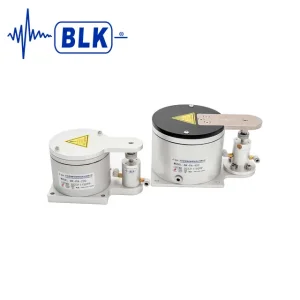
Precision air mounts (BK-PA Type) and active precision platforms attenuate micro-inch floor vibrations to meet VC-E and VC-G vibration criterion curves. Crucial for scanning electron microscopes (SEM), optical benches, and automated wafer inspection tools operated in cleanroom environments.
Power Transmission & Transformers
Electrical transformers transmit low-frequency hum (100Hz/120Hz harmonics) into building slabs. Specialized oil- and weather-resistant anti-vibration transformer mounts isolate electrical transformers and high-voltage gear, eliminating noise complaints in commercial and residential substations.
Heavy Stamping Presses & Machine Tools
Transient shock forces from mechanical presses and forge hammers degrade nearby precision equipment and cause slab cracking. Multi-layer damped dampers (BKSWA Type) and matrix mounts absorb high peak energy dynamic impacts up to 3–5 G acceleration.
Suspended Piping & Ductwork Networks
Fluid movement through industrial piping creates high-frequency structure-borne vibration that travels into building envelopes. Heavy-duty spring hangers and elastomeric ceiling hangers isolate suspended pipes, exhaust ducts, and ceiling air handling units.
Marine, Defense & Offshore Engines
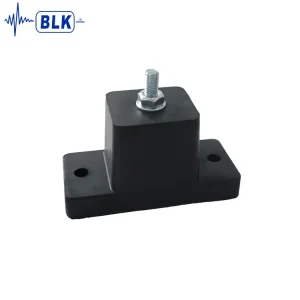
Marine propulsion gensets and auxiliary pumps require extreme shear and compression strength under pitch, roll, and dynamic yaw conditions. Highly resilient rubber mounts (BKVE and BKH types) provide reliable isolation under marine corrosive environments.
Technology Roadmap: Future Outlook in Vibration Attenuation
From passive elastomeric hysteresis to real-time hybrid active levitation—the 10-year engineering evolution.
Nano-Reinforced Viscoelastic Polymers
Integration of graphene and carbon nanotube additives into synthetic elastomeric polymers to elevate energy dissipation efficiency without increasing static creep, unlocking broader thermal operating ranges (-40°C to +120°C).
Electromagnetically Damped Pneumatic Springs
Combining sub-Hertz pneumatic air chambers with fast-response voice coil actuators. Provides passive static support for heavy tonnages while dynamically canceling transient step-response disturbances in real time.
Autonomous Self-Healing Mount Networks
Sensors embedded inside the isolator housing continuously analyze vibration spectrum FFTs. Micro-valves automatically adjust air pressure or fluid viscosity dynamically to compensate for changing machine load patterns.
International Compliance Standards & Localization Support
Sourcing vibration isolation hardware for multi-national projects requires adherence to internationally recognized structural and environmental standards. Premier vibration control manufacturers operate strict quality systems to ensure seamless regulatory approvals across regions.
- ISO 2017-1: Mechanical vibration and shock—Resilient mounting systems—Guidelines for isolation of mechanical systems.
- ASHRAE Equipment Guidelines: Compliance with HVAC equipment vibration isolation and deflection criteria for building mechanical rooms.
- DIN 4150-3: Structural vibration in buildings—Effects on structures and equipment protection standards.
- RoHS & REACH Compliance: Eco-friendly elastomeric production free of hazardous substances or prohibited phthalate plasticizers.
- Seismic & Wind Restraint Certification: Housed spring isolators designed to handle combined lateral and uplift seismic forces according to IBC guidelines.
Bellking maintains direct technical support channels, offering complete OEM design assistance within 24 hours, customized 3D CAD modeling, custom dynamic simulation testing, and expedited worldwide logistics for rapid project delivery.
Frequently Asked Questions (FAQ) for Engineering & Sourcing
Detailed answers to crucial selection, installation, and procurement questions.
How do engineers correctly choose between spring, rubber, and pneumatic isolators?
• Rubber Mounts / Pads: Best for high-frequency machinery (>1200 RPM / >20 Hz) such as small motors, high-speed fans, and electrical cabinets. Natural frequency typically ranges from 8 Hz to 15 Hz.
• Spring Isolators: Essential for lower operating speeds (300 to 1800 RPM) like chillers, cooling towers, low-speed pumps, and gensets. Provides low natural frequencies (3 Hz to 5 Hz) and high deflection capability.
• Pneumatic Air Mounts: Required for delicate metrology, CMMs, and semiconductor lithography requiring sub-Hertz or ultra-low natural frequencies (1.7 Hz to 3 Hz) and automatic leveling capabilities.
What parameters are required to generate a complete custom vibration isolation calculation?
1. Total operating weight of the equipment (including fluid charges or dynamic working loads).
2. Exact position of the Center of Gravity (CG) and weight distribution across support points.
3. Operating excitation speed (RPM) or forcing frequency range (Hz).
4. Number, layout, and mounting hole dimensions of support locations.
5. Environmental factors (indoor, outdoor, chemical exposure, ambient temperature range).
6. Structural constraints (floor loading capacity, seismic or wind restraint code compliance).
Why is Viscous Damping incorporated into spring mounts for heavy machinery?
What surface treatment ensures long service life in harsh chemical or coastal environments?
When should concrete-filled steel Inertia Bases be paired with spring isolators?
• The equipment is top-heavy or has high dynamic rotational torque (e.g., end-suction water pumps).
• The supporting floor structure lacks sufficient rigidity, requiring additional mass to reduce dynamic deflection.
• Piping connections must be stabilized against dynamic pressure surges and Start/Stop displacement.
Mass added by the inertia base lowers the combined center of gravity and increases the system mass, stabilizing the operating assembly.
What lead times and certification documents are provided with OEM shipments?
Specialized Industrial Vibration Isolation Series
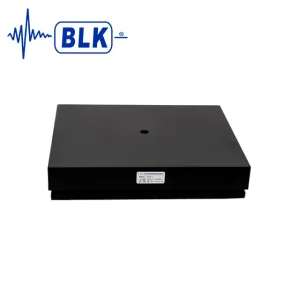
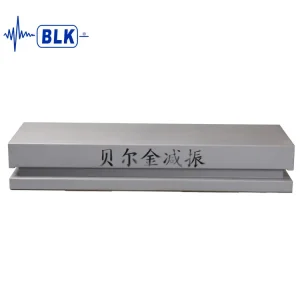
Explore our full line of damped rubber mounts, matrix systems, precision air mounts, and multi-layer shock absorbers.