
Featured Precision Isolation Components (1–8)
Factory-direct industrial elastomeric isolators, spring mounts, and precision damping platforms designed for heavy mechanical loading and micro-vibration mitigation.



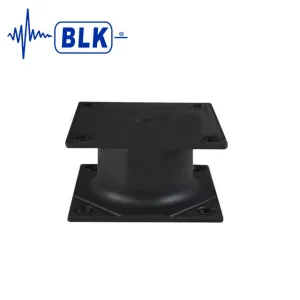
Macro Industry Landscape: Controlling Mechanical Energy Loss
How advanced machine vibration isolation pads mitigate structural dynamic fatigue, acoustic radiation, and precision drift in modern smart manufacturing.
In high-yield industrial environments, dynamic structural vibration is a primary contributor to unscheduled equipment downtime, micro-cracking in floor slabs, dimensional machining errors, and elevated operational noise. Unchecked kinetic force generated by heavy stamping presses, reciprocating air compressors, high-tonnage HVAC chillers, and CNC machining centers propagates directly into the building substrate as structure-borne shockwaves. Utilizing high-performance machine vibration isolation pads engineered from advanced elastomeric blends and composite matrix polymers is no longer merely an option—it is a mandatory asset-protection protocol.
As global manufacturing accelerates toward Industry 4.0 automation and nanometer-scale precision tolerances, traditional unengineered neoprene sheets or basic cork layers fail to satisfy strict compliance thresholds (such as ISO 10816 vibration severity standards or ambient acoustic thresholds NC-30/35). Modern high-capacity facilities require custom-engineered damping pads capable of delivering high static load capacity, predictable dynamic stiffness, controlled hysteresis loss, and extraordinary resistance to aggressive industrial fluids.
Global Procurement Trends Across Key OEM Sectors
Procurement directors and plant engineering managers across North America, Europe, and Asia-Pacific are increasingly adopting holistic total-cost-of-ownership (TCO) evaluation frameworks. Investing in verified high-damping elastomeric pads and matrix mounts yields measurable financial returns through:
Bearing & Spindle Protection
Isolating machines prevents external harmonic vibration from causing false brinelling on resting bearings and extends CNC spindle replacement intervals by up to 300%.
Substrate Integrity Safeguards
Attenuating impulse forces during stamping or forging cycles prevents localized floor slab fatigue, cracking, and expensive structural foundation retrofits.
OSHA & Environmental Compliance
Converting structural dynamic waves into thermal energy significantly reduces ambient airborne noise, helping plants pass strict noise pollution audits.
Technical Deep-Dive: Mechanical Physics & Damping Formulation
Understanding transmissibility ratios, natural frequency tuning, and rheological performance under dynamic shear and compressive stresses.
To correctly select a machine vibration isolation pad, mechanical design engineers must evaluate the system's disturbing frequency ($f_d$), expressed in Hertz (Hz) or RPM, against the natural frequency ($f_n$) of the isolator under load. The ratio of these frequencies ($f_d / f_n$) dictates whether the pad provides isolation, neutral performance, or unwanted resonance amplification.
f_n = (1 / (2 * π)) * √( K_d / m )
Where K_d = Dynamic Stiffness (N/m), m = Supported Mass (kg)
2. Transmissibility Ratio (T):
T = √ [ ( 1 + (2 * ζ * (f_d / f_n))^2 ) / ( (1 - (f_d / f_n)^2)^2 + (2 * ζ * (f_d / f_n))^2 ) ]
Where ζ = Damping Ratio of the Elastomeric Compound, f_d = Disturbing Frequency (Hz)
Isolation theoretically begins when $f_d / f_n > \sqrt{2} \approx 1.414$. However, for true high-efficiency performance exceeding 90% vibration reduction, engineering best practice requires establishing a frequency ratio $f_d / f_n \ge 3.0$. At this ratio, the transmitted dynamic force to the floor slab is reduced to a fraction of the input impulse.
Comparative Material Performance Matrix
Different industrial operating environments demand tailored elastomeric chemistries and physical architecture. The table below illustrates core parameters across our specialized pad and mount formulations:
| Material / Type | Durometer Shore A | Natural Frequency Range | Max Load Capacity | Oil & Chemical Resistance | Primary Industrial Applications |
|---|---|---|---|---|---|
| Nitrile Composite Pads (BKP) | 50 – 70 Shore A | 8.0 Hz – 12.0 Hz | Up to 1.5 MPa | Excellent (Petroleum, Coolants) | General Machine Tools, Lathes, Gearboxes |
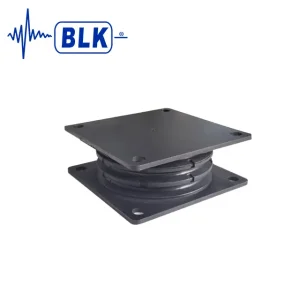
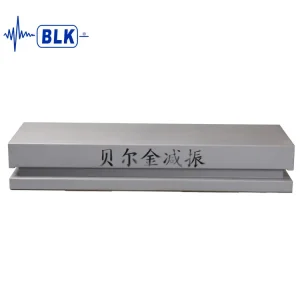
| Multi-Layer Polymer Dampers (BKSWA) | 45 – 65 Shore A | 5.0 Hz – 8.5 Hz | Up to 2.5 MPa | High (Hydraulic Oils, Solvents) | Punch Presses, Stamping Machinery, Injection Molding |
| High-Damping Polymer Pads (BK-PM) | 35 – 55 Shore A | 4.0 Hz – 7.0 Hz | Up to 0.8 MPa | Moderate (Ozone, Mild Acids) | Precision Metrology, CMM, HVAC Fan Units |
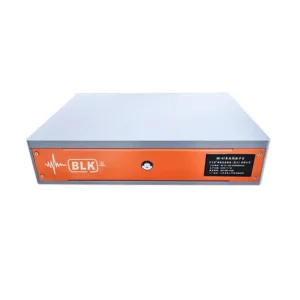
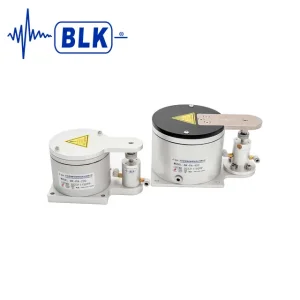
| Precision Air Mounts (BK-PA) | Pneumatic Air Chamber | 1.7 Hz – 3.0 Hz | Variable Pneumatic Control | High Outer Membrane Seal | Semiconductor Lithography, Electron Microscopes |
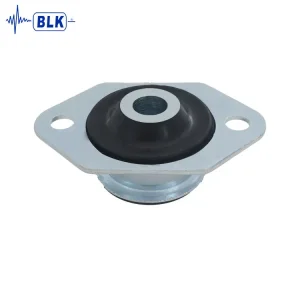
| Steel Spring Hybrid Mounts (MD / MB) | Helical Alloy Steel | 3.0 Hz – 5.0 Hz | Up to 5.0 Tons per Point | Dacromet Coating (900h Salt Spray) | HVAC Chillers, Cooling Towers, Transformers |
Sector-Specific Isolation Solutions
Tailored engineering strategies for complex industrial machinery and sensitive acoustic zones.
1. Semiconductor & Optical Metrology Facilities
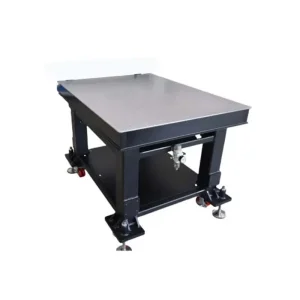
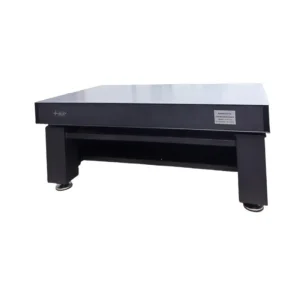
In sub-micron semiconductor fabrication cleanrooms and optical measurement labs, ambient floor vibrations caused by foot traffic or building HVAC can ruin inspection yields. Our pneumatic isolators (BK-PA) and low-frequency optical platforms (BK-DT) achieve ultra-low natural frequencies down to 1.7 Hz, ensuring isolation across VC-A through VC-E vibration criterion curves.
2. Heavy Stamping, Forging & Metal Forming
Impact pulse shocks from high-speed mechanical presses generate sharp transient forces exceeding 3G to 5G. Multi-layer composite pads (BKSWA) and heavy-duty spring mounts with integrated viscous dampers absorb high strain kinetic energy, preventing shockwave transmission into adjacent CNC equipment and structural columns.
3. Commercial HVAC, Chillers & Roof Towers
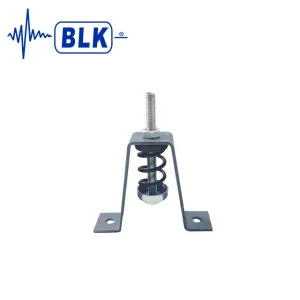
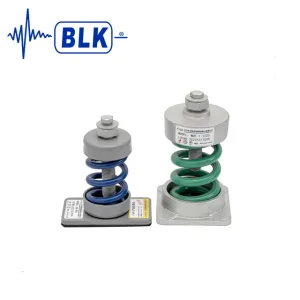
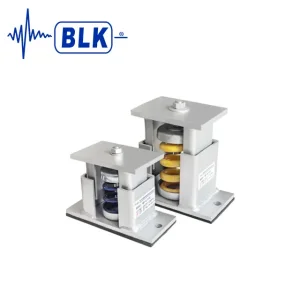
Continuous rotating equipment such as centrifugal chillers, cooling towers, and large air-handling units emit low-frequency structural hums. Utilizing specialized HV spring hangers and damped spring mounts eliminates low-frequency vibration transmission through suspended pipe networks and roof concrete slabs, maintaining strict acoustic comfort standards.
4. High-Voltage Transformers & Power Generation
Magnetostriction inside power transformers causes continuous 100 Hz / 120 Hz core hum that propagates through substation foundations. Matrix rubber isolators (BK-MT) and anti-vibration transformer mounts isolate electrical harmonics, preventing acoustic resonance in nearby commercial and residential structures.
Technology Roadmap: Next-Generation Damping Engineering
Where material science meets IoT predictive intelligence to redefine factory vibration management.
The future of industrial vibration isolation is transitioning from purely passive mechanical damping to intelligent cyber-physical monitoring systems. As manufacturing facilities adopt digital twin architectures, real-time isolation performance data is becoming essential for predictive maintenance.
Smart Sensor-Embedded Pads
Integrating thin-film piezoelectric sensors directly into polymer damping matrices allows continuous logging of dynamic load variations, tracking machine wear and misalignment before failures occur.
Sustainable Eco-Thermoplastics
Developing bio-based Thermoplastic Vulcanizates (TPVs) and fully recyclable elastomeric matrices reduces carbon footprint during production while retaining high chemical resistance and tear strength.
Active-Passive Hybrid Architectures
Combining high-capacity elastomeric pads with electromagnetic active actuators provides instant real-time counter-phase forces, dampening broad-frequency vibrations in sub-nanometer lithography.
Global Procurement, Quality Assurance & Compliance Standards
Rigorous laboratory testing, ISO certifications, and streamlined custom engineering workflows for international B2B buyers.
To maintain consistent quality across large international factory orders, Bellking adheres to strict quality management systems certified under ISO 9001:2015. Every batch of elastomeric raw material undergoes comprehensive physical and rheological testing in our Kunshan manufacturing center prior to vulcanization.
Material Testing Protocols
- ASTM D395: Compression Set testing under elevated temperatures to ensure pad thickness retention over 10+ years.
- ASTM D2240: Durometer Hardness verification for precise dynamic stiffness matching.
- ASTM D412: Tensile strength and ultimate elongation testing for heavy impact shock survival.
- ASTM D1171: Ozone resistance testing for harsh outdoor HVAC and chemical exposure.
Environmental & International Compliance
- EU RoHS 3 & REACH: Completely free of hazardous heavy metals, SVHCs, or banned plasticizers.
- Dacromet Coating: Metal spring housing passes 900-hour salt spray corrosion resistance tests.
- CE Certification: Fully certified for structural integration into European machinery and building infrastructure.
- Traceability: Full batch lot tracking and 3.1 material test certificates delivered with every order.
Rapid Customization Workflow for OEMs
When standard off-the-shelf isolators cannot accommodate non-standard machine footprints or eccentric centers of gravity, our engineering team delivers tailored OEM solutions through an accelerated 5-step process:
Heavy Industrial & Damped Isolation Systems (9–16)
High-capacity spring mounts, matrix mounts, polymer pads, and pneumatic isolators for high-tonnage industrial applications.

Frequently Asked Technical Questions (FAQ)
Direct engineering answers to procurement and facility management questions regarding machine vibration isolation pad selection and maintenance.
1. How do I determine whether my machine requires elastomeric pads, steel spring isolators, or pneumatic air mounts?
- Elastomeric Rubber Pads (BKP / BKSWA): Best suited for medium to high-speed machinery (operating above 1,200 RPM / 20 Hz) such as small punch presses, electric motors, and centrifugal pumps where low static deflection (2mm to 8mm) is sufficient.
- Steel Spring Mounts (MD / MB): Required for low-speed rotating machinery (300 RPM to 1,200 RPM) like heavy HVAC chillers, cooling towers, and diesel generator sets that require large static deflections (25mm to 50mm) to achieve natural frequencies down to 3–5 Hz.
- Pneumatic Air Mounts (BK-PA): Essential for ultra-sensitive micro-vibration equipment operating in cleanrooms or metrology labs (CMMs, lithography systems, electron microscopes) requiring low natural frequencies down to 1.7 Hz.
2. What is the difference between static stiffness ($K_s$) and dynamic stiffness ($K_d$) in rubber isolation pads?
3. How does chemical and oil exposure affect machine vibration isolation pad life?
4. What information is required to receive a custom pad layout and quote within 24 hours?
- Total operating weight of the equipment (including fluids and maximum work-piece loads).
- Number and physical location of support feet / mounting points.
- Center of gravity (COG) location if weight distribution is asymmetrical.
- Equipment operating speed (RPM) or stroke frequency (Hz).
- Environmental conditions (indoor/outdoor, ambient temperature, chemical contact).
5. Can machine vibration isolation pads be installed without anchoring bolts into the concrete slab?
6. What lead times, warranties, and documentation are provided for international orders?
Engineered Vibration Control for Your Machinery
Partner directly with Bellking Vibration Reduction Equipment Manufacturing Co., Ltd. for factory-direct engineering support, custom elastomer compounding, and fast 24-hour sizing calculations.
Request Technical Proposal & Engineering Quote