
High-Performance Motor Vibration Isolation Systems
Engineered to suppress mechanical resonance, isolate disturbing motor frequencies, and protect mission-critical equipment. Direct factory supply from Kunshan, China.

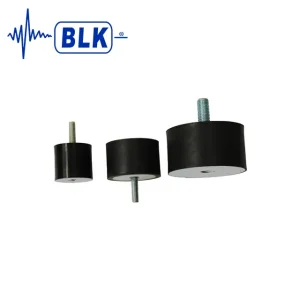



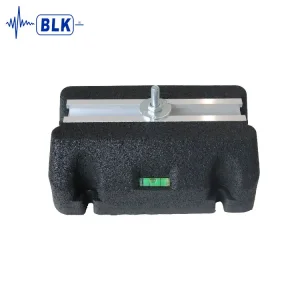

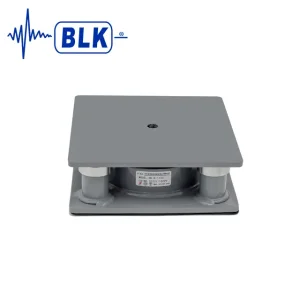
Motor Vibration Isolation Dynamics & Mathematical Foundations
A rigorous perspective on elastomeric compliance, resonance decoupling, and structural harmonic isolation for high-performance rotating machinery.
Disturbing vs Natural Frequency ($f_d / f_n$)
Kinematic isolation functions solely when the system excitation frequency ($f_d$), generated by the motor's operational RPM ($f_d = \text{RPM} / 60$), surpasses the mounting system’s natural frequency ($f_n$) by a factor greater than $\sqrt{2} \approx 1.414$.
When $f_d / f_n < \sqrt{2}$, the vibration isolator acts as an amplifier, exacerbating displacement and mechanical stress. Our custom-engineered mounts maintain a calibrated ratio of $f_d / f_n \ge 3.0$, securing >90% to 99% theoretical transmissibility attenuation.
Static Deflection & Spring Constant Calculation
The natural frequency of an elastomeric or helical spring isolator is governed by the static deflection ($\delta_{st}$) induced by the supported motor weight: $f_n = \frac{1}{2\pi}\sqrt{\frac{g}{\delta_{st}}} \approx \frac{5}{\sqrt{\delta_{st} \text{ (cm)}}}$.
To achieve low natural frequencies (e.g., 3.0 to 5.0 Hz) without compromising lateral stability, helical steel springs must feature an outside diameter-to-loaded-height ratio of at least 0.8, complemented by neoprene acoustic cups to arrest high-frequency sound transmission.
Viscous Damping & Phase Transmissibility
Uncontrolled resonance during motor startup and coast-down phases presents catastrophic shear risks. Integrating measured internal hysteresis damping ($\zeta \approx 0.05 - 0.15$) controls transient dynamic magnification at the critical resonance peak ($Q = 1 / 2\zeta$).
Bellking’s advanced polymer compounds and viscous dashpot dampers absorb surge kinetics while preserving isolation efficiency during continuous steady-state operation.
Engineering Evaluation Matrices for Tier-1 OEM Buyers
Global procurement teams across North America, Europe, and Asia-Pacific demand strict adherence to international vibration, acoustic, and environmental longevity standards.
| Evaluation Parameter | Commercial Grade Standard | Bellking Industrial Specification | Engineering Benefit & Compliance |
|---|---|---|---|
| Natural Frequency Range ($f_n$) | 8.0 Hz – 15.0 Hz (Limited low-speed isolation) | 1.7 Hz (Pneumatic) / 3.0 – 5.0 Hz (Spring) | Isolates slow-speed variable frequency drive (VFD) motors down to 300 RPM. |
| Isolation Efficiency ($\eta$) | 70% – 85% at nominal rated speed | 95% – 99.2% verified attenuation | Meets ASHRAE Chapter 48 guidelines and ultra-silent LEED building benchmarks. |
| Corrosion Resistance | Standard zinc electroplate (96–120 hrs salt spray) | Dacromet coating passing 900+ hrs ASTM B117 | Long-term survivability in coastal, marine, and chemical offshore atmospheres. |
| Shock Acceleration Tolerance | 1.0G – 1.5G before structural fracture | 3.0G – 5.0G transient impact resistance | Complies with seismic restraint standards (IBC / OSHPD criteria). |
| Service Life Expectancy | 3 – 5 years (Polymer hardening / spring fatigue) | 15+ years (Springs/Bases) | 6+ years (Air Mounts) | Reduces total lifecycle maintenance and unexpected plant shutdown expenses. |
Supply Chain Auditing & Quality Verification
Procuring motor vibration isolators requires verifiable manufacturing pedigree. Every Bellking batch provides full raw material heat traceability, dynamic stiffness documentation, and tension-compression modulus test curves certified to ISO 9001 standards.
Custom OEM/ODM Engineering Turnaround
Off-the-shelf catalog mounts often fail when equipment centers of gravity are eccentric. We engineer 1:1 customized isolator dimensions, custom bracket geometries, and application-specific spring constants with complete engineering submittals in under 24 hours.
Total Cost of Ownership (TCO) Optimization
By preventing motor-bearing spalling, shaft misalignment, seal failure, and structural fatigue, deploying premium isolators yields payback within 6–12 months of plant operation, avoiding costly secondary machine downtime.
China Factory 4.0: Supply Chain Resilience & Technical Precision
Operating from Kunshan, Jiangsu—the epicentre of precision mechanical manufacturing—Bellking integrates automated robotics, advanced metallurgical processes, and digitalized quality assurance.
Robotic Welding & CNC Machining
Eliminates structural weld seam vulnerabilities under intense cyclic excitation. Multi-axis CNC milling machines guarantee dimensional uniformity across all mounting flanges.
Elastomeric Compounding & Sintering
In-house formulations using premium neoprene, nitrile, and EPDM polymers optimize dynamic-to-static stiffness ratios while resisting ozone, oil, and continuous thermal degradation.
Automated Salt Spray Testing
Every structural isolator chassis undergoes rigorous anti-corrosion sintering with Dacromet barrier coatings, validated by 900-hour continuous salt spray chamber exposure.
Agile Scale & Rapid Logistics
With an annual capacity exceeding 100,000 units, standard spring mounts and rubber pads ship in 24 hours. Custom engineered solutions deploy in 3 to 5 business days worldwide.
Mission-Critical Application Scenarios & Engineering Implementations
Tailored kinematic mount selections to solve specific structure-borne vibration challenges across global industries.
Hyperscale Data Center Chillers & Pumps
Challenge: Continuous low-frequency excitation from 3,000 kVA chiller compressors and primary condenser pumps transmits structure-borne rumble through concrete slabs, disrupting precision server racks.
Solution: Concrete-filled CPB Inertia Bases combined with ME Series Open Spring Isolators delivering 25mm to 50mm static deflection. Isolates excitation down to 3.2 Hz with 97% transmissibility attenuation.
Semiconductor Cleanroom Metrology & Lithography
Challenge: Micro-vibrations exceeding VC-E criteria (<3.2 µm/s) corrupt electron microscope (SEM) resolutions and atomic layer deposition (ALD) processes.
Solution: Active-ready BK-DT and BK-R Pneumatic Air Mounts with automated auto-leveling valves. Delivers an ultra-low natural frequency of 1.7 Hz, eliminating floor ambient kinetic transfers.
Substation Power Transformers & Gensets
Challenge: Core magnetostriction generates a constant 100 Hz / 120 Hz hum, migrating through building foundations into neighboring commercial or residential areas.
Solution: High-load Bellking Transformer Anti-Vibration Mounts combined with multilayer BKDJ polymer damping pads, attenuating structure-borne sound by up to 28 dB(A).
Precision Anti-Vibration Mount Series & Damping Hardware
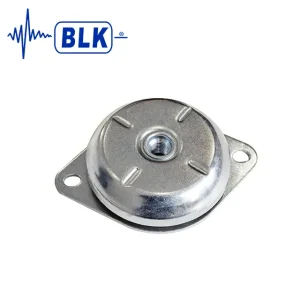
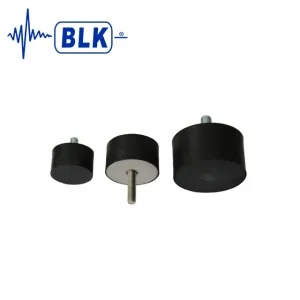
Explore specialized floor mounts, high-capacity elastomeric cushions, and heavy spring shock absorbers manufactured to exact international standards.
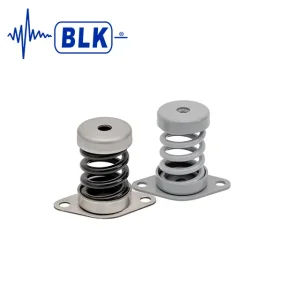





Frequently Asked Questions on Motor Vibration Isolation
Comprehensive engineering clarifications regarding mount sizing, dynamic deflection, environmental resilience, and project customization.
How do I choose between elastomeric rubber mounts, steel springs, and pneumatic air isolators?
- Rubber Mounts (8 Hz – 15 Hz $f_n$): Best for high-speed machinery (>1,800 RPM), small electric motors, fans, and compressors where structural compactness and direct cost-efficiency are paramount.
- Steel Spring Mounts (3 Hz – 5 Hz $f_n$): Ideal for heavy industrial equipment operating at 600–1,800 RPM, such as large HVAC chillers, cooling towers, low-speed diesel gensets, and water pumps.
- Pneumatic Air Mounts (1.5 Hz – 2.5 Hz $f_n$): Essential for ultra-low frequency micro-vibrations, metrology stages, cleanrooms, and semiconductor optical instruments.
What exact engineering data is required to generate a 24-hour custom isolation submittal?
- Total operating weight of the equipment, including fluids, attachments, and inertia base.
- 3D center of gravity (CoG) coordinate position to equalize load across non-symmetrical mounting points.
- Motor operating speed range (RPM) or variable frequency drive (VFD) cycle limits.
- Support point count, structural slab type (grade vs elevated flexible slab), and anchor hole geometry.
- Operating environment conditions (ambient temperature, oil/chemical mist exposure, outdoor salt spray requirements).