
Industrial Rubber Mounts & Anti-Vibration Isolators
Explore our core engineering catalog of anti-vibration mounts, spring dampers, polymer pads, and pneumatic isolators designed for high-load durability and structural noise suppression.

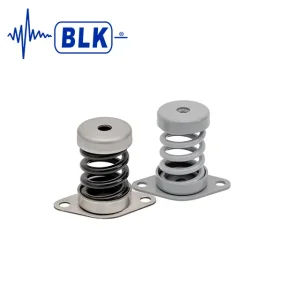


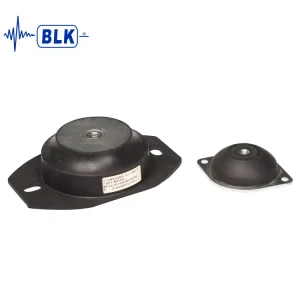
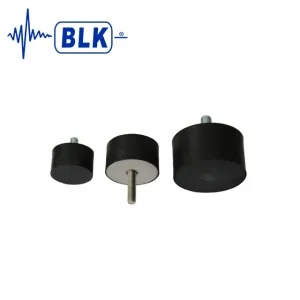
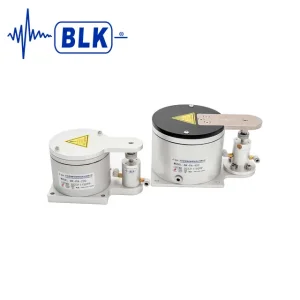
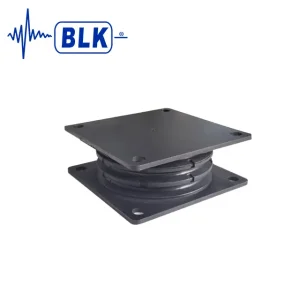
Fundamental Physics of Elastomeric Vibration Isolation Pads
In modern industrial engineering, mechanical vibration and structure-borne acoustic noise represent major drivers of operational inefficiency, early mechanical fatigue, and regulatory non-compliance. Rubber vibration isolator pads serve as specialized viscoelastic barriers inserted between rotating or impacting machinery and supporting foundations.
Unlike pure metallic springs which store potential energy with minimal internal dissipation, high-performance elastomeric pads exhibit dual characteristics: dynamic stiffness ($K_d$) for load carrying and high loss factor ($\eta = \tan \delta$) for internal kinetic energy conversion into harmless thermal dissipation.
To achieve positive isolation efficiency ($E = 1 - T$), the disturbing frequency of the machine ($f_d$) must exceed the natural frequency of the elastomer mount system ($f_n$) by a factor greater than $\sqrt{2}$ (approximately 1.414):
T = | 1 / (1 - (f_d / f_n)^2) |
Optimal structural isolation occurs when $f_d / f_n \ge 3.0$, yielding vibration attenuation performance exceeding 88% to 99% depending on compounding loss factors.
High Viscoelastic Damping
Suppresses sudden transient impacts and resonant peak amplification during motor start-up and shut-down sequences without requiring secondary hydraulic dampers.
Multi-Axis Isolation
Handles vertical compressive loads alongside lateral shear forces, providing 3D spatial stability under dynamic torque shifts and wind loads.
Acoustic Structure Decoupling
Interrupts solid-borne high-frequency noise waves (100 Hz – 5,000 Hz) that easily travel through steel beams and concrete structural slabs.
Elastomer Selection & Compounding Architecture
Selecting the optimal polymer compound determines the long-term static deflection, oil resistance, thermal aging, and compression set under continuous mechanical loads.
| Elastomer Type | Hardness (Shore A) | Operating Temp (°C) | Key Strengths | Primary Application |
|---|---|---|---|---|
| Natural Rubber (NR) | 40 - 75 Shore A | -40°C to +80°C | Maximum dynamic fatigue life, superior elasticity, low compression set. | HVAC chillers, centrifugal pumps, heavy press isolation. |
| Neoprene (Chloroprene / CR) | 45 - 80 Shore A | -35°C to +100°C | Excellent oil, ozone, weathering resistance, flame retardant capabilities. | Marine gensets, outdoor rooftop air handlers, transformers. |
| Nitrile (NBR) | 50 - 85 Shore A | -30°C to +110°C | Outstanding resistance to petroleum fuels, hydraulic oils, grease. | Industrial machine tools, hydraulic pump skid isolation. |
| EPDM Elastomer | 50 - 80 Shore A | -45°C to +130°C | Exceptional UV, steam, heat, chemical, and outdoor weathering endurance. | Cooling towers, chemical processing equipment, power substations. |
| Fluoroelastomer (FKM/Viton) | 60 - 90 Shore A | -20°C to +200°C | Extreme chemical inertness, high temperature survival, fuel resistance. | Aerospace testing, high-temp engine mounts, cleanrooms. |
China Factory Supply Chain Advantages & Precision Manufacturing
Operating directly from China’s premier industrial manufacturing clusters (Kunshan, Jiangsu), our facility bridges state-of-the-art polymer chemistry with hyper-efficient manufacturing workflows. This integrated ecosystem gives international clients clear strategic advantages:
Vertical Supply Chain Integration
From raw rubber compounding and vulcanization molding to CNC metal insert machining and anti-corrosion Dacromet plating—all operations take place under one roof, reducing lead times from weeks to days.
Custom Tooling & Rapid Tool Production
Our in-house mold tooling shop creates precision steel injection and compression molds in as fast as 3 to 5 business days, accelerating custom OEM project execution.
900+ Hour Corrosion Resistance
Metal-to-rubber bonded mounts utilize specialized Dacromet and hot-dip zinc surface treatments, verified through 900-hour continuous salt spray testing according to ASTM B117 standards.
Dynamic Testing Rig Validation
Every product batch undergoes rigorous spring rate verification, static-to-dynamic stiffness ratio ($K_d/K_s$) evaluation, and Mooney viscosity compliance testing before export dispatch.
Global Procurement Requirements & Customization Capabilities
Procurement officers and engineering teams at Fortune 500 enterprises demand more than low price tags—they require absolute supply chain resilience, repeatable manufacturing tolerances, and full regulatory compliance.
Compliance & Certifications
All elastomer compounds fully comply with REACH (EC 1907/2006), RoHS 3 (EU 2015/863), and ISO 9001:2015 quality management systems, preventing environmental audit failures.
1:1 Finite Element Analysis (FEA)
Our engineering team provides comprehensive FEA stress distribution modeling and load deflection curves prior to full production, guaranteeing installed isolation accuracy.
Flexible MOQ & Global Logistics
From single-unit prototype validation to multi-container mass production runs, we offer flexible ordering terms, DAP/DDP incoterms, and urgent air-freight fulfillment options.
Next-Generation Technologies in Structural Damping
The dynamic isolation sector is rapidly shifting toward sustainable materials, intelligent monitoring, and high-density polymer matrices:
1. Sustainable & Bio-Based Polymers
Development of bio-based elastomer compounding that incorporates recycled rubber micro-granules alongside renewable plant-derived oils, reducing carbon footprint while maintaining dynamic modulus stability.
2. IoT-Integrated Smart Damping Pads
Embedding piezo-electric wireless vibration sensors inside rubber pad matrices. Real-time telemetry tracks structural health, load imbalance, and structural fatigue, enabling predictive maintenance.
3. High-Damping Hybrid Composites
Multi-layer sandwich pads uniting cork, cross-linked rubber, and metallic plates to achieve ultra-low natural frequencies ($f_n < 5 \text{ Hz}$) without sacrificing structural stability.
4. Extreme Climate Performance Formulations
Modified synthetic elastomers designed to endure extreme thermal swings (-50°C to +150°C) for desert solar plants, Arctic wind power installations, and deep marine engine rooms.
Localized Application Scenarios
Rubber vibration isolator pads and spring-rubber hybrid mounts are essential across diverse industrial environments:
HVAC Chillers & Cooling Towers
Positioned beneath heavy water chillers, rooftop cooling towers, and air-handling units (AHUs) to suppress low-frequency structure-borne hum into commercial building offices.
Precision CNC Machine Tools
Protects high-precision CNC mills, lathes, and grinding equipment from external shop-floor vibrations, maintaining sub-micron machining tolerances and superior surface finishes.
Power Transformers & Substations
Dampens magnetostrictive 100 Hz / 120 Hz core vibrations in electrical power transformers, preventing acoustic noise pollution in suburban and municipal residential districts.
Heavy Stamping Presses & Forging
Absorbs high-energy transient shock loads generated by industrial stamping equipment, protecting building foundations from structural cracking and floor movement.
Semiconductor Cleanroom Optical Benches
Utilizes low-frequency pneumatic air mounts and precision rubber pads to isolate optical inspection stations and wafer steppers from floor micro-vibrations.
Marine Auxiliary Engines & Propulsion
Specialized salt-spray resistant, shear-rated Neoprene mounts supporting diesel generators and marine pumps against continuous wave motion and hull flex.
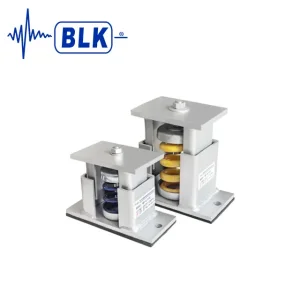
Advanced Damping Mounts & Isolation Platforms
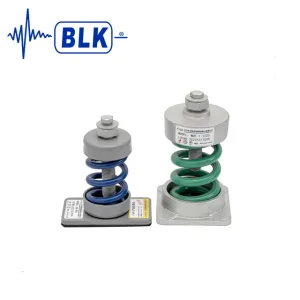
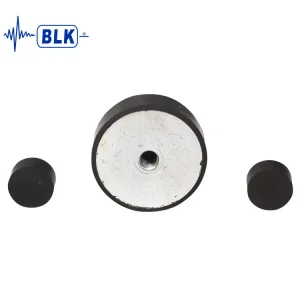
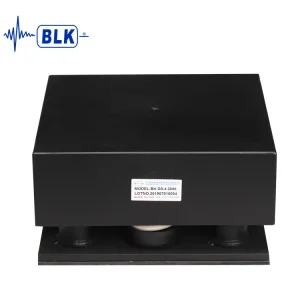
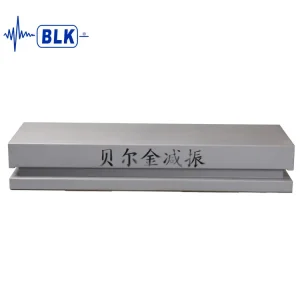
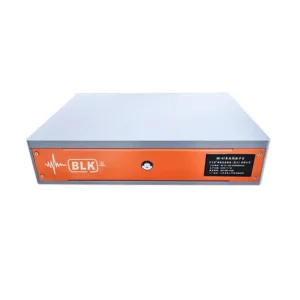
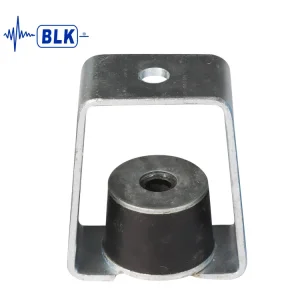
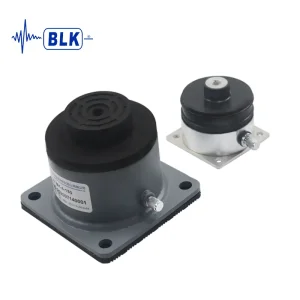
Discover our custom multi-layer dampers, desktop optical isolation platforms, damped spring assemblies, and matrix shock absorbers.
Engineering & Procurement FAQ
Find authoritative answers regarding rubber isolator calculation, durometer selection, temperature limits, and global export compliance.