
Precision Engineering Product Catalog (Part I)
Direct-from-factory vibration isolation mounts and custom rubber buffers engineered for industrial power transformers and heavy machinery.
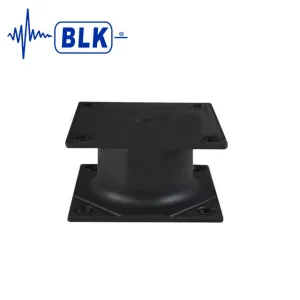
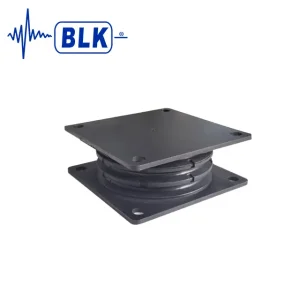
High-Quality BK-MT Type Matrix Anti-vibration Mount Manufacturers, Manufacturer

Executive Engineering Report: Advanced Transformer Isolation Technology
An in-depth guide on controlling core-born excitation, structural humming, and environmental acoustic noise through high-performance elastomer pad systems.
1. The Physics of Transformer Noise & Magnetostriction Dynamics
Electrical power transformers are critical assets in municipal grids, data centers, and heavy manufacturing installations. However, operational transformers generate continuous low-frequency hums that present significant environmental and structural hazards. This noise originates primarily within the laminated silicon steel core through a physical phenomenon known as magnetostriction.
When the magnetic field alternates at 50 Hz or 60 Hz line frequencies, the iron core laminations physically expand and contract twice per cycle. This creates a fundamental vibration frequency of 100 Hz or 120 Hz, alongside higher-order harmonic overtones (200 Hz, 300 Hz, 400 Hz, etc.). Furthermore, cooling fans, oil pumps, and electromagnetic forces within winding coils add dynamic energy to the transformer casing.
To break this solid-borne transmission path, high-performance transformer isolation pads must be placed beneath the equipment base. By inserting a elastic element with calculated dynamic stiffness ($K_d$), the mechanical energy is dissipated through elastomeric internal friction (hysteresis loss) rather than transmitted into the floor structure.
2. Mathematical Principles of Isolation pad Design
Designing an efficient transformer isolation pad requires balancing static load-bearing capacity against dynamic deflection. The core system natural frequency ($f_n$) determines the vibration transmissibility ($T_r$) into the ground structure:
$$f_n = \frac{1}{2\pi} \sqrt{\frac{g}{\delta}}$$
Where $g$ represents gravitational acceleration and $\delta$ represents the static deflection of the elastomer under the weight of the transformer. To achieve effective isolation (where $T_r < 1$), the disturbing frequency ($f_d$, typically 100 Hz or 120 Hz) must exceed $\sqrt{2} \times f_n$. The mathematical transmissibility equation is given by:
$$T_r = \left| \frac{1}{1 - (f_d / f_n)^2} \right|$$
When $f_d / f_n \ge 3$, isolation efficiency exceeds 88%. Advanced matrix compound pads manufactured by Bellking achieve natural frequencies low enough to yield isolation efficiencies between 92% and 99% across critical transformer harmonics, significantly reducing radiated dBA levels in surrounding spaces.
3. Comparative Matrix: Isolation Material Formulations
Selecting the correct material compound is essential to ensure long-term creep resistance, chemical stability, and dampening consistency under varying environmental loads. The table below details key performance metrics across industrial pad formulations:
| Elastomer Compound | Shore A Hardness | Damping Ratio ($\eta$) | Operating Temp. Range | Oil & Solvent Resistance | Primary Application Environment |
|---|---|---|---|---|---|
| High-Grade Neoprene (CR) | 45 – 70 | 0.08 – 0.12 | -30°C to +100°C | High | Oil-immersed outdoor transformers & substations |
| Engineered Nitrile (NBR) | 50 – 75 | 0.06 – 0.10 | -20°C to +120°C | Excellent | Direct oil-contact zones & industrial power units |
| Micro-Cellular Polyurethane | 30 – 60 | 0.15 – 0.25 | -40°C to +90°C | Moderate | Dry-type indoor transformers & commercial PDUs |
| Composite Steel-Rubber Matrix | 60 – 80 | 0.10 – 0.18 | -35°C to +110°C | High | Heavy power plant step-up units (>50 MVA) |
Global Market Trends & Procurement Intent Insights
Analyzing key structural shifts in renewable grid expansion, data center urbanization, and stringent acoustic noise compliance standards.
Hyperscale Data Center Proliferation
Modern AI processing centers require high-density power transformer substations placed directly adjacent to server halls or on upper levels. Ultra-low frequency isolation pads are essential to prevent structural vibrations from interfering with optical interconnects and storage drives.
Renewable Energy Microgrids
Solar farm step-up stations and wind turbine nacelle power distribution units demand outdoor-rated isolators capable of enduring dynamic wind loads, severe temperature cycling, and UV exposure while maintaining dynamic stiffness over decades.
Urban Substation Noise Regulations
Municipalities globally enforce strict night-time noise limits (often below 40 dBA at property lines). Utility operators must retrofit existing substations with multi-layer matrix isolation pads to avoid regulatory fines and shutdown orders.
Comprehensive Macro Industry Solutions
Tailored anti-vibration integration packages engineered for specific installation topographies and power equipment classifications.
Dry-Type Cast Resin Transformers
Dry-type units are predominantly deployed inside commercial buildings, hospitals, and cleanrooms. Bellking supplies custom BKSWA and BKVD rubber mounts with integrated top-level leveling plates. These units prevent structural resonance with floor slabs while resisting flame propagation in compliance with UL 94-V0 flammability standards.
- Target Deflection: 5 mm to 15 mm
- Damping Enhancement: Viscous core inserts optional
- Installation: Direct under-rail or footprint bolt-down
Oil-Immersed Distribution & Power Transformers
Oil-filled units present harsh environmental challenges including potential oil leakages, high thermal radiation, and severe weather exposure. Bellking’s BK-MT Matrix and BKH Rubber Isolators utilize specialized Nitrile-Neoprene compounds with Dacromet-coated metal hardware that withstands 900+ hours of salt spray testing.
- Chemical Resistance: ASTM No. 3 Oil, Diesel, Ozone
- Seismic Rating: Zone 4 dynamic shear stability
- Load Range: Up to 500 kN per point mount
Substation Retrofit & Acoustic Enclosures
When surrounding urban developments encroach on existing substations, installing acoustic enclosures alone can create sound bridges. Bellking provides dual-isolation solutions: combining foundation pad arrays beneath transformer rails with flexible acoustic wall isolation hangers to eliminate structural coupling.
- Noise Reduction: Up to 18 dBA structure-borne drop
- Customization: 1:1 footprint drop-in replacement
- Lead Time: Fast-track manufacturing within 3 days
Quality Control, Testing Protocols & Compliance Standards
Bellking’s Kunshan manufacturing facility operates under strict ISO 9001:2015 quality control systems. Every batch of transformer isolation pads undergoes comprehensive dynamic and static mechanical testing before shipment:
- Static Deflection & Load Rate Testing: Validating force-deflection curves using automated hydraulic compression frames to ensure uniform load distribution across all support feet.
- Dynamic Stiffness & Hysteresis Measurement: Testing pads under sinusoidal dynamic excitation (10 Hz to 200 Hz) to verify dynamic-to-static ratio ($K_d/K_s \le 1.4$).
- Accelerated Thermal Aging & Creep Analysis: Subjecting elastomeric samples to extended heat aging (70°C for 168 hours) according to ASTM D573 to guarantee less than 5% long-term permanent set over a 15-year service life.
- Corrosion Protection Verification: Metal load-distribution plates undergo Dacromet surface treatment, passing 900-hour salt spray corrosion testing in compliance with ASTM B117.
Precision Engineering Product Catalog (Part II)
Explore our complete line of anti-vibration spring mounts, pneumatic platforms, and specialized damping systems.
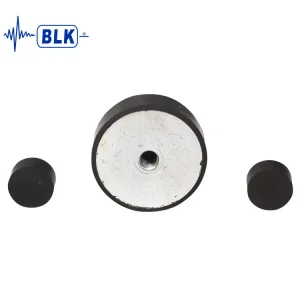
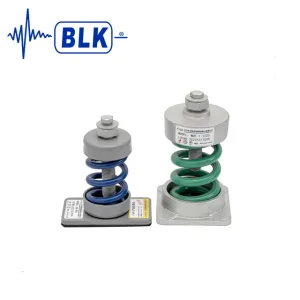
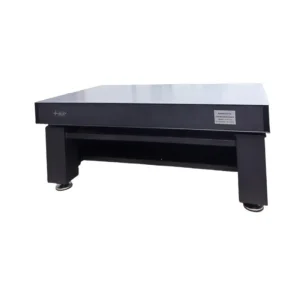
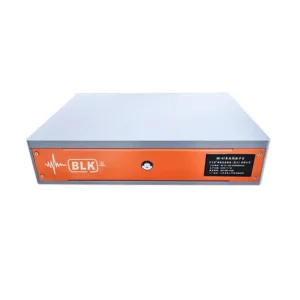
High-Quality BK-RT Type Damped Vibration Isolation Platform Factories, Manufacturers

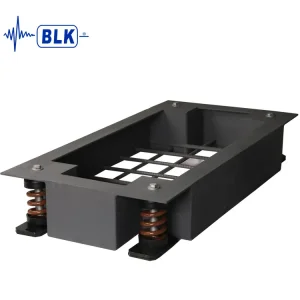
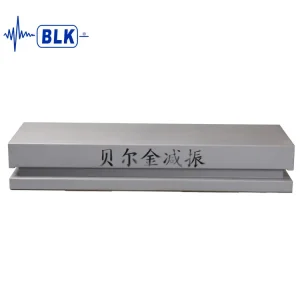
High-Quality CPB type Inertia Bases & Pump Supports Manufacturers, Manufacturer
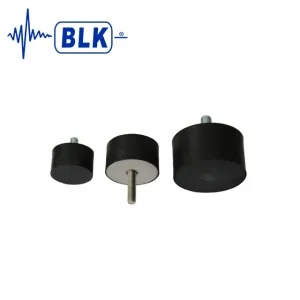

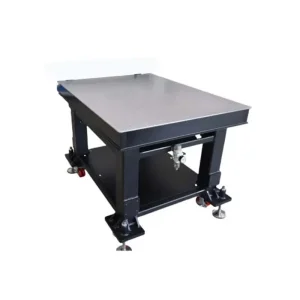
High-Quality BK-DT Type Low-Frequency High-Damping Optical Vibration Isolation Platform Factory, Manufacturer
Technology Roadmap & Future Innovations
Pioneering the next generation of smart vibration control systems and environmentally sustainable isolation materials.
Active Sensor Integration (IoT Ready)
Developing embedded piezoelectric sensors within composite pad layers to provide continuous real-time dynamic load monitoring, temperature tracking, and predictive vibration spectral analysis via cloud-connected edge gateways.
Eco-Compliant Bio-Polymer Formulations
Advancing green manufacturing initiatives by replacing petroleum-derived polymers with high-performance bio-elastomers, maintaining zero VOC off-gassing while meeting strict European REACH and RoHS compliance standards.
Hybrid Magnetorheological Damping
Engineering adaptive variable-damping isolation mounts that automatically adjust dynamic stiffness in response to sudden current surges, seismic shocks, or extreme weather load changes.
Global Engineering Support & Localization Guarantee
Bellking provides worldwide engineering assistance to EPC contractors, transformer OEMs, and acoustic consultants. Our service offering includes:
- 24-Hour Finite Element Sizing Reports: Send us your transformer weight, center of gravity (CoG) coordinates, support foot arrangement, and target dBA attenuation, and our team will generate a complete isolation scheme within 24 hours.
- Custom Mold Development: For non-standard rail geometries or restricted spatial footprints, custom molds can be produced within 3 to 5 working days.
- Global Logistics & Export Packaging: All products are shipped in ocean-worthy fumigated wooden crates with reinforced corner guards, ensuring pristine arrival at job sites anywhere in North America, Europe, the Middle East, or Asia-Pacific.
Frequently Asked Questions (Technical & Procurement FAQ)
In-depth answers to common questions asked by electrical engineers, facility directors, and procurement managers.
How do I select between spring isolators and elastomeric rubber isolation pads for a transformer?
Selection depends primarily on the required natural frequency ($f_n$) and the environmental context. Spring isolators offer lower natural frequencies (3 Hz to 5 Hz), making them suitable for severe low-frequency isolation where extreme deflection (>25 mm) is permissible. However, open steel springs can pass high-frequency audible noise harmonics directly through the steel coils unless paired with a rubber cup or pad in series.
Elastomeric pads (such as Bellking BK-MT or BKSWA composite series) provide continuous high internal damping, eliminate high-frequency acoustic sound bridging, offer resistance to oils and weather, and require significantly lower installation heights. For 100 Hz / 120 Hz fundamental transformer hum, properly selected elastomeric pads routinely deliver >92% isolation efficiency while maintaining high lateral stability under wind and seismic loads.
What engineering information is required to calculate pad footprint and thickness?
To accurately size transformer isolation pads, our application engineers require:
- Total Operating Weight: Including transformer core, windings, oil (if applicable), and enclosure.
- Support Foot Print / Rail Geometry: Dimensions and layout of structural channel rails or individual feet.
- Center of Gravity (CoG): To check for non-uniform load distribution across mounting points.
- Electrical Line Frequency: (50 Hz vs 60 Hz) to identify fundamental excitation (100 Hz vs 120 Hz).
- Installation Environment: Indoor cleanroom, outdoor rooftop, coastal/corrosive substation, or seismic zone rating.
How do Bellking pads prevent rubber creep and long-term pad flattening?
Rubber creep occurs when elastomeric polymers undergo permanent molecular shear under static pressure over time. Bellking prevents excessive creep by formulating high-grade synthetic polymers with specialized cross-linking vulcanization agents. Furthermore, our pad designs maintain static loading well within conservative stress limits (typically between 0.5 MPa and 2.5 MPa depending on durometer).
Accelerated heat aging tests (ASTM D573) confirm that Bellking pads exhibit less than 5% permanent set over a 15-year continuous operating lifecycle under rated load conditions.
Are Bellking transformer pads resistant to transformer oil and weather elements?
Yes. Our transformer isolation pads intended for oil-immersed applications are manufactured using Neoprene (CR) or Nitrile (NBR) rubber matrix formulations. These materials offer superior resistance to mineral transformer oils, ASTM No. 3 oil, ozone degradation, and direct ultraviolet (UV) exposure. Exposed steel mounting plates are coated with Dacromet anti-corrosion finish passing 900+ hours of salt spray testing.
Can customized pad dimensions be manufactured for retrofit projects?
Absolutely. Bellking specializes in 1:1 custom manufacturing. Whether you require specific bolt-hole patterns, unique base-rail shapes, or custom thickness build-ups to fit existing structural steel clear spans, our engineering team can design and manufacture customized isolators within 3 to 5 working days.