Precision Vibration Control Components
Explore our baseline precision mounts, low-frequency optical platforms, high-damping rubber pads, and HVAC spring isolators engineered for rigorous industrial duty.




1. Physics of Vibration Isolation: Mechanics, Transmissibility & Dynamics
In industrial engineering, unwanted kinetic energy—manifesting as mechanical vibration, dynamic imbalance, acoustic resonance, or micro-seismic motion—presents a fundamental challenge to operational efficiency, structural integrity, and measurement accuracy. Effective vibration isolation requires precise manipulation of system natural frequency ($f_n$) relative to forcing disturbance frequencies ($f_d$).
When dynamic machinery operates, it imparts harmonic forces into surrounding structures. The performance of any isolation system is quantified by the Transmissibility Ratio ($T$), defined as the ratio of transmitted dynamic force to applied force:
Where: r = f_d / f_n (Frequency Ratio), ζ = Damping Ratio (c / c_c).
A fundamental engineering axiom dictates that vibration isolation occurs only when r > √2 (≈ 1.414). Below this threshold (r < 1), the isolator acts as a rigid coupling; at resonance (r = 1), dynamic amplification occurs, dramatically increasing force transmission unless constrained by adequate internal damping ($\zeta$). To achieve high isolation efficiencies (exceeding 90% to 99%), mechanical design engineers target frequency ratios of $r \ge 3$ to $r \ge 5$.
Resonance Avoidance
Engineered stiffness ($k$) and damping parameters ensure system resonance ($f_n$) sits safely below operating speeds, preventing catastrophic fatigue failure and structural excitation.
High Energy Dissipation
Viscous and elastomeric material compounds absorb transient kinetic shock waves, preventing mechanical backlash in heavy industrial operations.
Acoustic Decoupling
Stops solid-borne audio vibrations (structure-borne sound transmission) from propagating into building shells and adjacent working environments.
2. Comprehensive Taxonomy of Industrial Isolation Types
Vibration isolators are categorized according to their load-bearing medium, elastic deflection mechanics, and damping characteristics. Choosing the appropriate type depends on operating parameters, ambient thermal profiles, dynamic load factors, and environmental exposure.
| Isolator Category | Natural Freq. ($f_n$) | Damping Ratio ($\zeta$) | Primary Material / Mechanics | Dominant Industrial Use-Cases |
|---|---|---|---|---|
| Helical Steel Spring Mounts | 2.0 Hz – 5.0 Hz | 0.005 – 0.02 (Low) | High-tensile alloy steel (Cr-Si / Cr-V) with epoxy or Dacromet finish | Low-speed heavy equipment: Chillers, cooling towers, heavy HVAC, gensets, inertia bases. |
| Elastomeric & Rubber Mounts | 6.0 Hz – 15.0 Hz | 0.05 – 0.15 (Medium) | Natural Rubber (NR), Neoprene (CR), Nitrile (NBR), Fluoroelastomers | High-speed machinery: Motors, rotary pumps, small compressors, automotive subframes. |
| Pneumatic Air Mounts | 1.0 Hz – 2.5 Hz | 0.06 – 0.20 (Tunable) | Reinforced elastomeric air bladders with active/passive leveling valves | Sub-Hz ultra-precision: Semiconductor lithography, CMMs, electron microscopes, laser optics. |
| Optical & Damped Platforms | 1.5 Hz – 4.0 Hz | 0.10 – 0.25 (High) | Honeycomb steel core with viscous fluid dampers or multi-layer polymer pads | Metrology labs, photonics research, cleanroom inspection tables, motion stages. |
| Polymer & Neoprene Damping Pads | 8.0 Hz – 20.0 Hz | 0.10 – 0.30 (High) | Cross-hatched, ribbed or waffle polyurethane / synthetic elastomers | Foundation isolation, transformer footings, structural floor decouplers, punch presses. |
A. Spring-Based Isolators
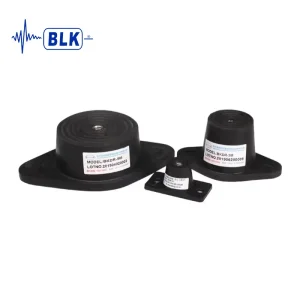
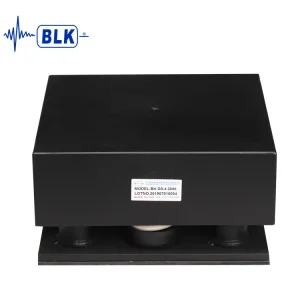
Helical spring mounts provide large static deflections required to isolate low disturb frequencies ($f_d < 15 \text{ Hz}$). To counteract low internal material damping, high-performance variants (such as the BK-DS Series) incorporate integrated viscous dampers or elastomeric cups to suppress transient surge and dynamic resonance.
B. Elastomeric & Rubber Mounts
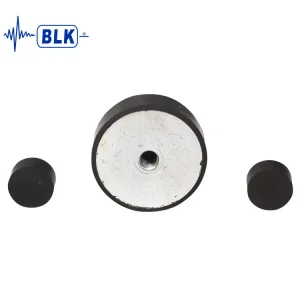
Elastomers store and dissipate energy via internal molecular friction. Products like the BKHQ and BKDR Series leverage optimized Shore A durometer formulations, offering excellent high-frequency noise attenuation, shear stability, and oil/chemical resistance in compact footprints.
C. Pneumatic Air Spring Systems
Pneumatic isolators compress trapped air volumes to reach ultra-low natural frequencies ($f_n < 2 \text{ Hz}$). Featuring dynamic height regulation via closed-loop mechanical or electronic sensing, pneumatic air mounts provide unmatched isolation for nano-scale fabrication tools.
3. Specialized Macro-Industry Solutions Architectures
Generic isolation solutions frequently fail because they ignore real-world boundary conditions. Different industrial sectors present distinct thermal, chemical, mechanical, and dynamic constraints.
1. HVAC & Heavy Building Infrastructure
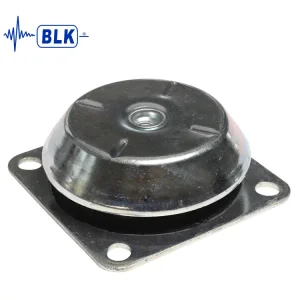
Chillors, large centrifugal pumps, and air handling units generate massive low-frequency forces. By integrating open or restrained spring mounts (e.g., MB & MA Types) with concrete inertia bases, engineers lower the center of gravity, equalize support loads, and absorb nozzle reaction forces, stopping structural vibration transmission through commercial high-rises.
2. Semiconductor & Metrology Fabrication
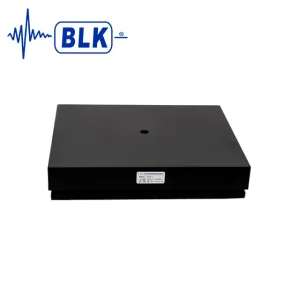
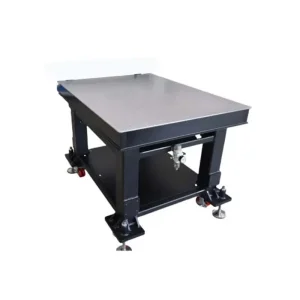
Sub-micron lithography and scanning electron microscopes (SEMs) demand adherence to stringent VC (Vibration Criterion) curves (VC-E to VC-G). Utilizing low-frequency optical platforms (BK-DT Series) and active-ready pneumatic air mounts insulates floor-borne micro-seismic disturbances, ensuring yield accuracy in cleanrooms.
3. Power Generation & Transformers
High-voltage dry and oil-filled transformers generate continuous magnetostrictive hum at 100 Hz / 120 Hz harmonics. Tailored transformer anti-vibration mounts and multi-layer polymer dampers decouple heavy electrical equipment from floor slabs, mitigating low-frequency noise in urban substations and data centers.
4. Technological Roadmap & Future Innovations in Shock Mitigation
The industrial vibration control landscape is shifting from traditional passive damping to smart, adaptive, and sustainable structural dynamics engineering. Key evolutionary thrusts include:
Active & Hybrid Electromagnetic Damping
Passive systems face a design trade-off between stiffness and isolation bandwidth. Next-generation systems integrate piezoelectric actuators and electromagnetic voice coil motors, driven by real-time DSP sensors, providing zero-phase delay cancellation across 0.5 Hz – 100 Hz frequencies.
Smart IoT-Enabled Vibration Monitoring
Integrating MEMS tri-axial accelerometers directly into isolator castings transforms passive mounts into edge-computing IoT nodes. Real-time spectrum analysis tracks elastomeric degradation, creep rate, and harmonic drift to enable predictive maintenance before system downtime occurs.
Advanced Metamaterials & Eco-Elastomers
Research into phononic crystal lattices and bio-based fluoro-elastomer compounds allows custom tailoring of acoustic bandgaps—blocking specific targeted excitation frequencies while maintaining structural load capacity and reducing carbon footprint.
5. China Industry 4.0: Supply Chain Resilience & Manufacturing Synergy
Based in Kunshan, Jiangsu—a major hub for high-end equipment manufacturing—our modern facility blends advanced production automation with strict quality controls. As a certified National High-Tech Enterprise, our manufacturing operations deliver high product consistency, rapid lead times, and global cost competitiveness.
Robotic Automation & Machining
Equipped with robotic welding cells, multi-axis CNC machining centers, and automated rubber vulcanization presses, ensuring tight geometric tolerances and high repeatability across production lots.
In-House Metallurgical & Dynamic Testing
Every product series undergoes comprehensive testing: dynamic stiffness mapping, fatigue testing up to 5,000,000 cycles, and 900-hour Dacromet salt spray chamber exposure for high corrosion resistance.
Agile Supply Chain Flexibility
Our integrated supply network supports standard component dispatches within 24 hours, alongside a rapid 3-day turnaround for non-standard 1:1 engineered-to-order custom prototypes.
6. Localization Support, Quality Governance & Global Procurement Intent
International EPC contractors, OEM equipment builders, and global procurement managers require complete technical transparency, regulatory compliance, and verified traceability. Our product lifecycle engineering complies with global structural and environmental standards.
ISO 9001:2015 Quality Management
Comprehensive quality inspection from raw material spectral analysis to final pre-shipment dynamic testing, complete with full lot-number traceability.
Environmental Compliance
100% compliance with EU RoHS and REACH directives. Our elastomeric formulations contain no hazardous heavy metals or banned plasticizers.
Global Standards Alignment
Products designed to meet requirements from ASHRAE (HVAC equipment isolation), DIN 4150 (structural vibration limits), and BS 6177 guidelines.
Comprehensive Export Logistics
Full export packaging protection (IPPC-certified heat-treated wooden crates, anti-corrosion barrier wrapping) ensuring safe international transit.
7. Technical FAQ: Intent-Driven Selection & Application Solutions
Direct answers from our structural vibration engineers to address common design, procurement, and installation queries.
How do I determine whether my application requires spring, rubber, or pneumatic isolators?
What design parameters are required for a custom vibration isolation sizing report?
- Total operating mass (kg) and center of gravity (CG) coordinates.
- Number, arrangement, and mounting footprint dimensions of support points.
- Disturbing excitation frequency (RPM, Hz, or reciprocating stroke speed).
- Environmental conditions (operating temperature, oil/chemical splash, indoor/outdoor exposure).
- Transient dynamic requirements (seismic restraints, wind load resistance, shock acceleration G-forces).
Why are concrete inertia bases recommended under pumps and HVAC chillers?
- They increase overall mass, reducing system vibration amplitude ($A \propto 1/m$).
- They lower the combined system center of gravity, preventing excessive rocking motion during motor start-up.
- They equalize point loads across all supporting spring mounts, preventing uneven spring deflection and piping stress.
How does ambient temperature impact rubber mount isolation characteristics?
What surface treatment is applied to protect steel springs against atmospheric corrosion?
Specialized & Heavy-Duty Mount Series
Explore our specialized high-capacity spring mounts, multi-layer dampers, pneumatic air mounts, and custom industrial elastomeric supports.