
Precision Mechanical Mounts & Platform Series (Part 1)
Factory-direct vibration control components engineered for HVAC, precision metrology, and heavy industrial plant stabilization.






Understanding Mechanical Vibration: Physics, Harmonics, and Structural Fatigue
Uncontrolled kinetic energy, harmonic resonance, and structure-borne acoustic waves cost global industries billions annually in equipment breakdown, structural wear, and precision yield degradation.
Disturbing Frequency vs. Natural Frequency
Vibration isolation hinges on the fundamental frequency ratio ($f_d / f_n$). Isolation only commences when the disturbing frequency ($f_d$) of the machinery exceeds $\sqrt{2}$ (approximately 1.41) times the natural frequency ($f_n$) of the isolator mount. To achieve isolation efficiency greater than 90%, engineers target an operational frequency ratio of 3 or higher.
Harmonic Resonance Mitigation
When $f_d$ approaches $f_n$, the amplification factor reaches dangerous dynamic levels, inducing dynamic stress strain, severe noise pollution, and immediate structural fatigue. Incorporating viscous damping elements, specialized elastomers, or active pneumatic compensation dissipates kinetic energy into thermal energy safely.
Structure-Borne Noise Isolation
High-frequency acoustic waves travel effortlessly through concrete floor slabs and structural steel frameworks. High-performance elastomeric pads, multi-layer dampers, and spring mounts interrupt these acoustic pathways, achieving noise reductions of up to 35 dB(A) in modern building HVAC and industrial plants.
Macro Industry Trends Driving Advanced Vibration Control Procurement
As industrial machinery scales in velocity, power, and micro-precision, global procurement specifications are shifting rapidly toward high-efficiency, long-lifespan isolation systems.
1. Semiconductor & Fab Sub-Nanometer Precision
Modern photolithography, wafer probing, and electron microscopy require environmental micro-vibration floors rated to VC-E or VC-G criteria. Ambient ground vibrations from nearby traffic or floor machinery can destroy yield rates. Low-frequency pneumatic mounts (1.7 Hz $f_n$) are now mandatory equipment components.
2. Urban Commercial HVAC & Building Codes
Commercial real estate complexes place heavy rooftop chillers, cooling towers, and large air handling units directly above luxury office space. Strict municipal acoustic ordinances demand high-deflection spring isolators paired with concrete inertia bases to isolate low-frequency rumble (15–60 Hz).
3. Heavy Power Infrastructure & Substation Isolation
Electrical transformers and high-voltage reactors continuously emit low-frequency magnetic hum (100 Hz / 120 Hz core vibrations). Customized anti-vibration transformer mounts prevent structural fatigue in oil lines while reducing ambient noise in urban electrical grids.
Proven Engineering Performance Backed by Rigorous Testing
Our ISO 9001 certified manufacturing plant in Kunshan, China integrates dynamic load testing, finite element analysis (FEA), and advanced metallurgic anti-corrosion treatments.
Comprehensive Vibration Isolator Selection Matrix
Compare mechanical properties, operational frequency spectrums, load capacities, and ideal factory deployment scenarios across primary product lines.
| Isolator Technology | Natural Freq. Range ($f_n$) | Primary Damping Mechanism | Max Load Capacity / Point | Ideal Factory Application |
|---|---|---|---|---|
| Pneumatic Air Mounts (BK-A Series) | 1.7 Hz – 3.0 Hz | Controlled Compressed Air & Orifice Viscous Damping | Up to 5,000 kg | Optical tables, CMMs, electron microscopes, semiconductor fab tools |
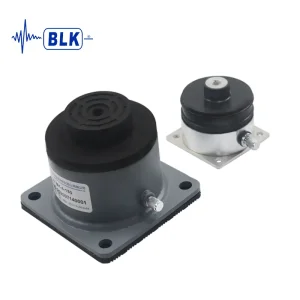
| Damped Spring Mounts (BK-DS / MA Series) | 3.0 Hz – 5.0 Hz | High-Tensile Alloy Springs with Internal Polymer Damping | Up to 12,000 kg | Industrial chillers, heavy water pumps, generators, cooling towers |
| Precision Desktop Platforms (BK-AT / BK-RT) | 2.0 Hz – 4.5 Hz | Multi-Layer Elastomer Damping & Honeycomb Core Structure | Up to 800 kg | Analytical balances, laboratory microscopes, precision inspection workstations |
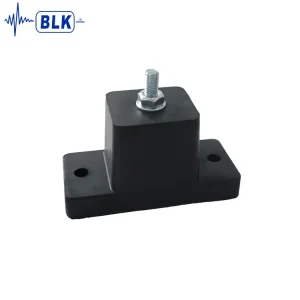
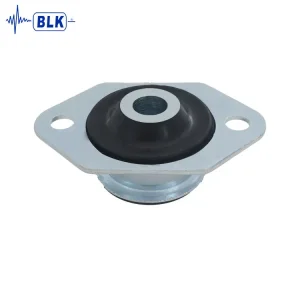
| Elastomeric Rubber Mounts (BKDR / BKVV Series) | 8.0 Hz – 15.0 Hz | High-Damping Neoprene / Natural Rubber Compound | Up to 2,500 kg | High-speed compressors, electric motors, small fans, CNC machine bases |
| Polymer Damping Pads (BKTS / BKDJ Series) | 12.0 Hz – 25.0 Hz | Engineered Matrix Polymer Shearing | Up to 50 kg/cm² | Structural slab isolation, punch presses, heavy machinery foundation lining |
Factory Price Structure & B2B Procurement Cost Factors
Understanding raw material choices, structural engineering options, and volume manufacturing dynamics that govern global supplier pricing.
Metallurgical & Polymer Selection
Standard carbon steel vs. high-stress spring steel 60Si2Mn dramatically affects unit durability and spring elasticity over decades. Premium oil-resistant synthetic neoprene compounds command higher upfront raw material cost but eliminate premature cracking and rubber oil-degradation failures.
Custom Engineering & FEA Modeling
Standard off-the-shelf catalog products benefit from automated mass production lines, lowering unit prices. Non-standard dimensions, custom seismic restraints, and bespoke load-bearing plates require CAD design, FEA stress modeling, and dedicated mold tooling, which factor into short-run pricing.
Surface Coating & Anti-Corrosion
Industrial installations operating in marine, outdoor HVAC, or chemical processing environments demand surface protection. Hot-dip galvanizing and advanced multi-layer Dacromet coating (passing 900+ hour salt spray testing) extend long-term value, substantially reducing total cost of ownership (TCO).
Localization Support, International Standards, & QA Guarantees
Bellking ensures seamless compliance across major industrial global markets through multi-national certifications and regional engineering support.
ISO 9001 & Quality Management
Our complete manufacturing supply chain adheres to ISO 9001 quality standards. Every batch of spring mounts and elastomeric pads undergoes strict dynamic load deflection testing, tension-compression verification, and spectral analysis prior to factory dispatch.
Seismic Restraint Compliance
For earthquake-prone zones and critical safety infrastructure (hospitals, data centers, power plants), our seismic restrained spring isolators comply with international building code structural requirements (ASHRAE, IBC), preventing equipment displacement during seismic events.
Rapid Technical & Logistics Response
We provide complete 24-hour engineering response services for global buyers. With standardized inventory shipping in 24 hours and customized engineering drawings supplied in 3 working days, we minimize downtime for complex installation projects worldwide.
Technology Roadmap: Next-Generation Smart Isolation (2025–2030)
Integrating IoT condition monitoring, piezoelectric active damping, and advanced metamaterial polymers into next-generation industrial vibration control platforms.
Embedding MEMS wireless tri-axial accelerometer sensors directly into spring caps for real-time vibration amplitude and frequency monitoring.
Deploying predictive maintenance software models that simulate spring creep, rubber fatigue, and dampening degradation based on operational telemetry.
Combining passive air mounts with high-speed piezoelectric actuators to counteract transient high-frequency shocks within sub-millisecond response times.
Utilizing 3D-printed acoustic metamaterial lattice structures to create ultra-lightweight isolators capable of blocking multi-spectrum structural noise.
Precision Mechanical Mounts & Platform Series (Part 2)
Explore heavy-duty spring dampers, rubber cone mounts, air mounts, and multi-layer isolation pads engineered to factory-direct standards.






Frequently Asked Questions (FAQ)
Expert answers to standard engineering inquiries regarding isolator selection, dynamic frequency calculations, factory pricing, and global logistics.