
Factory-Engineered Heavy Duty & Precision Mounts
Explore eight core engineered isolation configurations manufactured under ISO 9001 standards, featuring advanced vulcanized bonding, anti-corrosive Dacromet coatings, and certified high-transmissibility damping.





The Evolution of Elastomeric Shock & Vibration Control
From rudimentary natural rubber blocks to high-performance molecularly tailored synthetic polymers: understanding how dynamic stiffness, damping ratios, and multi-axis excitation are redefining industrial machinery isolation.
Dynamic vs. Static Stiffness Ratios (Kd/Ks)
Traditional procurement often focuses solely on static deflection ($\delta_{st}$). However, modern high-speed rotating equipment creates complex high-frequency excitation where dynamic stiffness ($K_d$) diverges dramatically from static stiffness ($K_s$). Premium elastomeric compounds maintain predictable $K_d/K_s$ ratios between 1.2 and 1.6, avoiding catastrophic under-isolation at operational frequencies.
Loss Factor ($\eta$) & Resonant Peak Suppression
Unlike steel coil springs that boast minimal intrinsic damping (loss factor $\eta \approx 0.005$) and risk massive resonant amplitude spikes during equipment spin-up, engineered rubber isolators exhibit loss factors between 0.10 and 0.55. This inherent internal hysteresis converts mechanical vibrational energy directly into thermal dissipation without supplementary viscous dampers.
High-Adhesion Vulcanization Metallurgy
Early-generation rubber mounts suffered from premature delamination at the metal-elastomer interface. Contemporary manufacturing relies on advanced silane coupling agents, multi-stage phosphate conversion baths, and automated high-pressure transfer molding to achieve shear bonding strengths exceeding the ultimate tensile tear strength of the rubber compound itself.
Demystifying "Low Price": Total Cost of Ownership (TCO) Analysis
In global supply chains, procuring vibration isolators solely on initial unit cost frequently yields catastrophic downtime, accelerated bearing wear, and acoustic non-compliance. Direct factory purchasing bridges high engineering integrity with authentic factory-floor pricing.
Tier-1 Material Formulations
Unregulated cheap mounts use carbon black fillers blended with recycled crumb rubber, leading to rapid plasticizer bleed-out and polymer embrittlement. Direct manufacturers formulate virgin polymers (NR, Neoprene, EPDM, NBR) according to rigid ASTM D2000 classifications to maintain dynamic elasticity over decades.
Compression Set Resistance
The primary death knell of cheap rubber mounts is permanent deformation (compression set). Once an isolator collapses by more than 15-20% of its uncompressed profile, its isolation frequency increases, transferring damaging shear forces directly into equipment anchor studs and shafts.
Environmental Resiliency
Equipment deployed in marine, petrochemical, or outdoor HVAC settings requires aggressive chemical protection. Bellking’s proprietary anti-ozone anti-aging masterbatches alongside 900-hour salt spray tested metal hardware guarantee compliance under severe ambient conditions without degrading damping performance.
Custom Compound Formulation
Procuring directly from an established manufacturing plant in Kunshan eliminates brokerage markups while granting direct access to chemical engineering teams. Durometer hardness (35 to 80 Shore A), dynamic response, and mounting geometries can be tailored 1:1 to unique customer engineering drawings.
Vibration Isolation Calculation Models & Sizing Matrix
Vibration isolation operates strictly on the mechanical laws of elastodynamics. To obtain legitimate vibration mitigation, engineering teams must calculate transmissibility based on excitation frequency, natural frequency, and damping factor.
Where: r = Frequency Ratio (f_d / f_n); f_d = Disturbing Excitation Frequency; ζ = c / c_c (Damping Ratio)
To achieve positive isolation efficiency, the frequency ratio r must strictly exceed √2 (≈ 1.414). At $r < 1.414$, the isolator amplifies vibration rather than mitigating it, reaching peak resonant catastrophic acceleration when $r = 1.0$. For premium industrial isolation efficiency ($\eta > 90\%$), target operating frequency ratios between $3.0$ and $5.0$.
| Elastomer / Mount Family | Hardness (Shore A) | Natural Frequency (fn) | Isolation Efficiency Range | Optimal Excitation Domain | Typical Industrial Target |
|---|---|---|---|---|---|
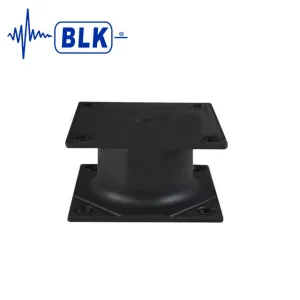
| BKHQ Heavy Rubber Mount | 45 - 65 A | 8.0 - 12.0 Hz | 85% - 94% @ >1500 RPM | Medium / High Frequency | Centrifugal Pumps, Hydraulic Power Packs |
| BKDD Double-Deflection Mount | 40 - 60 A | 6.0 - 9.0 Hz | 90% - 97% @ >1200 RPM | Multi-axis Dynamic Shearing | Rotary Screw Compressors, Marine Diesels |
| BKTS Ribbed Elastomeric Pad | 50 - 75 A | 12.0 - 18.0 Hz | 75% - 88% @ >1800 RPM | High-frequency Impact & Structure Airborne Noise | Stamping Presses, Electrical Switchgear |
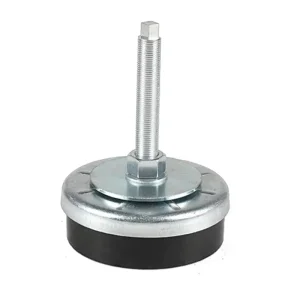
| BKAL Leveling Adjustment Foot | 60 - 80 A | 10.0 - 15.0 Hz | 80% - 92% @ >1500 RPM | Precision Leveling with Shock Dissipation | CNC Lathes, Automated Packaging Lines |
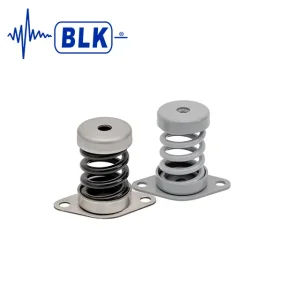
| Composite ME Spring-Rubber Mount | Hybrid Spec | 3.0 - 5.0 Hz | 95% - 99% @ >600 RPM | Ultra-Low Frequency Disturbances | Cooling Towers, Large Chillers, Reciprocating Gensets |
Macro-Industry Applications & Engineered Implementations
Vibration and shock control challenges differ radically across industrial sectors. Here is how Bellking isolators eliminate structural excitation across mission-critical facilities.
HVAC & Central District Cooling
Large chilled water pumps, rooftop AHUs, and induced-draft cooling towers transmit massive acoustic humming into building framing. By pairing custom high-deflection rubber hangers (HR series) with concrete-filled CPB inertia bases, structure-borne noise is arrested at the source, preventing ASHRAE acoustic criteria violations.
Data Center Backup Power Gensets
Continuous uptime in tier-IV data centers mandates that emergency diesel gensets run smoothly without jarring adjacent raised floors or dislodging sensitive server disk arrays. Our high-shock rated mounts withstand intense initial crank torque while isolating secondary crank harmonic resonance.
Semiconductor & Metrology Facilities
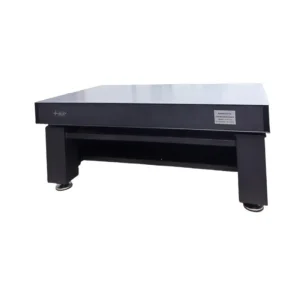
Precision coordinate measuring machines (CMM) and wafer inspection tools require near-zero environmental vibration (VC-C to VC-E curves). Bellking BK-PF precision air mounts and polymer damping pads isolate micro-vibrations down to 1.7 Hz, ensuring sub-micron manufacturing tolerances remain uncompromised.
Heavy Stamping & Forming Presses
Repetitive cyclic impact from metal forming presses shatters concrete foundation pads. BKSW high-strain buffers absorb instantaneous transient kinetic energy spikes of 3 to 5 G acceleration, dissipating impact shock and preventing reciprocal foundation cracks.
Dry & Oil-Immersed Transformers
Core magnetostriction in distribution transformers generates a penetrating 100 Hz / 120 Hz hum that propagates across steel structural beams in commercial and residential towers. Specialized transformer anti-vibration damping pads yield greater than 96% structure-borne acoustic decibel reduction.
Marine Propulsion & Rail Transit Auxiliary
Vessels and light rail systems demand vibration isolators certified against extreme roll, pitch, salt-fog corrosion, and ambient diesel mist. Bellking captive rubber-metal mounts contain mechanical failsafe interlocks that hold machinery captive even under sudden extreme sea shock loads.
Direct Manufacturer Capabilities: Kunshan Engineering Plant
Bellking Vibration Reduction Equipment Manufacturing (Kunshan) Co., Ltd. operates a high-precision, 2,000 square meter smart fabrication complex. We are a direct manufacturer—not an intermediary trader.
Advanced CNC Machining & Robotic Welding
Every steel top-plate, captive housing, and threaded adjustment stud is precision-machined in-house. Automated robotic welding fixtures maintain complete weld seam integrity across all load-bearing brackets, completely eliminating human welding defect variability.
In-House Static & Dynamic Testing Lab
Equipped with computerized electro-hydraulic servo fatigue test benches, dynamic vibration spectrum analyzers, and 900-hour Dacromet salt spray test chambers. Factory inspection certificates and full material test reports (MTR) accompany every batch.
3-Day Rapid Prototyping & 24h Dispatch
Stock standard catalog models ship within 24 hours of confirmation. Custom non-standard vibration isolator engineering designs—including bespoke durometer mixing, finite element analysis (FEA), and mounting bracket modifications—are delivered within 3 business days.
Engineering Roadmap: Next-Gen Elastomeric Damping
Vibration mitigation technology is evolving towards autonomous structural health monitoring, dynamic stiffness tuning, and non-petroleum polymer compounds.
Phase 1: Nano-Silica & Graphene Reinforced Elastomers
Infusing elastomer matrices with functionalized graphene oxide and nano-silica boosts high-temperature tear resistance by 40% and lowers dynamic compression fatigue, extending service lifespans beyond 20 years in harsh industrial environments.
Phase 2: IoT-Enabled Smart Health-Monitoring Mounts
Integrating passive piezoelectric stress sensors directly into vulcanized elastomer housings allows isolators to autonomously monitor dynamic strain, operating temperature, and cumulative fatigue life, interfacing directly with plant SCADA and predictive maintenance platforms.
Phase 3: Bio-Derived Synthetic Elastomers & Zero-VOC Vulcanization
Complying with advancing European RoHS, REACH, and corporate ESG standards by replacing petroleum aromatic oils with sustainable bio-monomers while maintaining ultra-low natural frequencies and flame-retardant performance.
Engineering & Procurement FAQ (Frequently Asked Questions)
Authoritative technical guidance compiled by Bellking application engineers to resolve critical specification, sizing, and durability inquiries.
Specify rubber vibration isolators when the equipment operating frequency is relatively high (above 1,200 RPM / 20 Hz)—such as high-speed vane pumps, rotary compressors, electric motors, and small fans—and high-frequency structure-borne acoustic noise transmission must be arrested. Steel springs are ideal for low frequencies (3-5 Hz), but their internal coils transmit high-frequency sound waves ("spring surge"). Rubber effectively halts high-frequency acoustic bridging.
Lower durometer rubber (e.g., 40-45 Shore A) provides lower spring stiffness ($k$), yielding greater static deflection ($\delta_{st}$) and a lower natural frequency ($f_n$), which maximizes vibration isolation efficiency. However, softer compounds carry lower load capacity and higher creep susceptibility. Harder elastomers (65-75 Shore A) handle intense loads and stability requirements but exhibit a higher natural frequency. Correct sizing matches the load per point directly to the optimum deflection curve.
Our engineering team requires: (1) Total equipment operating weight, (2) Precise Center of Gravity (CoG) coordinate offsets, (3) Number and coordinate locations of support points, (4) Operating excitation frequency / RPM spectrum, (5) Installation environment (chemical, oil mist, outdoor temperature exposure), and (6) Any seismic or dynamic wind restraint requirements.
Under rated mechanical static loads and operating within ambient temperatures of -25°C to +85°C, Bellking engineered rubber isolators consistently perform for 10 to 15+ years. Our metal bracket surfaces utilize a Dacromet coating that passes 900-hour salt spray testing, guaranteeing long-term corrosion immunity across high-humidity and marine environments.
Heavy Industrial, Pneumatic & High-Frequency Solutions
Complete your facility vibration isolation architecture with our advanced pneumatic leveling air mounts, suspended elastomer hangers, matrix dampers, and adjustable leveling feet.






Request Direct Factory Pricing & Custom Sizing Plans
Bypass middleman distribution margins. Send your equipment operating weight, RPM, and dimensional drawings to our Kunshan technical laboratory for a full vibration isolation analysis report delivered within 24 hours.