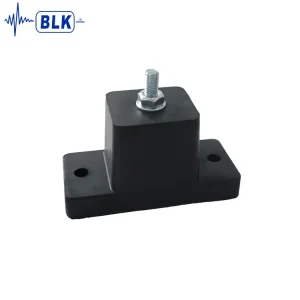
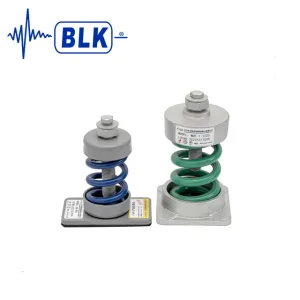
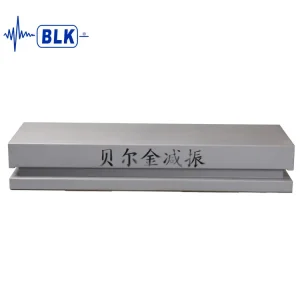
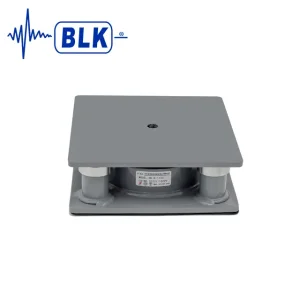
Featured Vibration Isolation & Damping Systems
Precision-engineered mechanical mounts for HVAC, industrial chillers, power generation, and sensitive laboratory platforms.
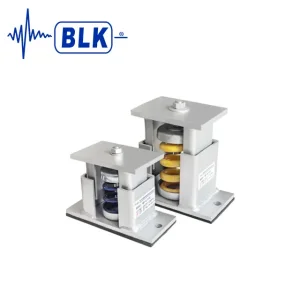
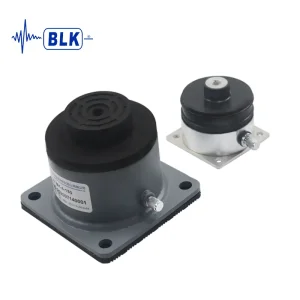

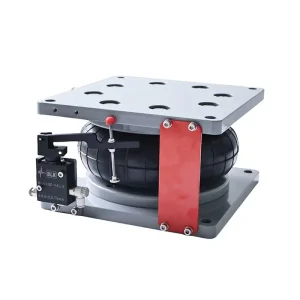
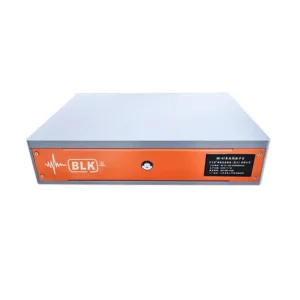

Executive Summary: Demystifying Low-Price vs. High-Gain Vibration Control
Evaluating structural longevity, transmission loss, and factory direct procurement value in modern industrial mechanical engineering.
The Economics of Structural Vibration Isolation
In modern industrial plants, high-capacity mechanical equipment—such as centrifugal chillers, reciprocating air compressors, cooling towers, and heavy diesel generators—produces high-amplitude dynamic disturbance forces. Unmitigated mechanical energy propagates through concrete slabs, steel superstructures, and fluid piping, causing structural fatigue, joint stress, micro-fractures, and severe acoustic discomfort.
Selecting a low-price spring type anti-vibration mount from a specialized direct OEM manufacturer does not mean sacrificing engineering standards. By leveraging optimized spring metallurgy, standardized CNC coiling, and direct-to-site distribution, plants achieve up to 99% vibration attenuation at a fraction of traditional distributor-markup costs.
Information Gain: Damping Physics vs. Total Cost of Ownership
Standard rubber pads fail at low disturbance frequencies (<15 Hz) due to excessive dynamic stiffness ($K_d/K_s$). Steel helical springs, by contrast, offer linear force-deflection characteristics and large static deflections ($\delta_s$), achieving fundamental natural frequencies ($f_n$) down to 2.5–4.5 Hz.
This whitepaper examines the physics of helical spring mounts, non-linear damping elastomers, anti-corrosion chemistry (Dacromet/Epoxy coatings), and supply chain efficiencies that enable elite OEM factories in China to supply global markets at competitive price points without compromising structural reliability.
Global Commercial & Industrial Vibration Control Landscape
Analysis of international demand drivers across HVAC, energy infrastructure, microelectronics, and urban high-rise development.
Commercial HVAC & MEP Retrofits
Urban density demands zero structure-borne noise transmission into occupied commercial space. ASHRAE guidelines dictate rigid deflection criteria for roof-mounted chillers, AHUs, and cooling towers, forcing building owners to upgrade from legacy elastomeric pads to high-deflection spring isolators.
Critical Power & Energy Storage
Heavy diesel and natural gas standby generators produce violent transient low-frequency shocks during startup and load swings. Power utilities, hospitals, and hyper-scale data centers rely on restrained spring mounts with integrated snubber cushions to prevent pipe shear and structural stress.
Semiconductor & High-Precision Labs
Sub-micron fabrication and optical metrology require sub-2 Hz passive isolation platforms. Combining pre-compressed helical springs with active air mount systems isolates ambient ground vibrations caused by nearby railway networks and heavy traffic.
Engineering Deep-Dive: Mathematical Foundation of Vibration Attenuation
Understanding transmissibility equations, static deflection requirements, and spring stiffness formulas for optimal isolation design.
1. Natural Frequency & Static Deflection
The natural frequency ($f_n$) of a single-degree-of-freedom (SDOF) spring isolation system is directly dictated by its static deflection ($\delta_s$, expressed in millimeters or inches) under dead load:
f_n = (1 / 2π) * √(g / δ_s) ≈ 4.98 / √(δ_s in cm)
To isolate a disturbing frequency ($f_d$) generated by a pump operating at 1,450 RPM ($f_d = 24.16\text{ Hz}$), the frequency ratio ($r = f_d / f_n$) must exceed $\sqrt{2} \approx 1.414$. In practice, professional engineering practice targets $r \ge 3.0$ to achieve isolation efficiency exceeding 88–95%.
2. Transmissibility ($T$) & Damping Ratio ($\zeta$)
Transmissibility defines the ratio of dynamic force transmitted to the supporting foundation versus the disturbing force generated by the machine:
T = √[ (1 + (2ζr)²) / ((1 - r²)² + (2ζr)²) ]
While bare steel springs have a low internal damping ratio ($\zeta \approx 0.005–0.01$), adding internal rubber cups or viscous dampers mitigates resonance spikes during startup/shutdown without compromising high-frequency isolation performance.
| Isolator Architecture | Static Deflection ($\delta_s$) | Natural Frequency ($f_n$) | Isolation Efficiency at 1,200 RPM | Primary Industrial Application |
|---|---|---|---|---|
| Neoprene / Rubber Mounts | 3.0 - 8.0 mm | 8.0 - 12.0 Hz | 40% - 65% (Poor at low RPM) | High-speed fans, small motors, electric cabinets |
| Open Helical Spring Mounts | 25.0 - 50.0 mm | 3.1 - 4.2 Hz | 91% - 96% (High Efficiency) | Chillers, AHUs, inline centrifugal pumps |
| Restrained Spring Isolators | 25.0 - 75.0 mm | 2.5 - 3.8 Hz | 95% - 98.5% (Elite Isolation) | Cooling towers, outdoor generators, seismic zones |
| Pneumatic Air Isolators | Active Leveling | 1.2 - 2.0 Hz | 98.5% - 99.8% (Ultra Precision) | Semiconductor steppers, CMMs, electron microscopes |
China OEM Manufacturing Efficiency: Low Cost Without Quality Compromise
How advanced metallurgy, automated coiling, and integrated raw material ecosystems deliver high-performance mounts at low direct-factory pricing.
1. High-Tensile 60Si2Mn Alloy Steel
Chinese OEM factories leverage premium 60Si2Mn and 55CrSi spring steels. Precision cold coiling and shot-peening treatments relieve internal shear stress, preventing sag, set, or fatigue cracking over millions of cyclic load shifts.
2. Dacromet & Galvanized Surface Treatment
To handle severe industrial environments, springs undergo hot-dip galvanization or Dacromet 500 coating. This provides 900+ hours of neutral salt spray resistance (ASTM B117), exceeding standard powder coatings at no extra cost.
3. Robotic CNC Milling & Rapid Prototyping
Automated robotic welding and multi-axis CNC base plate machining reduce manual labor by 65%. Custom bolt-hole patterns, load caps, and height-adjustment housings are produced in 3–5 business days.
Mission-Critical Deployment Scenarios
Tailored spring mount configurations optimized for real-world mechanical and acoustic environments.
Scenario A: Rooftop Chillers & Cooling Towers
Challenge: Variable water loads during peak cooling cycles cause shifting centers of gravity. Strong wind loads risk destabilizing or unseating non-restrained mounts.
Solution: Restrained spring isolators equipped with integrated vertical and horizontal limit snubbers. Heavy steel housing limits total equipment movement to <3mm during wind gusts while maintaining complete freedom of motion during regular operation.
Scenario B: Data Center Emergency Generators
Challenge: Sudden high-torque startup shock transfers immense low-frequency excitation into the concrete slab, creating structure-borne noise in adjacent server rooms.
Solution: Heavy-duty open spring mounts combined with concrete inertia bases. The inertia mass adds stability, lowers the system center of gravity, and dampens transient motor torque pulses.
Emerging Trends: Smart IoT Mounts & Hybrid Materials
Next-generation vibration control technologies entering the global industrial supply chain.
IoT Vibration Spectrum Sensors
Integrating wireless MEMS accelerometers directly into spring mount caps provides real-time peak-to-peak vibration telemetry. Automated alerts signal mechanical bearing wear or unbalance before catastrophic structural failure occurs.
Visco-Elastic Alloy Cores
Combining traditional high-tensile helical springs with internal visco-elastic polymer inserts creates a high-loss factor ($\eta > 0.25$) hybrid damper. This prevents resonance amplification without requiring external hydraulic shock absorbers.
Modular Matrix Spring Networks
Standardizing individual spring cells into modular matrix frames allows procurement engineers to scale total load capacities from 500 kg up to 50,000 kg on-site by adding or removing modular spring units.
Global Sizing Guide & RFQ Engineering Checklist
Follow this 5-step engineering verification protocol when sourcing spring mounts directly from factory manufacturers.
Step 1: Calculate Total Operating Weight ($W_t$)
Include net weight of equipment, fluid payload (water in pipes/chillers), connected valves, electrical boxes, and structural inertia bases.
Step 2: Determine Support Point Layout & CG
Locate the center of gravity. If asymmetrical, calculate individual corner loads ($W_1, W_2, W_3, W_4$) to select springs with matching static deflections under uneven weight distribution.
Step 3: Identify Disturbing Frequency ($f_d$)
Determine the lowest operating speed in RPM ($f_d = \text{RPM} / 60$). Ensure the spring mount static deflection provides $f_n \le f_d / 3$.
Step 4: Assess Environmental Factors
For outdoor or coastal environments, specify Dacromet or hot-dip galvanization with stainless steel leveling hardware. For seismic zones, require snubbed restrained mounts tested to IEEE 693 standards.
Step 5: Direct Factory RFQ Checklist
When contacting Chinese OEM manufacturers, request:
- Spring load-deflection curve & load tolerance certification.
- Salt spray test report (ASTM B117).
- Mill test certificate for 60Si2Mn spring steel.
- ISO 9001 factory inspection documentation.
Need Custom Vibration Calculation & Sizing Assistance?
Our application engineering team will model your equipment loads and provide a formal engineering sizing report within 24 hours.
Technical & Procurement FAQ
Direct engineering answers to common procurement, selection, and installation queries.
Why are factory direct spring mounts significantly lower in price?
Direct manufacturers eliminate distributor markup margins (often 40%–120%), leverage automated CNC coiling lines, and source high-tensile spring steel directly from integrated domestic steel mills, dropping manufacturing costs while keeping raw material quality intact.
What is the difference between open spring mounts and restrained spring mounts?
Open spring mounts feature an unhoused spring suitable for indoor applications where uplift forces do not exist. Restrained spring mounts incorporate an external housing with vertical limit bolts, essential for outdoor equipment subject to wind shear or liquid weight changes.
How do I prevent spring mount dynamic resonance during motor startup?
Selecting spring mounts fitted with integrated elastomeric friction cups or internal viscous pads dampens transient resonance as the motor passes through the natural frequency ($f_n$) zone during speed ramp-up.
What surface treatment is best for highly corrosive or marine environments?
Dacromet 500 or hot-dip galvanizing with stainless steel adjustment bolts provides superior salt spray performance (>900 hours per ASTM B117) compared to basic powder-coated finishes.
Can Chinese OEM factories manufacture custom non-standard spring mounts?
Yes. Custom load capacities, special top plate mounting bolt patterns, non-standard heights, and specialized spring constants can be designed, computer-modeled, and manufactured within 3 to 7 working days.
How long is the typical operational service life of high-quality spring isolators?
When engineered within fatigue limits (<80% solid load compression), premium 60Si2Mn helical springs treated with Dacromet maintain structural elasticity and isolation efficiency for 15 to 25 years without replacement.
Extended Anti-Vibration & Precision Mounting Product Range
Explore our complete catalog of low-price rubber isolators, adjustment feet, matrix mounts, and precision pneumatic platforms.