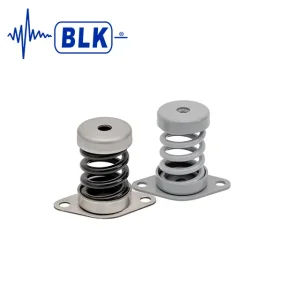
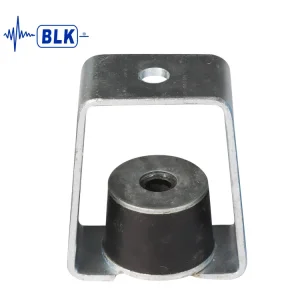
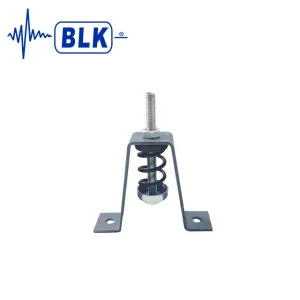
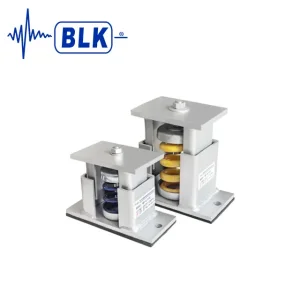
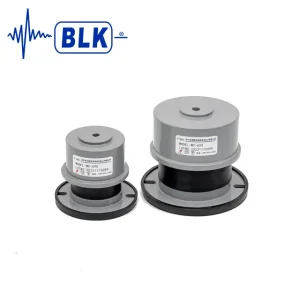
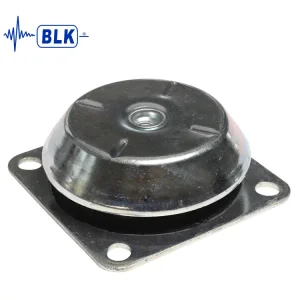
UL Listed & Industrial Elastomeric Isolator Series (Part I)
Select certified low-frequency damping pads, custom-molded rubber mounts, and optical vibration platforms manufactured with extreme precision.
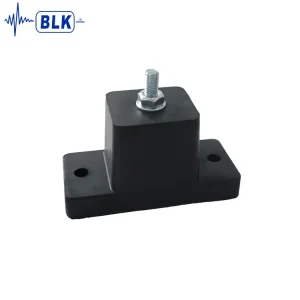
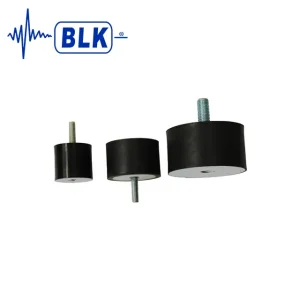
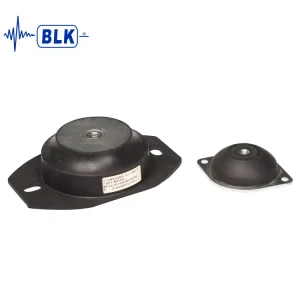
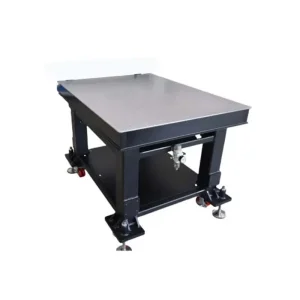
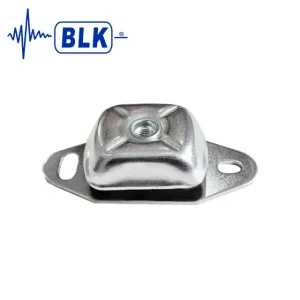
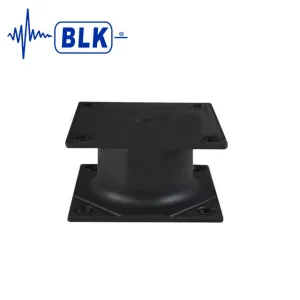
Global & Industrial Landscape of UL Listed Anti-Vibration Mounts
In modern industrial infrastructure, high-rise architectural engineering, and mission-critical commercial facilities, acoustic vibration and structure-borne shock represent silent threats to operational integrity. As rotating machinery, high-tonnage HVAC chillers, emergency fire pumps, and industrial transformers operate, they generate kinetic harmonics that transmit directly into host building slabs. Left unmitigated, these micro-vibrations lead to catastrophic structural fatigue, equipment miscalibration, premature component failure, and intolerable airborne acoustic pollution.
The international engineering baseline has shifted dramatically toward third-party verified vibration control hardware. Specifying UL Listed Anti-Vibration Mounts ensures that mechanical isolation systems do not merely meet acoustic damping parameters, but also comply with strict structural safety, fire-retardant material resilience, and seismic restraint standards such as the International Building Code (IBC) and NFPA 13 seismic guidelines. Factory procurement teams and engineering consultants face a dual directive: securing cost-efficient, competitive pricing ("Low Price") while demanding uncompromising, certified mechanical safety.
A UL Listing on an anti-vibration mount or seismic spring isolator verifies that under maximum dynamic deflection or catastrophic seismic event (up to 2.0g acceleration), the housing, elastomer compound, or steel spring coil will not suffer brittle fracture or structural separation. This prevents life-safety hazard escalation, particularly for overhead fire suppression piping and rooftop mechanical plants.
Industry Trends & Dynamic Market Drivers
The global market for anti-vibration mounts is undergoing a technological transformation driven by four core megatrends: hyper-scale data center expansion, stringent environmental noise regulations (LEED v4.1 acoustics), the rise of sub-nanometer semiconductor fab facilities, and automated Smart Building Management Systems (BMS).
Data Center Micro-Vibration Control
High-density AI server racks and emergency standby diesel generators generate severe floor-borne harmonics. Unisolated vibration causes micro-actuator positioning errors in Hard Disk Drives (HDDs) and optoelectronic transceivers. UL Listed spring mounts with internal viscous dampers are now standard requirements for Tier IV data centers.
EUV / DUV Semiconductor Fab Requirements
Next-generation semiconductor fabs require VC-E and VC-G vibration criteria curve compliance. Pneumatic active-passive hybrid vibration isolation platforms (reaching natural frequencies down to 1.7 Hz) ensure sub-nanometer lithography accuracy without external harmonic distortion.
Green Building Acoustic Compliance
Acoustic comfort credits in LEED, BREEAM, and WELL building standards mandate that mechanical equipment room noise remain below NC-30 or NC-25 levels. High-deflection open-spring mounts paired with neoprene noise pads break structure-borne bridges efficiently.
Localized Application Scenarios & Regional Engineering Demands
Anti-vibration requirements vary substantially depending on local building codes, geographic seismic risk levels, and environmental conditions:
| Target Region | Primary Governing Standard | Critical Isolation Requirement | Recommended Mount Solution |
|---|---|---|---|
| North America (USA / Canada) | IBC Seismic Risk Category D/E/F, OSHPD / HCAI, NFPA 13 | Seismic-restrained spring mounts tested for multi-axis wind/earthquake shearing forces. | Restrained Spring Isolators with All-Directional Limiters (BK-ME/MB Series) |
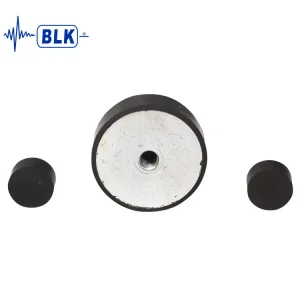
| Europe (EU / UK) | Eurocode 8, EN 12241 Acoustic Standard, CE / RoHS | Eco-compliant elastomeric compounds with REACH compliance and low VOC off-gassing. | High-Damping Neoprene & Polymer Damping Pads (BK-PM / BKTS Series) |
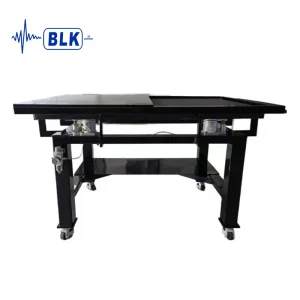
| Asia-Pacific (APAC) | GB 50011, JIS B 0907, High-Speed Rail Proximity Codes | High-frequency attenuation for elevated train noise and heavy industrial press isolation. | Optical Damping Platforms & Viscous Damped Spring Mounts (BK-DT / BK-VT Series) |
| Middle East (GCC Region) | C5-M Heavy Marine Anti-Corrosion Standards | Resistance to high ambient heat (up to 55°C) and extreme coastal salt spray corrosion. | Dacromet 900+ Hour Salt-Spray Coated Spring Mounts with Stainless Hardware |
Engineering Technical Roadmap & Future Outlook
The future of vibration mitigation lies in the synthesis of material science, active feedback control algorithms, and predictive IoT telemetry.
Phase 1: Advanced Hybrid Elastomer Formulation (Current Generation)
Transition from basic natural rubber to cross-linked nitrile, EPDM, and fluorocarbon polymers. Integration of carbon nanotubes (CNTs) increases tear strength by 40% and maintains consistent durometer hardness across -30°C to +120°C temperature operational envelopes.
Phase 2: Embedded IoT Condition Monitoring (Near-Term)
Integrating self-powered MEMS accelerometers into the steel top plates of UL Listed spring mounts. Wireless Bluetooth Mesh / LoRaWAN sensors continuously stream real-time deflection data and FFT harmonic spectra to cloud-based BMS platforms, flagging spring fatigue or mechanical misalignment before catastrophic failure.
Phase 3: Active Electromagnetic & Magnetorheological Damping (Next-Gen)
Combining passive air springs with active voice-coil linear actuators and magnetorheological fluid dampers. Real-time sub-millisecond feedback loops counteract low-frequency transient shocks (0.5 Hz - 5 Hz), completely stabilizing semiconductor cleanrooms and laser interferometers.
Macro Industry Solutions & System Engineering
Achieving optimal vibration isolation requires a holistic system-level design rather than isolated component selection. Below are four macro industry solutions engineered by Bellking Vibration Control:
1. HVAC Central Plant Acoustic Isolation Solution
Challenge: Rooftop centrifugal chillers and cooling towers transmit heavy low-frequency structure-borne hum into top-floor executive offices.
System Approach: Open spring mounts with 50mm static deflection are placed beneath concrete inertia bases. Suspended piping is supported by combination spring and rubber hangers (HV Type), eliminating acoustic bridging across floor penetrations.
2. Power Distribution Transformer Noise Mitigation
Challenge: Dry-type and oil-immersed transformers radiate continuous 100 Hz / 120 Hz magnetostrictive core hum through electrical room concrete foundations.
System Approach: Specially formulated high-damping rubber mounts (BKTS / BKH Type) engineered with high tear resistance isolate the transformer base rails. System delivers up to 18 dB dBA noise reduction in adjacent occupied spaces.
3. Fire Suppression System & Emergency Pump Isolation
Challenge: Emergency diesel fire pumps create severe dynamic torque thrust during immediate automated start-up, risking pipe joint rupture.
System Approach: UL Listed seismic restrained spring mounts (MB / ME Type) featuring heavy-duty steel limit snubbers absorb dynamic start-up torque while guaranteeing compliance with NFPA 20 and NFPA 13 fire safety standards.
4. Precision Optical & Laboratory Isolation
Challenge: High-magnification electron microscopes, laser interferometers, and CMM machines fail calibration due to ambient footfall micro-vibrations.
System Approach: BK-DT Series optical vibration isolation platforms with integrated low-frequency pneumatic diaphragms isolate up to 99% of floor disturbance, achieving cleanroom VC-D/VC-E stability thresholds.
Frequently Asked Questions (FAQ) & Technical Buyer's Guide
Expert answers from senior vibration isolation engineers regarding UL Listing verification, load calculations, and mounting selections.
$$f_n = \frac{1}{2\pi} \sqrt{\frac{g}{\delta}}$$
Where $g$ is acceleration due to gravity ($9.81 \text{ m/s}^2$) and $\delta$ is the static deflection of the mount in meters.
Transmissibility $T$ (ignoring damping factor for simplicity):
$$T = \left| \frac{1}{(f_d / f_n)^2 - 1} \right|$$
Isolation Efficiency ($E$) percentage:
$$E = (1 - T) \times 100\%$$
To achieve over 90% isolation efficiency, the ratio $f_d / f_n$ must be greater than 3.2.
Steel Spring Isolators: Essential for lower-speed rotating machinery (<1,200 RPM / <20 Hz) or critical structural isolation where large static deflection (25mm to 75mm) is required to achieve a natural frequency under 3-5 Hz.
UL Listed & Heavy-Duty Spring Mount Series (Part II)
Explore factory-direct pricing on heavy-duty spring mounts, polymer damping pads, and ceiling hanger isolators.