
Precision Vibration Absorbing Mounts & Pads (Series I)
Factory-direct elastomeric, damped spring, and high-deflection isolation components engineered for HVAC, power infrastructure, and heavy machinery.




Global Commercial & Industrial Status of Vibration Absorbing Mounts
Analyzing structural dynamics, acoustic pollution standards, and total cost of ownership in modern OEM equipment integration.
In contemporary industrial manufacturing, HVAC infrastructure, and high-precision electronic fabrication, micro-vibrations represent a silent tax on productivity, equipment longevity, and compliance. Unmitigated mechanical oscillations generated by rotating equipment—such as chillers, heavy-duty pumps, air handling units (AHUs), diesel generators, and transformer cores—propagate through floor slabs and structural framing as structure-borne noise and kinetic fatigue.
Key Insight for Procurement & Engineering Teams: Sourcing low price vibration absorbing mounts from qualified Chinese factories does not mean compromising structural safety or dynamic damping performance. By bypassing multi-tier regional distributors, global OEMs capture direct factory-gate pricing while maintaining strict alignment with ISO 10816, ASHRAE environmental standards, and DIN 4150 structural vibration guidelines.
The global market for vibration control components has shifted rapidly toward engineered elastomeric compounds (high-damping natural rubber, Neoprene, Nitrile, EPDM) and computer-modeled helical spring assemblies. Modern facilities operate under strict acoustic limits (e.g., LEED certification criteria, municipal noise control ordinances), demanding isolation efficiencies exceeding 90% across disturbing frequencies ranging from 3 Hz to 300 Hz.
Vibration Isolation Physics & Selection Methodology
Understanding transmissibility curves, natural frequency tuning, and dynamic damping ratios for optimal mount specification.
Disturbing Frequency ($f_d$)
Determined directly by equipment RPM or stroke rate. For example, a 4-pole motor operating at 1,750 RPM exhibits a primary forcing frequency of 29.17 Hz ($f_d = \text{RPM} / 60$). Isolation designs must ensure $f_d$ avoids system resonance.
Natural Frequency ($f_n$)
The inherent frequency of the mount under static load, governed by static deflection ($\delta$): $f_n \approx 5 / \sqrt{\delta \text{ (cm)}}$. High deflection springs achieve low natural frequencies (3–5 Hz), isolating low-RPM machines effectively.
Isolation Efficiency ($T_e$)
Calculated via Transmissibility ratio ($T_r$): $T_e = (1 - T_r) \times 100\%$. True isolation only occurs when $f_d / f_n > \sqrt{2}$. Achieving $f_d / f_n \ge 3$ yields over 88% vibration force attenuation.
| Mount Technology | Natural Freq. Range ($f_n$) | Isolation Efficiency Range | Primary Industrial Application | Corrosion / Environmental Suitability |
|---|---|---|---|---|
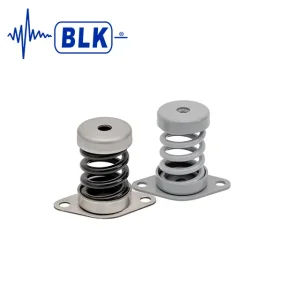
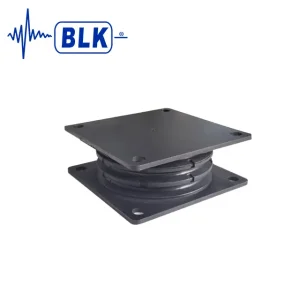
| Spring Mounts (ME, BK-DS) | 3.0 Hz – 5.0 Hz | 95% – 99% | Low-speed chillers, pumps, HVAC compressors, gensets | Excellent (Dacromet / Hot-Dip Galvanized) |
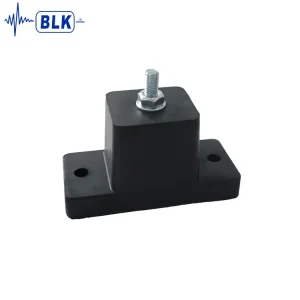
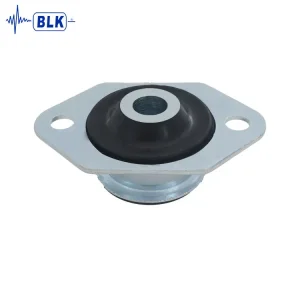
| Elastomeric / Rubber (BKDR, BKP, BKVV) | 8.0 Hz – 15.0 Hz | 80% – 92% | High-speed motors, small air fans, electrical panels | Good (Chemical & Oil resistant polymers) |
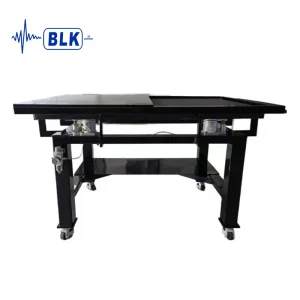
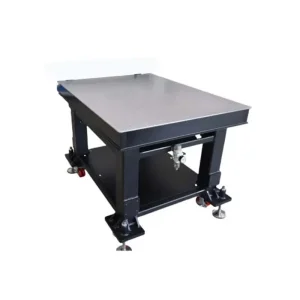
| Pneumatic Air Mounts | 1.7 Hz – 3.0 Hz | 98% – 99.8% | Semiconductor tools, metrology, optical benches | Cleanroom compatible (Controlled environment) |
| Inertia Base Systems (CPB) | Tuned via Springs | 90% – 98% | High-eccentricity pumps, heavy HVAC plant rooms | Heavy-duty structural steel frame + concrete fill |
Localized Deployment Scenarios for Vibration Absorbing Mounts
How specialized mounts solve complex structure-borne noise and mechanical shock issues across global industrial installations.
1. Commercial HVAC & Building Mechanical Rooms
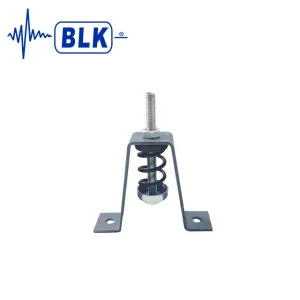
Mounted on upper building floors or basements, large chillers, cooling towers, and suspended ductwork transmit low-frequency hum throughout commercial structures. High-deflection spring hangers (HV Type) and damped spring mounts eliminate tenant complaints and acoustic structural transmission.
2. Semiconductor & Precision Optical Metrology
Wafer inspection equipment, coordinate measuring machines (CMMs), and laser interferometers demand nanometer-scale positional stability. Ultra-low frequency pneumatic isolation platforms (BK-DT Series) filter ambient foot-traffic, highway rumble, and building sway down to 1.7 Hz.
3. Power Transformers & Electrical Substations
Dry-type and oil-immersed transformers emit persistent 100 Hz / 120 Hz magnetostrictive core hum. Specialized elastomeric transformer anti-vibration mounts attenuate sound propagation through concrete foundation pads into adjacent residential or commercial zones.
4. Heavy Industrial Machinery & Stamping Presses
Punch presses, forging hammers, and industrial centrifuges impart massive dynamic kinetic shocks. High-capacity damped rubber mounts (BKDR Type) absorb severe pulse loads (up to 3-5G force), preventing foundation cracking and machine misalignment.
China Factory Supply Chain Resilience & Cost Advantage
Why sourcing vibration mounts directly from Kunshan manufacturing hubs delivers superior price-to-performance ratio for international buyers.
1. Kunshan Precision Manufacturing Cluster Integration
Located in Kunshan, Jiangsu Province, our factory operates within China's premier industrial equipment manufacturing corridor. This spatial concentration offers immediate access to raw material refining (60Si2Mn high-tensile spring steel, premium virgin natural rubber imports, specialty synthetic polymers), advanced CNC machining centers, and automated vulcanization equipment. Supply chain proximity reduces procurement lead times for specialized raw materials from weeks to hours.
2. Vertical In-House Tooling & Rapid Customization (OEM/ODM)
Unlike Western brand catalog distributors who mark up standardized components, our integrated facility maintains an independent mold tooling shop and engineering design team. Custom rubber durometer formulations (Shore A 40 to 75), non-standard load plates, and specific spring stiffness rates can be prototyped in as fast as 3 working days, vastly accelerating product development cycles for original equipment manufacturers.
3. Advanced Surface Treatments & Quality Controls
Cost efficiency does not come at the expense of durability. Our automated Dacromet surface treatment line provides spring components with over 900 hours of salt spray resistance (ASTM B117 standard), far outperforming traditional primer painting. Every production batch undergoes 100% tension-compression load deflection testing and dynamic spectrum analysis before packing.
Technical Roadmap & Next-Generation Vibration Damping
Innovations shaping the future of industrial vibration control: smart IoT sensing, active magnetic levitation, and eco-friendly elastomeric alloys.
IoT-Enabled Smart Mounts
Integration of MEMS tri-axial micro-accelerometers into spring top-plates. Real-time vibration telemetry transmits operational spectra via Modbus/WirelessHART to cloud monitoring dashboards, enabling predictive maintenance before bearing failure occurs.
Hybrid Active Damping (Active Electro-Magnetic)
Combining mechanical springs for static load support with active voice-coil actuators. Counter-phase dynamic forces eliminate low-frequency resonant spikes ($< 1$ Hz) in critical sub-nanometer semiconductor lithography environments.
Recyclable Bio-based Polymers & Metamaterials
Developing non-petroleum-derived rubber polymers engineered for zero toxic off-gassing in cleanrooms, paired with architected lattice metamaterials that dissipate shock energy across multi-frequency bands without fluid degradation.
Localized Support & International Regulatory Standards
Ensuring complete peace of mind for engineering leads, procurement directors, and site installation contractors worldwide.
ISO 9001:2015 Quality Management
Every vibration absorbing mount manufactured in our Kunshan plant is traceable from raw steel heat-numbers and raw rubber compound batches down to final dimensional inspection reports.
Environmental Compliance (RoHS & REACH)
All elastomeric pads, Neoprene isolators, and anti-vibration rubber mounts are certified free of SVHCs (Substances of Very High Concern), heavy metals, and toxic plasticizers, satisfying strict EU environmental audits.
Seismic & Wind Restraints (IBC / OSHPD)
For earthquake-prone zones or rooftop HVAC cooling tower installations, our constrained spring mount series (BK-DS Type) features heavy-duty steel snubbers engineered to withstand horizontal and vertical shear forces up to 2.0g.
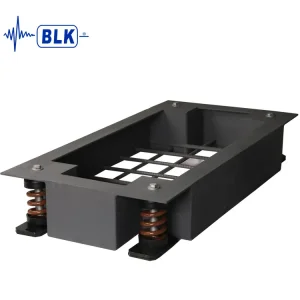
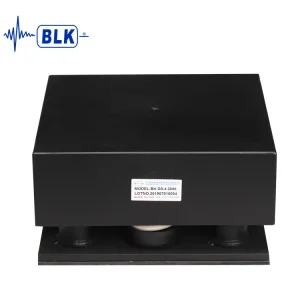
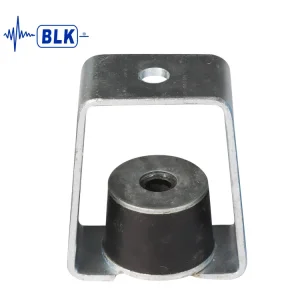
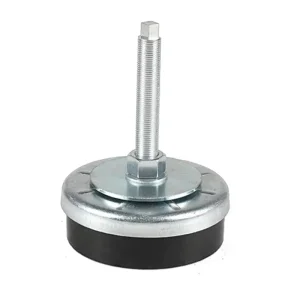
Specialized Vibration Mounts, Hangers & Supports (Series II)
Comprehensive mounting hardware engineered to solve complex structure-borne noise, pipe thrust, and equipment resonance challenges.

Frequently Asked Questions by Technical Procurement & Engineers
Clear engineering guidance on sizing, installation practices, material selection, and custom factory manufacturing.
How do I determine whether my application requires rubber or spring isolators?
The choice depends primarily on your equipment's operating frequency (RPM) and the target isolation efficiency. Rubber mounts (such as BKP or BKDR types) feature higher natural frequencies (8–15 Hz) and are ideal for high-speed equipment ($>1,500$ RPM) such as small motors, air compressors, and light fans. Spring isolators (ME or BK-DS types) provide low natural frequencies (3–5 Hz) and large static deflections, making them essential for lower-speed equipment (e.g., chillers operating at 300–1,200 RPM) where high vibration isolation efficiency ($>95\%$) is required.
What key data must be supplied to factory engineers for accurate mount sizing?
To receive a fully verified engineering sizing calculation within 24 hours, provide: (1) Total operating wet weight of the machine, (2) Exact position of the Center of Gravity (CG), (3) Number, layout, and mounting hole dimensions of support points, (4) Operational speed (RPM) or forcing frequency, and (5) Environmental conditions (e.g., outdoor corrosive salt mist, oil exposure, seismic zone requirement).
Why is an Inertia Base (CPB Type) recommended for heavy water pump installations?
End-suction and split-case pumps experience dynamic fluid thrust during startup and operational surges. An inertia base adds structural mass (typically 1 to 2 times the weight of the pump assembly), lowering the overall center of gravity, curbing transient motion, preventing pipe flange shear fatigue, and maintaining shaft alignment when mounted on spring isolators.
How does direct factory procurement from Kunshan impact pricing and OEM delivery schedules?
By eliminating third-party trading intermediaries and regional brand licensing markups, direct factory sourcing typically yields a 30% to 50% cost reduction on high-grade vibration absorbing mounts. Standard catalog models ship within 24 hours, while custom 1:1 OEM engineering designs can be turned around in as fast as 3 to 5 working days.
What surface protection measures prevent atmospheric corrosion on steel spring isolators?
Our standard spring isolation units receive a multi-stage Dacromet coating or heavy hot-dip galvanizing process tested to withstand over 900 hours of continuous salt spray (per ASTM B117), making them suitable for coastal offshore installations, cooling tower basins, and high-humidity industrial environments.