Custom Elastic Vibration Isolation Solutions
Explore our top-tier precision mounts, rubber vibration isolators, and multi-layer structural dampers direct from ISO 9001 certified manufacturing facilities.
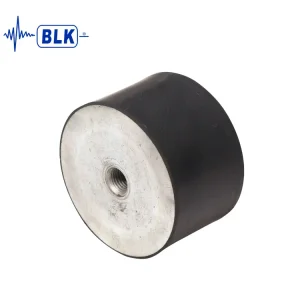
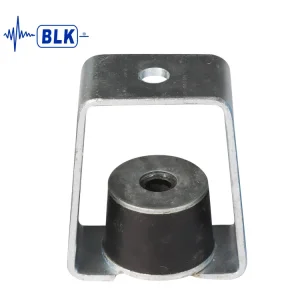
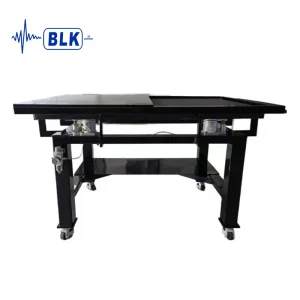
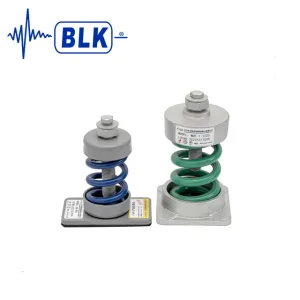
Engineering Fundamentals of Custom Elastic Vibration Isolation
In modern mechanical and structural engineering, controlling structure-borne vibration and unwanted mechanical energy transfer is crucial. Unmitigated dynamic vibration causes structural fatigue, severe noise radiation, reduced tool accuracy, and component failure in heavy industrial machinery, precision cleanrooms, power distribution hubs, and commercial HVAC networks.
Elastic vibration isolation operates by introducing a resilient medium—typically engineered elastomers (such as Natural Rubber, NBR, EPDM, Silicone, or Fluoroelastomers) or steel springs paired with elastomeric damping elements—between a vibrating source and its supporting foundation. The primary goal is to shift the natural frequency of the mechanical system ($f_n$) significantly lower than the disturbing excitation frequency ($f_d$) of the operating machinery.
Key Dynamics: Dynamic-to-Static Stiffness Ratio ($K_d / K_s$) & Damping Factor
Designing effective elastic vibration isolation requires controlling the elastomeric material's static stiffness ($K_s$) and dynamic stiffness ($K_d$). While static deflection determines physical settlement under dead load, dynamic stiffness dictates the response during operation. Elastomers exhibit viscoelastic properties, meaning their dynamic stiffness is higher than static stiffness by a factor of 1.2 to 2.5 depending on durometer hardness, elastomer compound, and frequency spectrum.
System performance is quantified by Transmissibility ($T$), defined as:
$$T = \sqrt{\frac{1 + (2\zeta r)^2}{(1 - r^2)^2 + (2\zeta r)^2}}$$
where $r = f_d / f_n$ is the frequency ratio and $\zeta$ is the system damping ratio. Isolation occurs only when $r > \sqrt{2} \approx 1.414$. To achieve isolation efficiencies above 90% to 99%, mechanical systems target a frequency ratio $r \ge 3.0$.
Custom Elastic Isolator Technical Performance Matrix
Compare mechanical properties across core elastic mount configurations to optimize static deflection, resonant avoidance, and environmental durability.
| Isolator Family / Type | Dynamic/Static Ratio ($K_d/K_s$) | Natural Frequency ($f_n$) | Damping Ratio ($\zeta$) | Corrosion Defense Coating | Target Industrial Application |
|---|---|---|---|---|---|
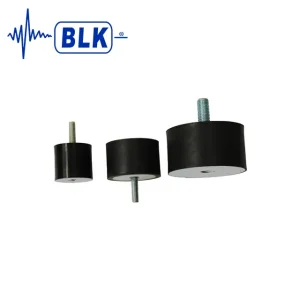
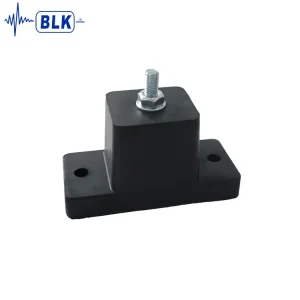
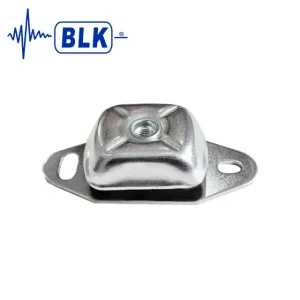
| BKVE / BKDD Rubber Mounts | 1.3 – 1.8 | 7.0 – 12.0 Hz | 0.08 – 0.15 | Zinc Galvanized / Dacromet | Small compressors, industrial pumps, hydraulic units |
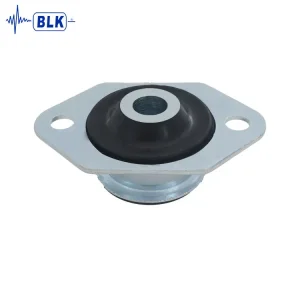
| BKM / BKCN Cone Mounts | 1.4 – 2.0 | 6.0 – 10.0 Hz | 0.10 – 0.18 | Electro-Coated / Dacromet | Cab mounts, mobile generators, marine auxiliary engines |
| MD Spring Isolators w/ Viscous Damping | 1.05 – 1.15 | 3.0 – 5.0 Hz | 0.02 – 0.08 | 900h Salt Spray Dacromet | Heavy HVAC chillers, cooling towers, power generators |
| HR Rubber Hangers & Dampers | 1.3 – 1.6 | 8.0 – 14.0 Hz | 0.07 – 0.12 | Powder Coated Steel Casing | Suspended piping networks, air handling unit ducts |
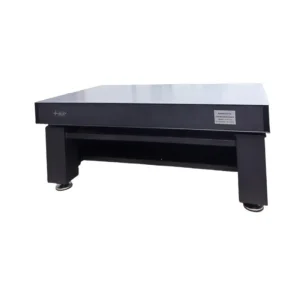
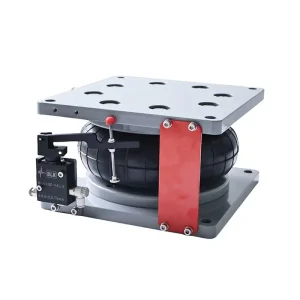
| BK-VT / BK-PF Precision Air Mounts | 1.02 – 1.08 | 1.7 – 2.5 Hz | 0.15 – 0.25 (Active) | Anodized Aluminum / SS304 | Semiconductor CMMs, optical tables, cleanroom metrology |
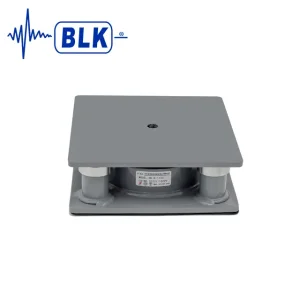
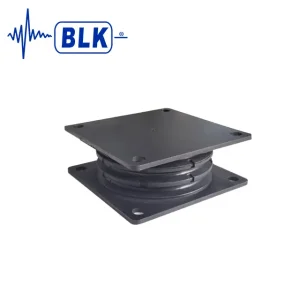
| BKSWA Multi-Layer Dampers | 1.5 – 2.2 | 5.0 – 9.0 Hz | 0.12 – 0.20 | Custom Polymer Base | Transformer shock mitigation, heavy stamping presses |
Price Drivers & Cost Structure for Custom Vibration Isolators
Understanding the raw material, engineering, and manufacturing variables that impact factory-direct pricing for standard and custom elastic vibration isolators.
Elastomeric Compound Selection
Base polymer choice dictates raw material cost. Standard Natural Rubber (NR) and Nitrile (NBR) offer high cost-efficiency. Specialty compounds like EPDM (for ozone/weathering), Silicone (high/low temp extremes), or Viton/Fluoroelastomers add a material premium ranging from 30% to 250% per unit weight.
Tooling & Custom Mold Amortization
Custom geometries (such as specialized cone profiles or multi-tiered matrix mounts) require custom steel compression molds. Factory direct sourcing from integrated plants like Bellking minimizes initial tooling investment (typically $800–$3,500 per mold), which is amortized rapidly across production runs over 500 units.
Surface Protection & Hardware Alloys
Standard indoor mounts utilize commercial zinc electroplating. Heavy-duty, marine, or chemical applications require advanced Dacromet multi-layer coatings (capable of 900+ hour salt spray resistance) or full Stainless Steel (SS304/SS316) hardware, impacting final unit prices by 15% to 45%.
Localized Application Scenarios & Engineering Deployment
Real-world deployment demands tailored vibration control tailored to specific operating environments and regulatory frameworks globally.
Semiconductor Cleanrooms & Sub-Fab Facilities
In East Asian mega-fabs (Taiwan, Japan, Mainland China), sub-fab environments experience continuous low-frequency vibrations from vacuum pumps, CMP tools, and lithography suites. Custom pneumatic platforms (BK-VT and BK-PF) supply sub-2Hz resonance control to prevent nanometer-scale line distortion.
Power Substations & Transformer Hum Isolation
Urban electrical transformers generate a continuous 100Hz/120Hz magnetostrictive acoustic hum. Custom matrix mounts and transformer isolators installed at substations prevent core vibration from transmitting into surrounding building foundations, complying with strict municipal noise standards.
Rooftop HVAC Plant Rooms & Chiller Skids
Commercial building HVAC installations in North America and Europe demand strict compliance with ASHRAE guidelines. Heavy open-spring isolators with viscous damping (MD Series) and rubber pads absorb low-frequency motor dynamics while providing seismic and wind restraint protection.
Technology Roadmap: Future of Elastic Isolation
How next-generation materials science, smart sensors, and active-passive hybrid architectures are redefining industrial vibration damping.
China Factory Supply Chain Resilience & Manufacturing Efficiency
Global procurement specialists and OEM engineering directors increasingly rely on centralized manufacturing hubs in China—specifically Kunshan, Jiangsu—to balance precision quality with supply chain speed and cost leadership.
The Kunshan Precision Manufacturing Cluster Advantage
Bellking Vibration Reduction Equipment Manufacturing (Kunshan) Co., Ltd. benefits directly from operating inside the world's highest-density industrial supply ecosystem. Located in Kunshan, our facility operates within a 50-kilometer radius of tier-1 raw rubber compounding facilities, precision wire winding mills, specialized CNC machining hubs, and advanced surface-treatment facilities (such as automated Dacromet coating plants).
72-Hour Rapid Tooling Cycle
Our integrated CNC tool-making center allows custom rubber mold design, prototype machining, and sample vulcanization in as little as 3 working days, reducing global product development lead times by up to 60%.
Vertical Process Control
From raw elastomer Banbury mixing, high-tonnage vacuum compression molding, robotic frame welding, to 900-hour salt spray batch testing, all core operations remain vertically integrated within our 2,000 m² plant.
Intellectual Property & R&D Capacity
As a designated National High-Tech Enterprise, Bellking holds 37 patents—including 16 national invention patents—underlining our engineering depth in low-frequency resonance mitigation.
Localization Support & Global Compliance Assurance
Rigorous international certification frameworks ensure seamless engineering integration and regulatory acceptance across all global jurisdictions.
ISO 9001:2015 Quality Management
Every manufacturing step follows audited Quality Management System procedures. Full material heat traceability, durometer testing, dynamic load testing, and batch inspection certificates accompany every shipment.
Environmental Compliance (RoHS & REACH)
Elastomer compounds undergo third-party chemical screening ensuring total compliance with EU RoHS 3 and REACH regulations, eliminating toxic heavy metals, phthalates, and SVHC hazardous substances.
Structural & Acoustic Standards Alignment
Designed and verified to comply with major global mechanical standards, including DIN 4150-3 (Structural Vibration in Buildings), ASHRAE 170 (HVAC Vibration), and ISO 10816 (Mechanical Vibration Measurement).
Frequently Asked Questions (FAQ)
Get authoritative answers from senior engineering staff regarding custom elastic isolation selection, calculation methods, pricing, and factory lead times.
Precision Platforms & Air Mount Isolation Products
Discover our comprehensive collection of specialized active/passive isolation platforms, matrix mounts, cone dampeners, and low-frequency pneumatic mounts.