
Featured Precision Vibration Control Systems (Series I)
Direct factory-engineered isolation mounts, rubber pads, spring hangers, and active-ready pneumatic platforms manufactured to stringent mechanical compliance standards.





Understanding Kinetic Vibration Control Systems: An Engineering Perspective
Mechanical vibration and structure-borne acoustic transmission represent major operational challenges in industrial plants, high-rise commercial structures, and cleanroom semiconductor facilities. Custom kinetic vibration isolators are explicitly designed to attenuate disturbances at the source or shield sensitive payload systems from external excitation forces.
When operating heavy HVAC machinery—such as centrifugal chillers, industrial cooling towers, high-pressure air handling units (AHUs), and emergency diesel power generators—dynamic kinetic forces are transferred directly into building floors and structural slabs. Without precision-matched vibration isolation, these harmonic disturbances induce structural fatigue, violate municipal acoustic codes, and destroy precision instrumentation in nearby laboratories.
The efficiency of a kinetic vibration isolator depends on the ratio between the equipment's forced disturbing frequency ($f_d$) and the isolator's natural frequency ($f_n$). Isolation occurs strictly when $f_d / f_n > \sqrt{2} \approx 1.41$. The transmissibility equation is governed by:
$$T = \sqrt{\frac{1 + (2\zeta r)^2}{(1 - r^2)^2 + (2\zeta r)^2}}$$
Where $r = f_d / f_n$ is the frequency ratio, and $\zeta$ is the damping ratio. To achieve greater than 95% to 99% isolation efficiency, mechanical designers must ensure $r \ge 3$ to $5$.
Low-Frequency Steel Spring Isolators
Spring mounts provide low natural frequencies ($3.0\text{ Hz}$ to $5.0\text{ Hz}$), ideal for equipment operating at low rotational speeds ($1,200\text{ RPM}$ to $1,800\text{ RPM}$). Integrated viscous dampers prevent resonant amplitude spikes during equipment startup and shutdown sequences.
Elastomeric & Rubber Shear Mounts
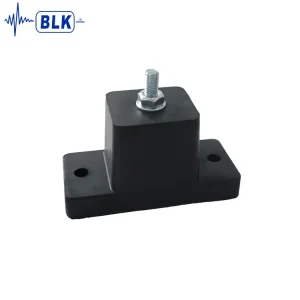
High-grade Neoprene and Natural Rubber isolators excel at mitigating high-frequency acoustic noise and structure-borne hum above $15\text{ Hz}$. They feature internal damping, preventing sound bridge transmission along metal-to-metal mounting bolts.
Pneumatic Air Springs & Precision Platforms
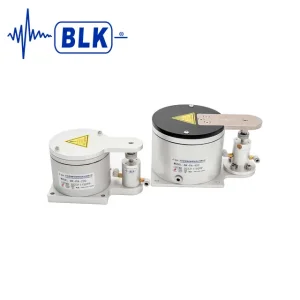
Pneumatic air mounts achieve ultra-low natural frequencies down to $1.2\text{ Hz} - 1.7\text{ Hz}$. Equipped with automatic level sensing valves, they are essential for semiconductor inspection tools, electron microscopes (SEM/TEM), and laser interferometers.
Custom Kinetics Vibration Isolation Pricing Mechanics & Total Cost of Ownership (TCO)
Procurement directors and MEP engineering contractors seeking "Kinetics vibration isolation price" must evaluate raw material specifications, dynamic load ratings, custom structural engineering overhead, and surface protection treatments.
Sourcing direct from accredited Chinese OEM manufacturers drastically eliminates middleman distributor markups while ensuring compliance with international manufacturing specifications. Below is an authentic B2B procurement price benchmark matrix spanning various custom kinetics isolation product tiers.
| Isolator System Category | Typical Load Capacity per Point | Natural Frequency ($f_n$) | Estimated Factory Direct Unit Price (USD) | Primary Industrial Applications |
|---|---|---|---|---|
| BKTS / BKDJ Rubber Pads | $50\text{ kg} - 2,500\text{ kg}$ | $8\text{ Hz} - 15\text{ Hz}$ | $3.50 – $28.00 | HVAC units, small pumps, punch presses, floor Damping |
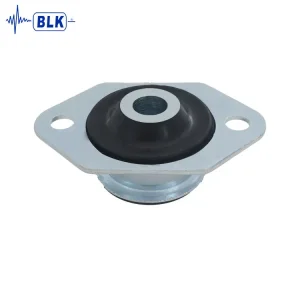
| BKDD / BKVD Rubber Mounts | $20\text{ kg} - 800\text{ kg}$ | $6\text{ Hz} - 12\text{ Hz}$ | $8.00 – $45.00 | Diesel generators, electric motors, cabinet fans |
| ME / HV Spring Mounts & Hangers | $100\text{ kg} - 4,500\text{ kg}$ | $3.0\text{ Hz} - 5.0\text{ Hz}$ | $25.00 – $180.00 | Chillers, AHUs, suspended piping, cooling towers |
| CPB Type Inertia Base Frames | $500\text{ kg} - 12,000\text{ kg}$ | Custom Dynamic Match | $220.00 – $1,250.00 | High-pressure end-suction pumps, reciprocating compressors |
| BK-PA Precision Pneumatic Air Mounts | $100\text{ kg} - 3,000\text{ kg}$ | $1.2\text{ Hz} - 2.0\text{ Hz}$ | $180.00 – $850.00 | Semiconductor steppers, CMMs, optical tables |
| BK-AT / BK-VT Desktop Platforms | $10\text{ kg} - 300\text{ kg}$ | $1.5\text{ Hz} - 2.5\text{ Hz}$ | $350.00 – $1,600.00 | Analytical balances, atomic force microscopes (AFM) |
China Factory Supply Chain Ecosystem & Manufacturing Process
Operating out of the advanced industrial hub of Kunshan, Jiangsu Province, our specialized manufacturing facilities combine heavy-duty structural steel fabrication with precision polymer formulation.
High-Tensile Alloy Spring Wire Synthesis
We utilize premium 60Si2Mn and 50CrVa spring steel with shot-peening treatments, eliminating internal stresses and guaranteeing zero sag over decades of continuous maximum compression loads.
Dacromet Anti-Corrosion Surface Finishing
Standard paint coatings fail under harsh coastal or industrial environments. Our isolators undergo Dacromet thermo-reactive zinc-chromate processing, passing 900+ hours of continuous salt spray testing per ASTM B117.
Robotic Welding & CNC Machining Precision
Automated robotic MIG/TIG welding cells ensure deep penetration welds on custom inertia bases and seismic restraint brackets, removing human error and maintaining structural fatigue limits.
Industry Trends: Next-Generation Vibration Mitigation Innovations
The global vibration control industry is undergoing rapid technical evolution, driven by ultra-clean semiconductor fabrication requirements, high-density AI data centers, and rigorous building acoustic regulations.
1. Hybrid Passive-Active Pneumatic Isolation: Traditional passive pneumatic mounts are increasingly paired with piezo-actuated active feedback loops, enabling sub-hertz isolation ($< 0.5\text{ Hz}$) and instant stabilization against stage motion acceleration in EUV lithography tools.
2. Integrated Seismic-Vibration Dual Protection: Modern municipal codes (e.g., California OSHPD, IBC 2024) mandate that mechanical isolation systems possess integrated tri-axial seismic snubbing. Our custom kinetics spring isolators feature heavy-duty steel housings capable of withstanding $3.0\text{G}$ to $5.0\text{G}$ lateral shear loads.
3. Eco-Friendly Elastomers & Polymer Damping: Transitioning away from polycyclic aromatic hydrocarbon (PAH) heavy rubbers toward environmentally compliant, low-outgassing synthetic elastomers tailored for ISO Class 3 cleanroom environments.
Targeted Application Scenarios & Engineering Implementations
Different engineering fields impose radically different dynamic loads, excitation frequencies, and environmental constraints. Below is a breakdown of custom kinetics vibration isolation solutions across core industries.
Commercial High-Rise Mechanical Rooms
Chillers, pumps, and cooling towers located on upper levels or roof slabs transmit low-frequency hum throughout the building structure. Installing ME spring isolators and CPB inertia bases reduces structure-borne noise levels by up to $35\text{ dB(A)}$.
Electrical Transformers & Generators
Dry-type and oil-immersed power transformers emit a constant $100\text{ Hz} / 120\text{ Hz}$ magnetostrictive hum. Specialized transformer anti-vibration mounts attenuate structure-borne hum, preventing sound propagation into adjacent commercial offices or residential areas.
Cleanroom Precision Metrology & Wafer Fab
Sub-micron semiconductor manufacturing tools require protection against micro-seismic footfall vibrations. BK-PA pneumatic air mounts eliminate environmental noise floor interference down to VC-E and VC-G vibration criterion curves.
Compliance, Quality Assurance & Global Localized Technical Support
Deploying industrial isolation equipment overseas requires strict compliance with local safety codes, structural engineering reviews, and prompt technical support.
Full International Regulatory Compliance: Our manufacturing facility operates under strict ISO 9001:2015 Quality Management Systems. Products comply with international standards including CE, RoHS, REACH, and ASHRAE equipment isolation guidelines.
24/7 Global Engineering Consultation: We provide 1:1 dynamic sizing verification. By transmitting equipment dimensions, total operating weight, center of gravity (CG), and operating RPM, our application engineers deliver comprehensive Finite Element Analysis (FEA) reports and isolation layout CAD drawings within 24 hours.
Featured Precision Vibration Control Systems (Series II)
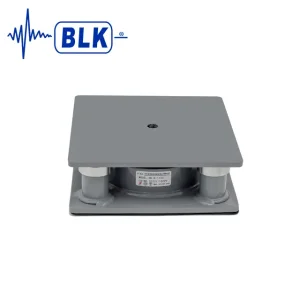
Explore our complementary range of heavy-duty spring mounts, cone mounts, high-deflection hangers, and air isolator systems.





Technical Engineering FAQ & Procurement Guidance
Detailed answers to the most critical technical and purchasing inquiries encountered by structural consultants and procurement officers.