
Precision Elastomeric & Vibration Control Product Range
Explore our primary factory-direct damper units, optical platforms, and dynamic anti-vibration mounts engineered for low dynamic stiffening and long-term durability.








Understanding Low-Damping Rubber Dampers: Mechanics & Physics
In industrial vibration control engineering, selecting between high-damping and low-damping elastomeric materials is a crucial trade-off between resonance amplitude suppression and high-frequency isolation efficiency. A low-damping rubber damper is specifically formulated using high-purity natural rubber (NR) or high-resilience synthetic elastomers (such as polybutadiene or low-viscosity neoprene blends) characterized by a low loss factor ($\tan \delta \le 0.05 \text{ to } 0.10$).
Information Gain: The Transmissibility Principle
While high-damping rubber dissipates energy quickly during startup or shutdown resonance, it suffers from a major engineering limitation: it stiffens dynamically at high excitation frequencies. This dynamic stiffening elevates vibration transmissibility ($T$) in the isolation region where the forcing frequency ratio $r = f/f_n > \sqrt{2}$. Conversely, low-damping rubber dampers maintain superior isolation performance ($T \ll 1$) across ultra-high excitation frequencies, preventing structure-borne acoustic noise transmission in sensitive environments.
The fundamental formula governing steady-state transmissibility ($T$) of a single-degree-of-freedom (SDOF) elastomeric damper highlights this critical mathematical relationship:
Where $\zeta$ is the damping ratio ($\zeta = \tan \delta / 2$), and $r$ is the frequency ratio ($f_{operating} / f_{natural}$). When $r > 3$, reducing $\zeta$ directly minimizes transmissibility $T$. For precision optical platforms, high-speed CNC spindles, HVAC centrifugal chillers, and transformer substations, low-damping rubber dampers offer maximum isolation performance by minimizing energy leakage into surrounding mounting structures.
Macro Industry Applications & Engineered Solutions
Custom low-damping rubber dampers provide tailored elastic performance for critical infrastructure, manufacturing plants, high-tech labs, and energy hubs worldwide.
Semiconductor & Metrology Cleanrooms
Sub-nanometer wafer probing and coordinate measuring machines (CMMs) are extremely sensitive to ambient micro-vibrations. Custom low-damping rubber mounts isolate ultra-high frequencies ($>50 \text{ Hz}$) generated by cleanroom air handling units (AHUs) and floor resonances without introducing thermal drift or chemical off-gassing.
Hyperscale Data Center HVAC Infrastructure
Continuous operation of roof-top chillers, cooling towers, and variable-refrigerant flow (VRF) pumps produces persistent tonal hums. Low-damping rubber dampers stop structure-borne acoustic vibration from migrating through concrete slabs into server racks, preventing disk drive head disruption and structural fatigue.
Substation Transformers & Energy Storage
Magnetostriction in electrical transformer cores generates magnetostrictive forces at 100 Hz / 120 Hz harmonics. Bellking custom-formulated low-damping elastomer pads decouple heavy transformer footings from substation foundations, cutting low-frequency acoustic noise emissions in urban grid locations.
Dynamic Stiffening Ratio ($K_d / K_s$) & Compound Mechanics
When specifying custom rubber dampers, mechanical engineers often make the mistake of designing solely based on static deflection ($\delta_s$) and static stiffness ($K_s$). However, elastomers under cyclic dynamic motion exhibit viscoelastic behavior where dynamic stiffness ($K_d$) exceeds static stiffness ($K_s$).
| Elastomer Compound Type | Hardness (Shore A) | Loss Factor ($\tan \delta$) | Dynamic Stiffening Ratio ($K_d / K_s$) | Operating Temp Range | Primary Isolation Advantage |
|---|---|---|---|---|---|
| Low-Damping Natural Rubber (Bellking Blend NR-L) | 40 - 60 | 0.03 - 0.06 | 1.15 - 1.25 | -35°C to +70°C | Lowest dynamic stiffness ratio; maximum continuous isolation efficiency ($>98\%$). |
| High-Resilience Neoprene (CR-LR) | 45 - 65 | 0.06 - 0.09 | 1.30 - 1.45 | -25°C to +90°C | Balanced oil, ozone, and flame resistance with minimal thermal dynamic stiffening. |
| High-Damping Nitrile / EPDM (Comparison) | 50 - 75 | 0.20 - 0.45 | 1.80 - 2.40 | -20°C to +120°C | High transient energy absorption; less effective at high-frequency acoustic decoupling. |
| Low-Damping EPDM (Bellking Custom Formulation) | 50 - 70 | 0.07 - 0.10 | 1.35 - 1.50 | -40°C to +130°C | Excellent weather and UV aging resistance for outdoor chillers and power plants. |
By optimizing the vulcanization cross-linking density and selecting high-structure carbon black fillers in low dosage, Bellking achieves a ultra-low dynamic stiffening ratio ($K_d / K_s \approx 1.2$). This ensures that the installed natural frequency of the mount remains stable regardless of excitation frequency shifts.
Custom Low-Damping Rubber Damper Factory & Price Structure
Direct-from-factory procurement eliminates intermediary markup while guaranteeing rigorous quality compliance under ISO 9001 standards. Pricing for custom low-damping rubber dampers depends primarily on four commercial and engineering variables:
1. Elastomer Compound Chemistry
Pure natural rubber compounds with specialized antiozonants offer the lowest material cost with exceptional dynamic properties, whereas fluorocarbon or silicone low-damping blends carry higher raw material cost.
2. Metal Insert Surface Bonding
Precision CNC-machined steel flanges or aluminum baseplates treated with Chemlok hot-vulcanization bonding agents ensure zero interface delamination under high shock shear loads ($>3\text{G}$).
3. Tooling & Mold Amortization
Standard cylindrical mounts incur zero tooling fees. Custom geometries (e.g., progressive stiffness ribs or integrated leveling bolts) require custom steel compression molds ($300 - $1,200$ one-time fee).
4. Batch Volume Tiers
High-volume automated press lines reduce unit manufacturing costs dramatically. Volume tiers (>500 pcs) yield price savings of 35% to 50% compared to prototype runs.
| Damper Model / Custom Series | Load Capacity Range (kg/mount) | Natural Freq ($f_n$) | Est. Sample Unit Price (USD) | Volume OEM Price (500+ Pcs) | Lead Time (Standard vs Custom) |
|---|---|---|---|---|---|
| BKDD Series (Light-Duty Cylindrical) | 10 - 150 kg | 8 - 12 Hz | $3.50 - $8.00 | $1.80 - $4.20 | 24 Hours / 7 Days |
| BKDE Series (Heavy Equipment Mount) | 150 - 1,200 kg | 6 - 10 Hz | $12.00 - $35.00 | $6.50 - $18.00 | 24 Hours / 10 Days |
| BK-DSR Damped Custom Rubber Series | 200 - 2,500 kg | 5 - 8 Hz | $28.00 - $75.00 | $14.00 - $38.00 | 3 Days / 12 Days |
| BK-MT Matrix Anti-Vibration Array | 500 - 5,000 kg | 4 - 7 Hz | $85.00 - $220.00 | $45.00 - $110.00 | 3 Days / 14 Days |
Localized Application Scenarios & Real-World Results
Sub-Micron Laser Interferometry
Challenge: Structural excitation from neighboring tramlines created 45 Hz floor harmonics that disrupted precision optical measurements.
Solution: Installation of 16 custom Bellking low-damping NR mounts beneath the granite isolated 94.2% of ground vibrations, stabilizing optical fringe readings without pneumatic power consumption.
Rooftop Chiller Acoustic Retrofit
Challenge: Tonal structure-borne acoustic noise (120 Hz) exceeded local environmental sound regulations at night.
Solution: Replaced standard high-stiffness rubber pads with BK-DSR custom low-damping rubber dampers. Structure-borne sound levels inside executive offices dropped by 18 dB(A).
500 kVA Transformer Base Decoupling
Challenge: Severe 100 Hz hum propagated through concrete foundation walls into an adjacent residential district.
Solution: Custom vulcanized low-damping neoprene base pads fitted with Dacromet corrosion-resistant steel plates eliminated 96% of kinetic energy coupling, ensuring total EPA acoustic compliance.
Global Engineering Compliance & Field Support
Every Bellking custom low-damping rubber damper is designed, batch-tested, and certified against stringent international engineering standards. We provide full documentation traceability to support OEM machine builders, MEP contractors, and municipal infrastructure projects globally.
ISO 9001 & ISO 14001 Quality Control
Every production batch undergoes dynamic tension-compression testing, durometer verification, and zero-defect visual inspection. Dynamic spectrum analysis report included with all commercial shipments.
Environmental & Chemical Safety
Compliant with EU RoHS 3 and REACH SVHC standards. Free from heavy metals, toxic plasticizers, or polycyclic aromatic hydrocarbons (PAHs), safeguarding indoor air quality in HVAC cleanrooms.
900-Hour Corrosion Resistance
Steel outer casings and bonded baseplates are coated with advanced Dacromet or hot-dip galvanization passing 900+ hours of continuous salt spray testing per ASTM B117 for extreme coastal environments.
Next-Generation Innovations in Elastomeric Vibration Control
Piezoelectric Sensor Integration
Embedding micro-piezoelectric film sensors into low-damping rubber mounts enables real-time dynamic force monitoring and predictive health management (PHM) for Industry 4.0 automated factories.
Magnetorheological Hybrid Dampers
Combining low-damping rubber bases with fast-responding magnetorheological (MR) fluids allows active tuning of damping ratios during resonance transients while maintaining ultra-low stiffness during steady state.
Bio-Based Sustainable Isoprene Polymers
Replacing synthetic petroleum monomers with bio-derived monomers allows us to produce carbon-neutral low-damping elastomers with identical mechanical fatigue strength and low creep drift.
Complementary Vibration Isolation & Support Systems
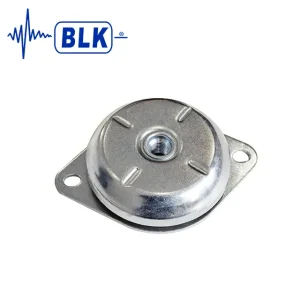
Explore our additional specialized vibration mounts, matrix isolators, desktop platforms, and low-cost factory-direct rubber mounts.







Technical FAQ: Engineering, Sizing & Factory Procurement
Why choose a low-damping rubber damper over a high-damping damper for continuous-duty equipment?
How do temperature fluctuations affect low-damping elastomer performance?
What technical data is required to size a custom low-damping rubber damper?
What is the typical factory lead time for custom tooling and sample prototypes?
How do Bellking low-damping rubber dampers compare against metallic spring mounts?
Are Bellking rubber mounts certified for salt spray and outdoor exposure?
Need a Custom Low-Damping Rubber Solution?
Contact our application engineering team in Kunshan today. Get custom FEA dynamic stiffness analysis, tooling quotes, and factory-direct pricing within 24 hours.
Request Custom Engineering Quote