


The Evolution of Renewable Energy Vibration Damping Systems
As the world transitions to multi-gigawatt clean energy infrastructure, mechanical vibration control has evolved from a passive maintenance consideration into a critical factor governing Levelized Cost of Energy (LCOE) and asset longevity.
1. The Scalability Challenge: Larger Turbines, Broader Arrays, and Accelerated Fatigue
Modern renewable energy infrastructure operates under harsh physical stresses. Offshore wind turbine capacities have reached 15 MW to 18 MW per unit, with rotor diameters exceeding 240 meters. At this scale, low-frequency aerodynamic excitation, rotor unbalance, and hydrodynamic wave action induce multi-axis dynamic loads on the nacelle, gearbox, and tower structure.
Without custom tuned mass dampers (TMDs) and high-deflection spring isolators, structural fatigue leads to micro-cracking in welded joints, premature bearing failure, and grid-frequency acoustic resonance. Similarly, utility-scale solar trackers (single-axis and dual-axis) suffer from wind-induced galloping and torsional aeroelastic instability under wind gusts exceeding 15 m/s, necessitating specialized bidirectional hydraulic and elastomeric dampers.
2. Battery Energy Storage Systems (BESS) & High-Frequency Acoustic Damping
With the surge in containerized lithium-ion and sodium-ion Energy Storage Systems (BESS), HVAC liquid chillers, cooling pumps, and power conversion systems (PCS) operate continuously inside rigid steel enclosures. Unmitigated mechanical vibrations create structural harmonics, which loosen internal busbar joints, degrade thermal interface materials (TIM), and breach acoustic noise ordinances near residential grids.
Wind Power Dynamics
Driveshaft, generator, and nacelle isolation designed to mitigate order frequencies (1P, 3P, 6P) and structural bending modes.
Solar Tracker Stabilization
Viscous linear and rotary dampers engineered to stop vortex-induced vibration (VIV) and aeroelastic torsional flutter.
BESS Container Damping
Precision elastomeric pads and isolated inertia frames preventing HVAC inverter resonance from transferring to cell racks.
Selection Mechanics & Mathematical Principles of Damping
Predictable vibration attenuation requires calculating natural frequencies, dynamic stiffness matrix, and transmissibility under variable operational temperatures.
When engineering custom renewable energy isolators, the core goal is achieving an optimal disturbing frequency to natural frequency ratio ($f_d / f_n \ge 3$). Isolation commences only when this ratio exceeds $\sqrt{2} \approx 1.414$.
$$f_n = \frac{1}{2\pi} \sqrt{\frac{K_d}{m}} = \frac{15.8}{\sqrt{\delta_{st}}} \quad [\text{Hz}]$$
Where $K_d$ is dynamic stiffness (N/mm), $m$ is supported mass (kg), and $\delta_{st}$ is static deflection (mm).
2. Vibration Transmissibility ($T_r$):
$$T_r = \sqrt{\frac{1 + (2\zeta \cdot \frac{f_d}{f_n})^2}{(1 - (\frac{f_d}{f_n})^2)^2 + (2\zeta \cdot \frac{f_d}{f_n})^2}}$$
Where $\zeta$ is the damping ratio (C/C_c) provided by the elastomeric compound or viscous fluid.
Never size an isolator solely on total static load weight. Dynamic shock amplification during turbine emergency shutdowns or solar tracker high-wind stow procedures can generate instantaneous forces 3.0x to 5.0x the nominal load rating. Always demand verified dynamic load-deflection curves (DIN 53513 / ISO 4664) from your manufacturer.
| Damper Technology Type | Natural Freq ($f_n$) | Damping Ratio ($\zeta$) | Operating Temp Range | Target Renewable Application | Corrosion Protection |
|---|---|---|---|---|---|
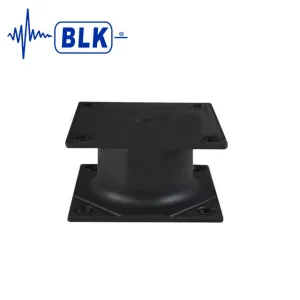
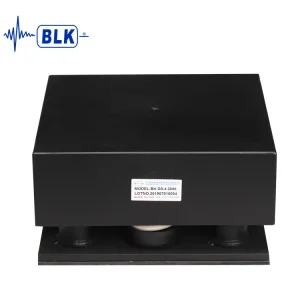
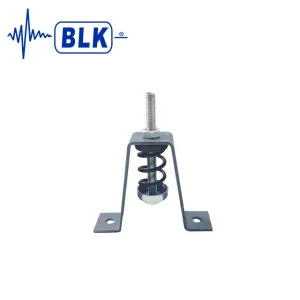
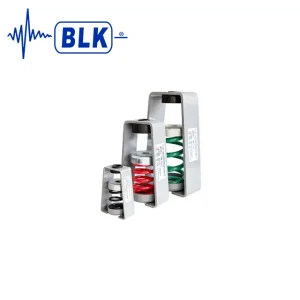
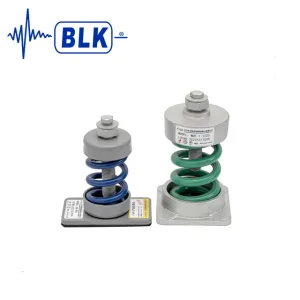
| BK-DS Damped Spring Isolators | 2.5 Hz – 4.5 Hz | 0.08 – 0.15 | -40°C to +100°C | Turbine Gearboxes, Heavy Substation Transformers | Dacromet 900h |
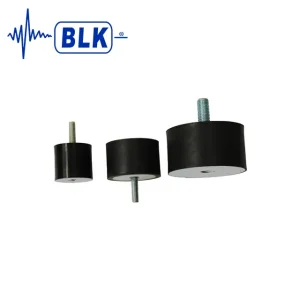
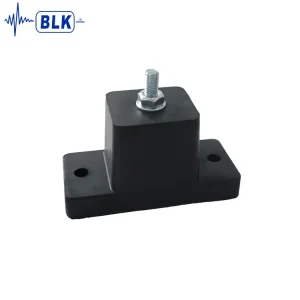
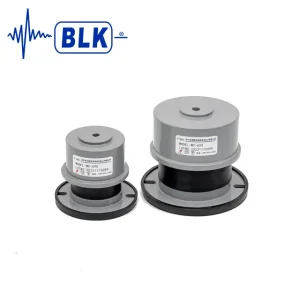
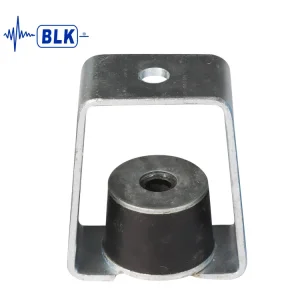
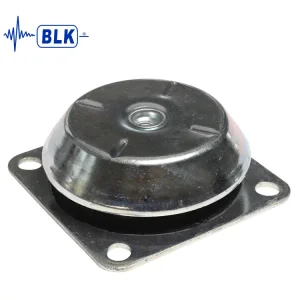
| BKVD High-Damping Rubber Mounts | 6.0 Hz – 12.0 Hz | 0.12 – 0.22 | -30°C to +80°C | Wind Nacelle Auxiliary Motors, BESS Inverters | EPDM / NBR Marine |
| Viscous Fluid Track Dampers | N/A (Velocity Damped) | 0.25 – 0.45 | -40°C to +65°C | Single-Axis Solar Tracking Torque Arms | Stainless 316 / C5-M |
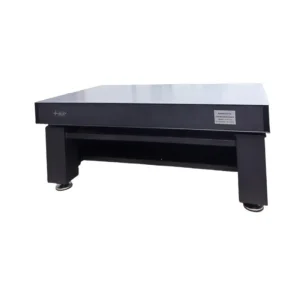
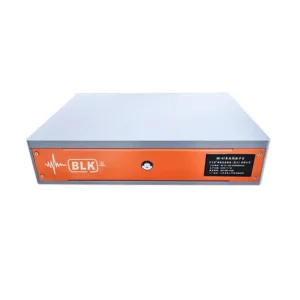
| BK-PA Precision Air Mounts | 1.5 Hz – 2.5 Hz | 0.05 – 0.10 | -10°C to +50°C | Metrology & Cleanroom Solar Wafer Inspection | Anodized Aluminum |
Global B2B Purchasing Needs & Pricing Drivers
Understanding cost structures, customization parameters, and factory-direct volume pricing enables EPC contractors and OEMs to optimize project budgets without sacrificing reliability.
What EPCs Look for in Damper Suppliers
- Custom Load Range Verification: 1:1 tailored spring rates supporting single unit loads from 20 kg up to 50 Metric Tons.
- Environmental Certification: Full compliance with IEEE 693 (Seismic), IEC 61400-1 (Wind), and ISO 9001 quality audits.
- Traceability & Testing: 100% stiffness validation reports, batch material certificates (EN 10204 3.1), and fatigue test data.
Custom Renewable Damper Pricing Matrix
Pricing for specialized renewable isolators varies based on material formulation, dynamic testing requirements, and order volume:
- Standard Rubber Mounts (BKVD/BKVV): $12.00 – $45.00 / unit (Ideal for internal BESS pumps and light fans).
- Heavy Damped Spring Isolators (BK-DS/MC): $85.00 – $380.00 / unit (Built for power transformers & wind gearboxes).
- Custom Solar Tracker Hydraulic Dampers: $45.00 – $160.00 / unit (Based on bulk volume and stroke length).
Supply Chain Resilience, CNC Precision & OEM Scale
Located in Kunshan, China's industrial manufacturing hub, Bellking operates a 2,000 m² smart facility integrating robotic welding, automatic elastomer vulcanization, and advanced spectral analysis.
Rapid 3-Day Custom Prototyping
Our in-house engineering team utilizes FEA modal simulation and CAD modeling to deliver validated custom damper drawings and prototypes within 72 hours.
Strict ISO 9001 Quality Inspection
Every dynamic spring and rubber blend undergoes rigorous tension-compression testing, dynamic fatigue cyclic testing, and salt spray exposure analysis.
100,000 Units Annual Capacity
Direct supply chain integration cuts lead times by 40% compared to European suppliers while offering factory-direct cost efficiency for global projects.
Localized Renewable Application Scenarios
Real-world engineering implementations across offshore wind parks, utility solar plants, grid substations, and energy storage hubs.
Scenario A: Offshore Wind Turbine Drivetrain & Nacelle Isolation
Operating Environment: North Sea Offshore Wind Farm (12 MW Turbines).
Challenge: Gearbox mesh frequencies and yaw motor oscillations transmitted low-frequency noise down the tubular steel tower, risking weld seam stress fatigue.
Solution: Installed custom BK-DS Damped Spring Mounts with 900-hour Dacromet coating under gearbox torque arms, achieving 96.4% vibration isolation and protecting structural integrity over a 20-year operational life.
Scenario B: Utility-Scale Single-Axis Solar Tracker Wind Damping
Operating Environment: Atacama Desert Solar Park (500 MW Project).
Challenge: Thermal inversion currents and high wind gusts caused torsional galloping in 120-meter single-axis solar tracker rows, damaging drive motors.
Solution: Integrated custom bidirectional viscous fluid dampers on tracker torque tubes, dissipating aerodynamic flutter energy and increasing structural stow stability up to wind speeds of 45 m/s.
Scenario C: BESS Container HVAC Liquid Chiller Isolation
Operating Environment: 100 MW / 400 MWh Grid Storage Facility in Texas, USA.
Challenge: Heavy liquid cooling chillers mounted on top of BESS enclosures transferred high-frequency motor hum into internal battery cabinets, loosening electrical terminals.
Solution: Standardized on BKVD Type Rubber Mounts beneath all chiller frames, isolating structure-borne vibration by 98.1% and maintaining low ambient noise compliance below 55 dBA at plant boundary.
Scenario D: High-Voltage Step-Up Transformer Damping
Operating Environment: 220 kV Renewable Integration Substation.
Challenge: Magnetostriction core vibration created continuous 100 Hz / 120 Hz hum, exceeding local environmental acoustic noise limits.
Solution: Retrofitted transformer base rails with high-capacity MC Type Anti-Vibration Spring Isolators, reducing foundation ground vibration transmission by over 22 dB.
Frequently Asked Questions by Renewable Energy Engineers
Get instant answers regarding specs, custom pricing, lead times, and marine compliance.
How do I select between rubber mounts and spring isolators for renewable projects?
What factors determine the pricing of custom renewable energy dampers?
How does Bellking ensure damper performance in high-salinity marine environments?
What is the lead time for custom non-standard isolators?
What documentation is provided with OEM orders for wind and solar projects?

Request a Tailored Vibration Isolation Plan & Factory Direct Quote
Send our senior application engineers your project specs (operating load, center of gravity, equipment RPM, and operating ambient environment). We will return a validated engineering layout and pricing breakdown within 24 hours.