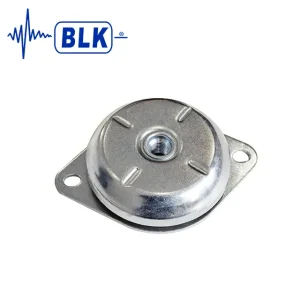
Featured Industrial Isolator Solutions
Engineered rubber-to-metal bonded isolators, pneumatic air mounts, and spring dampers manufactured for critical equipment vibration decoupling.








Engineering Fundamentals of Elastomer-Metal Interfacial Bonding
An authoritative deep dive into chemical cross-linking, vulcanization mechanics, dynamic modulus tuning, and viscoelastic energy dissipation.
Chemical Interfacial Vulcanization Mechanics
The structural integrity of custom rubber-metal bonded isolators relies on covalent chemical bonding established at the interface between elastomer compounds and metallic substrates. During high-temperature press vulcanization (typically 140°C to 170°C under 15-25 MPa hydraulic pressure), organosilane and poly-isocyanate adhesive primer coats react simultaneously with substrate metal oxides and cross-linking polymer chains.
Achieving ultimate shear failure strength (exceeding 12 MPa per ASTM D429 Method B) requires automated surface preparation. Metal substrates undergo SA 2.5 shot blasting with chilled iron grit to establish an optimal surface roughness ($R_a$ 3.2–6.3 µm), maximizing mechanical interlocking alongside molecular chemical bonding.
Viscoelastic Damping & Dynamic Modulus Mechanics
Unlike rigid mechanical mountings or metallic springs that transfer energy, rubber-metal isolators utilize the inherent viscoelastic properties of synthesized elastomers (such as NR, NBR, EPDM, Fluororubber, and Silicone). Under dynamic cyclic loading, the complex shear modulus $G^* = G' + iG''$ governs both energy storage ($G'$) and kinetic thermal dissipation ($G''$).
The loss factor ($\tan \delta = G''/G'$) determines the mount's capacity to suppress resonance peak amplitude during start-stop transient phases. Custom elastomeric compounding allows precise tuning of the dynamic-to-static stiffness ratio ($K_d/K_s$ ranging from 1.2 to 1.8), isolating high-frequency harmonic vibrations without sacrificing static load positioning stability.
Global Commercial & Industrial Status of Bonded Isolators
Understanding the macroeconomic forces, technological adoption drivers, and operational mandates shaping anti-vibration demands worldwide.
1. High-Precision Electronics & Semiconductor Cleanrooms
Modern semiconductor fabrication plants operates at nanometer lithography nodes where sub-micron ground tremors cause severe wafer misalignment. Global fab operators mandate low-frequency pneumatic and custom bonded rubber isolators under vacuum pumps, turbomolecular units, and chiller loops to isolate structural floor excitation (VC-C to VC-E environmental criteria).
2. Urban Power Infrastructure & Transformer Sub-Stations
Rapid urban encroachment on high-voltage power substations has triggered strict municipal magnetostrictive acoustic hum noise ordinances. Transformer OEMs install custom heavy-duty elastomeric bonded mounts with engineered oil-resistant synthetic rubbers under transformer core footings to attenuate 50Hz/60Hz double-frequency magnetostrictive hum by up to 18-25 dB(A).
3. Marine Propulsion & Heavy Defense Transportation
Naval defense and commercial maritime engineering require flexible engine mountings capable of enduring extreme multidirectional shock loadings (up to 5G-10G transient impact during rough seas) while maintaining low continuous structure-borne sound transmission to reduce underwater acoustic signatures and engine deck resonance.
The Chinese Factory Advantage: Precision, Scale & Efficiency
Why global original equipment manufacturers (OEMs) choose specialized Kunshan/Jiangsu precision clusters for custom rubber-metal isolators.
Vertical Integration & Rapid Tooling Iteration
Chinese manufacturing hubs, particularly in Kunshan (Jiangsu), feature complete industrial ecosystem integration. In-house rubber formulation compounding, CNC mold machining, steel surface grit blasting, automatic adhesive spraying, and vacuum press vulcanization operate within unified quality-managed facilities.
- Prototype Speed: Rapid custom mold design and sample delivery in as fast as 3 to 5 working days.
- Compound Versatility: Direct control over durometer hardness (Shore A 30 to 85) and custom chemical resistant formulations.
- Cost Optimization: Total cost of ownership (TCO) savings of 30%–45% compared to Western European or North American manufacturing without sacrificing dimensional tolerances.
Rigorous ISO Quality Assurance & Testing Infrastructure
Leading Chinese isolator factories adhere to international quality management systems (ISO 9001:2015). Advanced testing equipment guarantees strict batch-to-batch consistency and verifiable dynamic performance.
- Dynamic Characterization: Computer-controlled servohydraulic dynamic testing rigs to map stiffness curves across frequencies (1–200 Hz).
- Corrosion Protection: Automatic Dacromet and Zn-Ni plating line passing 900+ hours of continuous neutral salt spray (ASTM B117).
- Non-Destructive Inspection: Ultrasonic bond line integrity verification and 100% static deflection loading inspections before packaging.
Localized Application Scenarios & Engineering Implementations
Tailored mounting solutions engineered for severe operating environments across multi-industry applications.
HVAC Chillers & Rooftop Air Handling Units
Heavy rotary screw chillers installed on elevated commercial building roofs induce severe low-frequency structure-borne vibration into floor slabs. Custom shear-compression rubber-metal mounts, featuring built-in height adjustment leveling bolts and non-skid bases, decouple structural transmission, achieving up to 98% isolation efficiency at 1,450 RPM operating speeds.
Industrial Emergency Diesel Generator Sets
Standby diesel generators exhibit severe transient engine pitch, roll, and lateral torque reaction during cold start-ups. Captive, fail-safe rubber-metal mounts with interlocked steel housings prevent engine over-excursion and limit dynamic shock transmission, protecting rigid fuel lines, electrical connections, and building foundations.
Heavy Stamping Presses & Forging Hammers
Forging presses generate violent shock pulses ($10^5$ to $10^6$ N) that shatter surrounding concrete foundations and misalign adjacent high-precision CNC equipment. High-dampened multi-layer rubber-metal composite cushions offer progressive spring rates under shock compression, converting kinetic energy into thermal dissipation.
Future Trends in Rubber-Metal Isolator Development
Emerging technologies shaping the next generation of smart, sustainable, and hyper-elastic vibration control systems.
1. Smart Sensing & IoT-Integrated Isolators
Integration of embedded MEMS accelerometers, strain gauges, and wireless telemetry sensors inside the elastomer core. Real-time monitoring of dynamic deflection, temperature spikes, and structural degradation enables predictive maintenance algorithms, alerting plant managers before bond fatigue or elastomer degradation occurs.
2. FEA Non-Linear Material Simulation (Mooney-Rivlin Modeling)
Transitioning from classical empirical testing to advanced hyperelastic Finite Element Analysis (FEA). Utilizing Mooney-Rivlin, Ogden, and Yeoh constitutive material models allows precise simulation of stress concentrations at the rubber-metal bond lip, drastically reducing physical design cycles for custom complex mounts.
3. Eco-Friendly Vulcanization & Non-Aromatic Primers
Global environmental regulations (REACH, RoHS 3) are driving the elimination of volatile organic compounds (VOCs) and toxic heavy metals from bonding primers. Next-generation waterborne adhesive primers and bio-based synthetic elastomers reduce carbon footprints during vulcanization without compromising bond tensile strength.
4. Active-Passive Hybrid Electromagnetic Damping
Combining high-load passive rubber-metal bonded mounts with active voice-coil or magnetorheological (MR) fluid dampeners. This hybrid approach delivers dynamic response adaptation across broad bandwidths, suppressing low-frequency sub-Hz building sway as well as high-frequency machinery hum.
Technical Procurement Metrics & Regulatory Compliance Standard
A definitive guideline for engineering buyers and procurement officers selecting qualified vibration isolator manufacturers.
| Evaluation Parameter | Testing Standard / Metric | Acceptance Threshold / Engineering Value | Impact on System Performance |
|---|---|---|---|
| Rubber-to-Metal Bond Strength | ASTM D429 Method B (90° Peel Test) | ≥ 10 to 14 N/mm (100% Rubber Tear Failure) | Prevents catastrophic catastrophic delamination under high shear load. |
| Durometer Hardness Tolerance | ASTM D2240 / ISO 48 (Shore A) | ± 5 Shore A (Option for ± 3 Shore A) | Controls static deflection and target natural frequency ($f_n$). |
| Compression Set Resistance | ASTM D395 Method B (22h @ 70°C) | ≤ 20% to 25% Permanent Deformation | Ensures multi-year equipment alignment and height retention. |
| Corrosion Resistance Coating | ASTM B117 Neutral Salt Spray Test | 900 Hours without Red Rust (Dacromet / Zn-Ni) | Protects structural metal flanges in marine or outdoor environments. |
| Environmental Compliance | EU RoHS 3 Directive & REACH SVHC | Zero Heavy Metals (Pb, Cd, Hg, Cr6+) & Low VOC | Guarantees site audit compliance for global export. |
Engineering Selection Equation Reference:
Natural Frequency: f_n = (1 / 2π) * √(g / δ) | Transmissibility: T = √[ (1 + (2ζr)²) / ((1 - r²)² + (2ζr)²) ]
Where δ = static deflection (m), r = frequency ratio (f_disturbing / f_n), and ζ = damping ratio of the selected rubber compound. Isolation occurs when r > √2 (recommendation: r ≥ 3 for >90% efficiency).
Frequently Asked Questions (Technical Sizing & OEM Sourcing)
Detailed technical answers from senior vibration control engineers regarding compound selection, load math, and manufacturing customization.
Explore Full Rubber-Metal & Damping Series
High-durability vibration control mounts, damped spring elements, and polymer isolation pads for modern industrial applications.