
Precision Vibration Isolators & Rubber Metal Mounts
Direct factory engineered mounts providing high damping factors, low natural frequencies, and superior load distribution for commercial and heavy industrial applications.

Global Commercial & Industrial Status of Vibration Absorbing Metals
Analyzing the macroeconomic shifts, technical demands, and global supply chain dynamics shaping modern mechanical vibration mitigation.
Sub-Micron Precision Requirements
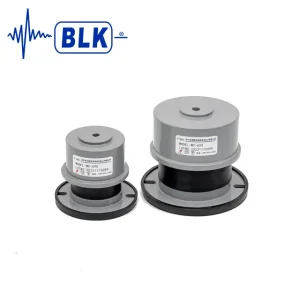
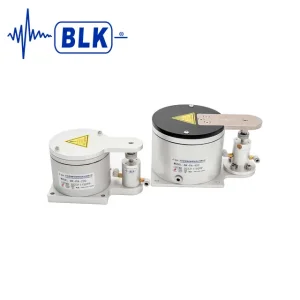
With the expansion of 2nm/3nm semiconductor fabrication plants, nanometer metrology, and high-speed optics, traditional elastomeric mounts are insufficient. Industrial procurement has shifted heavily toward high-damping metal-matrix alloys and active pneumatic isolators capable of attenuating ambient floor vibrations down to 1.7 Hz.
Acoustic & Environmental Compliance
Urban commercial density mandates strict structure-borne noise regulations (ISO 2017-1). Heavy HVAC chillers, emergency power generators, and rooftop cooling towers demand custom vibration absorbing metal assemblies that withstand 15+ years of continuous weathering without fatigue or elastomeric degradation.
Extreme Industrial Operating Envelopes
Marine, offshore oil platforms, and high-voltage electrical substations require vibration absorbers resistant to thermal expansion (-40°C to +120°C), corrosive salt fog, and magnetostrictive hum. Stainless steel wire mesh and Dacromet-coated spring assemblies are now mandatory specification standards.
Market Valuation Trend
The global industrial mechanical vibration isolator market is projected to reach $7.2 Billion USD by 2030, driven by automation, high-speed rail development, and modern power grid infrastructure upgrades. Custom vibration absorbing metal manufacturers in China are positioned at the forefront of this supply chain transition.
Physics & Metallurgy of Vibration Absorbing Metal Mounts
Understanding viscoelastic hysteresis, loss factor metrics, and mechanical transmissibility equations for structural engineering optimization.
1. Hysteresis Loop & Loss Factor (η)
Vibration absorbing metals and bonded metal-elastomer mounts dissipate kinetic energy through internal micro-friction and polymer viscoelastic hysteresis. Under dynamic cyclic shear stress, the energy absorbed per cycle ($U_d$) is proportional to the area enclosed within the stress-strain hysteresis loop:
Where $U_m$ is the maximum elastic strain energy. High-damping Mn-Cu alloys and custom vulcanized rubber mounts engineered by Bellking achieve loss factors exceeding $\eta = 0.25$, rapidly suppressing resonant peaks.
2. Transmissibility Ratio Equation (T)
The efficiency of a mechanical vibration absorber is dictated by the ratio of force transmitted to the foundation versus forcing excitation. The transmissibility equation is governed by frequency ratio ($f/f_n$) and damping ratio ($\zeta$):
Isolation occurs strictly when $f/f_n > \sqrt{2}$. Bellking custom spring and pneumatic isolators target $f/f_n \ge 3$, securing isolation efficiencies higher than 95% to 99% across industrial equipment ranges.
Engineering Isolator Performance Comparison Matrix
| Isolator Material / Type | Natural Frequency ($f_n$) | Isolation Efficiency | Load Range (per point) | Corrosion Resistance | Primary Application |
|---|---|---|---|---|---|
| Pneumatic Air Mounts (BK-PA) | 1.7 Hz – 3.0 Hz | 98% – 99.5% | 50 kg – 3,500 kg | Anodized / Dacromet | Semiconductor, CMM, Optical Benches |
| Spring Mounts (MC / BKSWA) | 3.0 Hz – 5.0 Hz | 92% – 99.0% | 100 kg – 12,000 kg | 900h Salt Spray Dacromet | HVAC Chillers, Gensets, Pumps |
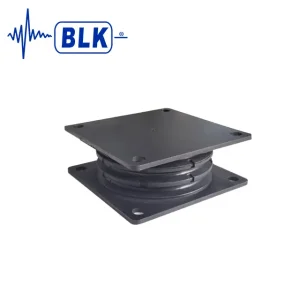
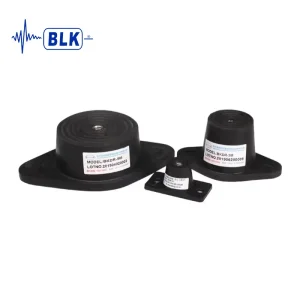
| Rubber Metal Mounts (BKM / BKVD) | 7.0 Hz – 15.0 Hz | 80% – 92.0% | 10 kg – 1,500 kg | Zinc Plated / EPDM Vulcanized | Motors, Air Compressors, Cabinets |
| Transformer Mounts (BKH) | 4.0 Hz – 8.0 Hz | 90% – 97.0% | 500 kg – 25,000 kg | Heavy Industrial Epoxy / Galvanized | Substation Power Transformers |
| Polymer Damping Pads (BK-PM) | 10.0 Hz – 25.0 Hz | 75% – 88.0% | Up to 50 kg/cm² | Oil & Chemical Resistant Polymer | Foundation Damping, Inertia Bases |
China Manufacturing Efficiency & Supply Chain Advantages
How Bellking's 2,000m² Kunshan manufacturing hub delivers superior quality control, rapid prototyping, and unprecedented cost efficiencies.
Full In-House Ecosystem
Unlike trading intermediaries, Bellking operates CNC machining, robotic welding cells, rubber vulcanization presses, and spring coiling equipment under one roof in Jiangsu, eliminating markups and quality friction.
Rapid 3-Day Prototyping
Using localized tooling supply chains, customized non-standard drawings transition from CAD approval to physical prototype testing within 72 hours, drastically shrinking global OEM project lead times.
Rigorous QA & Dacromet Coating
All steel components undergo Dacromet anti-corrosion treatment passing 900+ hours of continuous salt spray testing. Every production batch includes tensile test certificates and dynamic stiffness spectrum reports.
30% - 45% Cost Optimization
Optimized raw material procurement and advanced automation allow global buyers to reduce total bill-of-materials costs by up to 45% compared to Western European or North American equivalent suppliers.
Localized Application Scenarios & Industrial Deployment
Tailored engineering strategies for isolating critical assets across varied industrial environments.
Semiconductor Lithography & Cleanrooms
Micro-vibrations from nearby foot traffic or HVAC systems can ruin wafer etching accuracy. Pneumatic air platforms (BK-DT / BK-PA) provide ultra-low 1.7 Hz resonance, maintaining sub-nanometer stability in ISO Class 5 cleanrooms.
Electrical Power Substations
Dry-type and oil-filled transformers generate continuous 100Hz/120Hz magnetostrictive hum. Custom BKH-series transformer mounts decouple acoustic transmission into building concrete, preventing neighbor noise complaints.
Heavy Stamping & Hydraulic Presses
High-impact dynamic shock loads (3G to 5G) degrade facility foundations. Custom multi-layer dampers (BKSWA) absorb transient kinetic energy, extending press life and protecting adjacent machinery.
Commercial Building HVAC Plant Rooms
Massive cooling towers and water pumps suspended or floor-mounted in high-rise buildings utilize spring mounts and inertia bases to stop low-frequency fluid dynamics from resonating through steel beams.
Global Sourcing Technical Specification Checklist
Avoid costly selection errors by utilizing Bellking’s step-by-step engineering procurement verification protocol.
Step 1: Equipment Operational Data
- ✔ Total Operating Weight: Include fluid weights, piping loads, and dynamic mass.
- ✔ Center of Gravity (COG): Asymmetric COG requires custom spring rate selection per point.
- ✔ Disturbing Frequency ($f_d$): Record machine operating RPM or motor Hz.
Step 2: Environmental & Safety Mandates
- ✔ Corrosion Rating: Standard zinc, Dacromet (900h salt spray), or 316 Stainless Steel.
- ✔ Seismic / Wind Restraints: Snubbers required for rooftop installations per IBC codes.
- ✔ Temperature Envelope: Verify rubber durometer stability under extreme heat or sub-zero conditions.
Future Trends in Vibration Absorbing Metal Engineering
Pioneering advancements in smart materials, additive lattice dampers, and AI-driven dynamic isolation.
Magnetorheological (MR) & Active Metals
Integration of MR fluids and shape memory alloys (SMA) into metal spring bodies enables real-time dynamic damping adjustment via microprocessors, neutralizing sudden transient harmonic spikes instantly.
3D Printed Metal Lattice Structures
Additive manufacturing of customized titanium and stainless steel mesh matrices allows variable density damping that is physically impossible through traditional casting or coiling methodologies.
IoT Predictive Health Sensors
Smart isolators embedded with piezoelectric sensors transmit real-time deflection, FFT vibration spectrums, and thermal load data directly to cloud SCADA systems for predictive maintenance alerts.
Specialized Metal Buffers & Precision Damping Systems
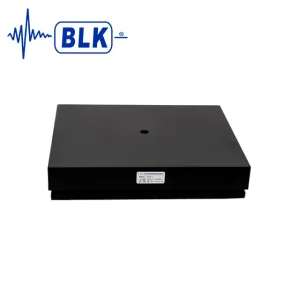
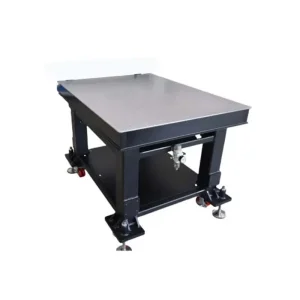
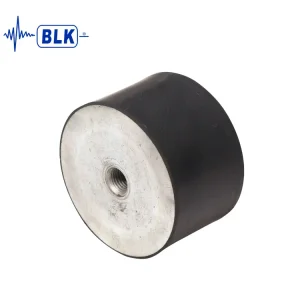
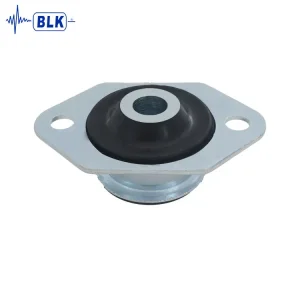
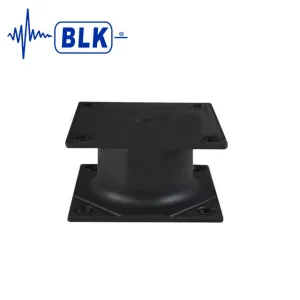
Explore custom damped rubber mounts, optical platforms, cone isolators, and heavy-duty mechanical buffers.


Frequently Asked Technical Questions (FAQ)
Direct answers from our senior vibration control engineers addressing sizing, resonance, dynamic testing, and custom manufacturing.