Precision Vibration Isolation & Damping Platforms
Explore our certified range of HVAC rubber isolators, damped platforms, and pneumatic air mounts optimized for commercial outdoor condensing units and industrial machinery.




HVAC Mechanical Vibration Decoupling: Material Dynamics & Acoustic Physics
In modern building services engineering, heating, ventilation, and air conditioning (HVAC) systems represent one of the primary sources of structure-borne noise and mechanical fatigue. Rotary compressors, axial fan blades, and refrigerant fluid pumps generate dynamic kinetic forces that oscillate at disturbing frequencies ($f_d$) ranging from 10 Hz to over 100 Hz. When these unattenuated forces transmit directly into floor slabs, steel brackets, or rooftop structural beams, they generate low-frequency hums, compromise structural integrity, and drastically shorten equipment service lifespans.
Air conditioner vibration pads (elastomeric anti-vibration dampeners) act as critical kinetic circuit breakers. By transforming dynamic kinetic energy into dissipated thermal energy through internal polymer molecular friction (hysteresis), high-performance isolation pads decouple the equipment mass from the supporting substrate. To achieve vibration isolation efficiencies exceeding 92%, the fundamental natural frequency of the isolation pad ($f_n$) must be designed precisely relative to the disturbing frequency of the air conditioning unit ($f_d$), maintaining a frequency ratio ($f_d / f_n$) strictly greater than $\sqrt{2} \approx 1.414$, with an optimal engineering design window operating between 2.5 and 4.0.
Global Commercial & Industrial HVAC Isolation Landscape
The global air conditioner anti-vibration pad market is undergoing a rapid transition driven by stringent urban noise pollution regulations (such as WHO environmental noise guidelines and EU Directive 2002/49/EC), rising energy efficiency standards, and the proliferation of rooftop Variable Refrigerant Flow (VRF) installations in densely populated metropolitan areas. Commercial procurement officers, MEP contractors, and HVAC OEMs are no longer seeking basic rubber mats; they require engineered polymer solutions that resist environmental degradation, ozone exposure, and heavy compressive creep.
Commercial & High-Rise Residential Demand
In modern multi-story structures, rooftop-mounted air handling units and split-system condensers transmit low-frequency harmonics directly through reinforced concrete. Without high-loss elastomeric pads, structure-borne noise causes secondary acoustic radiation inside living spaces below, triggering costly building code compliance disputes and retrofits.
Industrial Chillers & Data Center Infrastructure
Hyperscale data centers and manufacturing plants operate heavy-duty water-cooled centrifugal chillers 24/7. Continuous micro-vibrations cause fretting corrosion in pipe joints, electrical control board solder cracking, and premature compressor bearing failure. Engineered vibration pads prevent thousands of dollars in unscheduled downtime.
Stringent Regulatory & Environmental Compliance
Global supply chains require full transparency regarding material toxicity, fire safety, and chemical sustainability. Procurement standards specify non-recycled virgin EPDM or Neoprene elastomers complying with RoHS 3, REACH SVHC, and UL 94 V-0 flame retardancy ratings for HVAC acoustic accessories.
Polymers, Cross-Ribbed Topography & Technology Roadmap
The performance of an air conditioner vibration pad depends on the elastomer's compounding formulation and geometric cross-section. Simple solid rubber blocks fail to provide adequate deflection, acting nearly rigid under load. High-performance pads utilize composite layer geometries or cross-ribbed surface patterns to permit lateral elastomeric bulge under vertical compressive load.
| Material / Construction Type | Durometer (Shore A) | Damping Loss Factor ($\eta$) | Temp Range (°C) | Resistance Focus | Optimal Application Scenario |
|---|---|---|---|---|---|
| Virgin EPDM Elastomer | 45 - 65 | 0.15 - 0.25 | -40 to +120 | UV, Ozone, Extreme Weather | Rooftop VRF / Outdoor Condensing Units |
| Neoprene (Chloroprene) | 50 - 70 | 0.20 - 0.35 | -30 to +100 | Oils, Refrigerants, Flame | Industrial Equipment Plant Rooms |
| Composite Rubber-Cork-Polymer | 60 - 80 | 0.30 - 0.45 | -25 to +85 | High Damping, Low Creep | Heavy Commercial Chillers & Compressors |
| Thermoplastic Vulcanizate (TPV) | 55 - 75 | 0.12 - 0.20 | -40 to +135 | Recyclability, Chemical Solvents | Green Building & LEED Certified Sites |
Technology Roadmap & Future Outlook (2025–2030)
The HVAC vibration isolation sector is evolving from passive isolation elements toward intelligent, dynamically responsive damping systems. Our R&D engineering roadmap focuses on three technological pillars:
Dual-Durometer Compound Co-Extrusion
Combining a soft 45 Shore A core for micro-vibration absorption with a high-durability 70 Shore A shell for anti-skid framing and structural load distribution.
Self-Extinguishing Flame-Retardant Polymers
Integrating non-halogenated nanoclay and phosphorus additives to achieve UL 94 V-0 flame ratings without degrading elastomeric dynamic deflection properties.
Smart IoT Integrated Piezoelectric Pads
Embedding micro-piezoelectric sensors inside the polymer matrix to continuously measure load balance, vibration spectrum drift, and compressor bearing wear in real time.
Bio-Based Elastomeric Matrix Synthetics
Replacing petroleum-derived carbon black filler with sustainable bio-silica derived from agricultural waste, achieving a 40% reduced carbon footprint.
Localized Application Scenarios in HVAC & Industrial Systems
Vibration isolation requirements vary significantly based on installation topography, local environmental factors, and unit weight distribution. Below are the primary deployment scenarios engineered for our product line:
1. Rooftop VRF & Split-System Condenser Brackets
Rooftop condensing units are exposed to intense UV rays, freezing temperatures, and wind shear. Standard rubber pads harden and crack within 24 months. Our EPDM cross-ribbed pads maintain elastomeric elasticity down to -40°C while preventing structure-borne hum from penetrating top-floor executive suites or residential bedrooms.
2. Acoustically Sensitive Commercial Environments
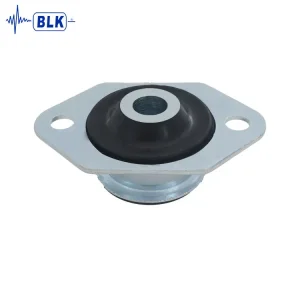
Hospitals, sound recording studios, luxury hotels, and broadcasting centers enforce ultra-low ambient sound criteria (NC-25 to NC-30 curves). Installing BKDJ and BK-DSR rubber mounts beneath air handling units (AHUs) eliminates low-frequency harmonic resonance transmitted through mechanical equipment room floors.
3. Heavy Industrial Chillers & Cooling Towers
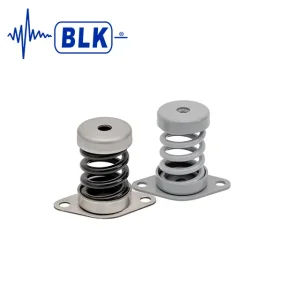
Centrifugal and screw chillers weighing several tons generate high startup dynamic torque. Matrix isolation systems (such as the BK-MT series) combine high-deflection coil springs with elastomeric dampening pads to absorb shock loads during compressor soft-starts while preventing lateral instability.
Chinese Factory Supply Chain Resilience & Cost-Efficiency
As a direct-from-factory manufacturing ecosystem centered in China's advanced industrial hardware clusters, we provide global B2B buyers, distributors, and OEMs with unmatched cost efficiency, scale, and technical agility. By controlling the entire manufacturing pipeline—from raw rubber compounding to automated compression molding and dynamic testing—we deliver wholesale pricing structures that optimize procurement margins.
Raw Material Upstream Integration
Our long-term joint procurement contracts for synthetic EPDM polymers, natural rubber, and high-tensile steel inserts buffer against global spot-market volatility, guaranteeing fixed pricing agreements for large B2B project contracts.
Automated Vulcanization & CNC Tooling
Equipped with multi-cavity hydraulic compression presses and robotic demolding cells, our factory maintains a monthly production capacity exceeding 500,000 units with strict dimensional tolerances (±0.2mm).
Factory-Direct Wholesale Tiered Pricing
By removing intermediary distributors, B2B importers gain direct access to FOB/CIF volume pricing matrixes, customized OEM branding, molded logo tooling, and tailored retail packaging solutions.
Localized Technical Support & International Compliance
International trade requires seamless alignment with destination country regulatory frameworks, environmental standards, and quality management protocols. Our factory operates under strict ISO 9001:2015 Quality Management Systems and ISO 14001:2015 Environmental Management Systems.
RoHS 3 & REACH SVHC Compliance
All elastomeric batches undergo regular GC-MS laboratory testing to ensure complete absence of polycyclic aromatic hydrocarbons (PAHs), heavy metals, or restricted phthalates.
ISO 20170 & ASTM D395 Testing
Compression set tests according to ASTM D395 Method B ensure that under long-term continuous static loading, pad permanent deformation remains under 12%.
Accelerated Weathering (ASTM G154)
UV and salt spray chamber testing guarantees that outdoor rooftop AC pads withstand coastal marine salt haze and intense solar radiation without surface micro-cracking.
24/7 B2B Application Engineering
Our localized support teams provide rapid dynamic static load calculation, CAD drawing submittals, and custom compound engineering for specialized HVAC OEM integration.
Engineering & Procurement FAQ
Detailed technical answers regarding selection formulas, load calculations, factory lead times, and customization options.
1. How do I calculate the required air conditioner vibration pad dimensions and quantity for an outdoor unit?
To accurately size vibration isolation pads, follow these engineering steps:
- Determine Total Operational Weight ($W_{total}$): Sum the dry weight of the condensing unit plus operating fluids (refrigerant, oil) and dynamic fan load.
- Identify Support Points ($N$): Most residential/commercial units have 4 mounting feet. Calculate the static load per point: $P_{static} = W_{total} / N$. Account for center-of-gravity offsets if the compressor side is significantly heavier.
- Select Polymer Area for Target Compressive Stress: Optimal elastomeric deflection occurs at a compressive stress ($\sigma$) between 0.3 MPa and 0.8 MPa (approx. 45 to 115 PSI). Calculate target pad area: $A = P_{static} / \sigma_{target}$.
- Verify Frequency Ratio ($f_d / f_n$): Ensure the pad thickness and Shore A hardness yield a natural frequency ($f_n$) that is less than half of the compressor’s operating frequency (e.g., for a 50 Hz / 3000 RPM compressor, $f_n$ should be ≤ 10 Hz).
2. What is the difference between solid rubber pads, cross-ribbed rubber pads, and rubber-cork composite pads?
The structural design determines the pad's dynamic stiffness and damping performance:
- Solid Rubber Blocks: Provide low dynamic deflection because rubber is an incompressible material in bulk. Without void space to expand laterally, solid blocks act almost rigid under vertical load.
- Cross-Ribbed Rubber Pads: Feature alternating perpendicular grooves on top and bottom faces. These ribs allow the elastomer to flex and bulge sideways under compression, achieving higher deflection and lowering the system natural frequency.
- Rubber-Cork Composite Pads: Impregnate cork granules into a polymer matrix. Cork contains trapped air cells that compress volumetrically, offering high internal damping loss factors ($\eta \approx 0.35$) and superior sound attenuation for high-frequency hum.
3. What OEM/ODM customization options are available from your Chinese factories?
As a direct manufacturer, we offer comprehensive customization across multiple technical parameters:
- Custom Hardness & Color: Formulating Durometer Shore A ratings from 30 to 80, with color-coded inserts for easy job-site density identification.
- Molded Logos & Part Numbers: Custom CNC tooling for embossed brand logos, part numbers, and orientation markers.
- Metal Insert Integration: Co-molding steel or aluminum distribution plates, threaded stud studs, or anti-shear perimeter lips.
- Bespoke Dimensions & Die-Cut Shapes: Custom mold fabrication within 7 to 10 working days.
4. How do environmental conditions (UV, extreme cold, oil exposure) affect pad selection?
Environmental factors dictate polymer chemistry selection:
- Rooftop / Sunlight Exposure: Specify EPDM (Ethylene Propylene Diene Monomer) due to its unmatched resistance to ultraviolet degradation, thermal aging, and atmospheric ozone.
- Machine Rooms / Oil Traces: Specify Neoprene (Chloroprene) or Nitrile (NBR), as standard EPDM degrades and swells when exposed to petroleum-based compressor lubricants.
- Sub-Zero Environments: Ensure the polymer's glass transition temperature ($T_g$) is well below local winter extremes (EPDM performs down to -40°C without brittle cracking).
5. What are the typical factory lead times, MOQ requirements, and wholesale price structures?
Our production scheduling is streamlined for international B2B logistics:
- Standard Catalog Models: Minimum Order Quantity (MOQ) starts at 500 units, with shipment ready within 3 to 5 business days.
- Custom OEM Production: Initial sample approval within 5 days; full container load (FCL) production completed within 15 to 20 days.
- Pricing Tier Structure: Tiered B2B pricing drops significantly at 1,000, 5,000, and 20,000 unit thresholds, offered under FOB Shanghai/Ningbo or CIF target port terms.
Advanced Spring Mounts, Optical Platforms & Hangers
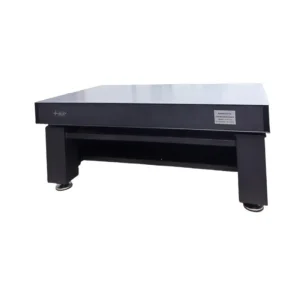
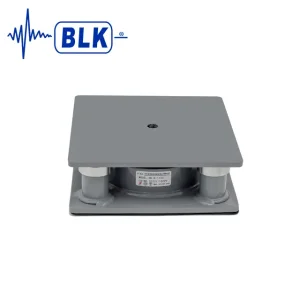
Complete acoustic protection solutions including low-frequency optical platforms, spring isolators, and specialized HVAC ceiling hangers.