
Precision Anti-Vibration Mounts & Damping Systems
Explore our factory-direct precision air mounts, heavy-duty spring isolators, custom rubber buffers, and vibration isolation platforms engineered for maximum transmissibility reduction.
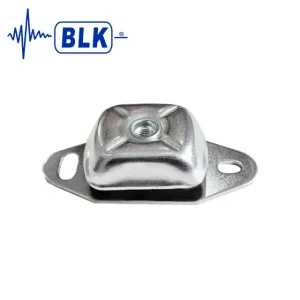
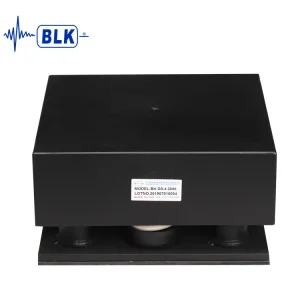
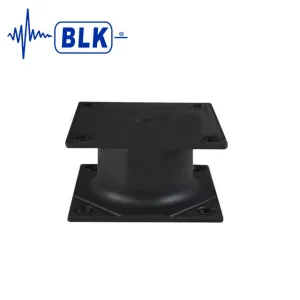
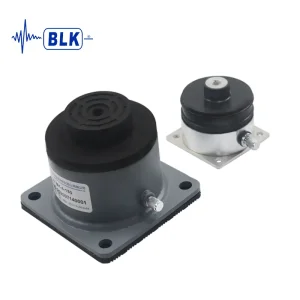
The Mechanics & Physics of Anti Vibration Motor Mounts
Understanding harmonic excitation, transmissibility ratios, elastomeric hysteresis, and natural frequency optimization in heavy industrial machinery.
In modern industrial engineering, rotating and reciprocating machinery such as electric motors, internal combustion engines, heavy-duty pumps, and HVAC compressors inherently generate periodic dynamic forces. Uncontrolled motor vibrations cause severe structural fatigue, premature bearing destruction, acoustic pollution, and operational downtime. High-quality anti vibration motor mounts serve as critical mechanical decouplers designed to attenuate dynamic forces transmitted between motor units and supporting foundations.
1. Fundamental Equations of Vibration Transmissibility
The primary mechanical performance parameter of any vibration isolator is its Transmissibility ($T$), defined as the ratio of the dynamic force transmitted to the foundation ($F_t$) to the disturbing force generated by the motor ($F_0$). Mathematically, transmissibility in a single-degree-of-freedom (SDOF) system is expressed as:
Vibration Transmissibility Formula:
$$T = \sqrt{\frac{1 + (2\zeta r)^2}{(1 - r^2)^2 + (2\zeta r)^2}}$$
Where:
- $r = \frac{f_d}{f_n}$ is the Frequency Ratio (Disturbing Frequency $f_d$ over System Natural Frequency $f_n$).
- $\zeta = \frac{c}{c_c}$ is the Damping Ratio of the isolator material (Neoprene, NBR, Silicone, or viscous oil damping).
- $f_n = \frac{1}{2\pi} \sqrt{\frac{k}{m}}$ represents the Natural Frequency calculated from static stiffness ($k$) and dynamic motor mass ($m$).
To achieve meaningful vibration isolation (isolation efficiency $>90\%$), the operating frequency ratio ($r$) must exceed $\sqrt{2} \approx 1.414$. When $r < 1.414$, the system operates in the amplification zone, where improper mount selection actually worsens dynamic loading and risks catastrophic structural resonance. Engineering best practices mandate sizing anti vibration motor mounts such that $r \ge 3.0$, driving the natural frequency $f_n$ down to $3 - 5\text{ Hz}$ for spring mounts, or $1.7 - 2.5\text{ Hz}$ for precision pneumatic air mounts.
2. Elastomeric Hysteresis vs. Damped Spring Dynamics
Factory engineers and plant managers must choose between two dominant structural damping mechanisms based on motor excitation profiles:
| Damping Mechanism | Natural Frequency ($f_n$) Range | Damping Ratio ($\zeta$) | Primary Application Profile | Environmental Resistance |
|---|---|---|---|---|
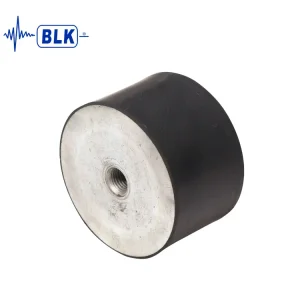
| Rubber / Elastomeric Mounts (BKDD, BKM, BKDR) | 7.0 Hz – 15.0 Hz | 0.05 – 0.15 | High-RPM electric motors, compact pumps, auxiliary power units | Resilient against mechanical shock; requires oil/chemical-resistant NBR or EPDM compounds. |
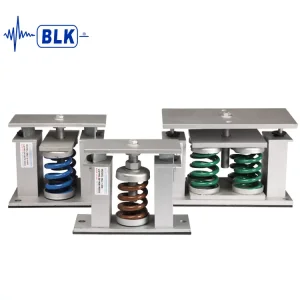
| Viscous Damped Spring Mounts (MA, BK-DS) | 3.0 Hz – 5.0 Hz | 0.01 – 0.20 (With Oil Damping) | Low-speed chillers, massive diesel generators, reciprocating compressors | Superior low-frequency isolation; Dacromet coating guarantees 900-hr salt spray corrosion resistance. |
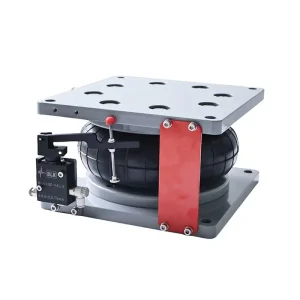
| Pneumatic Air Isolators (BK-PF, BK-A, BK-R) | 1.7 Hz – 3.0 Hz | 0.06 – 0.12 | Semiconductor inspection, optical benches, ultra-precision motor stages | Active auto-leveling valves; zero creep over extended operating cycles. |
Global Industry Trends in Vibration Isolation Technology
How smart manufacturing, sustainability mandates, and ultra-precision industrial requirements are transforming motor mounting engineering worldwide.
1. Integration of Smart IoT Sensors & Condition Monitoring
Modern Industry 4.0 plants are transitioning from passive vibration damping to smart mount architectures. Advanced motor mounts are now designed to integrate wireless piezo-electric accelerometers and thermal sensors. Real-time vibration telemetry feeds into predictive maintenance AI models, alerting engineers to mechanical unbalance, motor bearing pitting, or rubber fatigue before catastrophic failure occurs.
2. Zero-VOC Eco-Friendly Elastomeric Compounds
Global environmental regulations (EU REACH, RoHS 3.0) have forced a shift away from legacy vulcanization additives and toxic plasticizers. Factories now engineer low-VOC, heavy-metal-free synthetic elastomers (polynorbornene, high-grade EPDM, ultra-pure silicone) that maintain structural damping elasticity across extreme temperature windows (-40°C to +120°C) without off-gassing hazardous compounds.
3. Active-Passive Hybrid Attenuation Systems
For applications demanding sub-micron rotational stability (such as semiconductor lithography motors and high-speed CNC spindles), passive elastomeric or spring mounts are paired with electromagnetic voice-coil actuators. This hybrid setup delivers ultra-fast counter-forces to neutralize ambient transient shocks while maintaining low static deflection.
Global Enterprise Procurement Dynamics & Intent Mining
Analyzing B2B buyer requirements, Total Cost of Ownership (TCO), dynamic load verification, and procurement risk reduction.
Procurement directors and EPC (Engineering, Procurement, and Construction) contractors sourcing anti vibration motor mounts look far beyond initial unit price. The selection process evaluates critical long-term economic and technical variables to prevent dynamic fatigue, operational shutdown, and catastrophic foundation cracking.
Key Sourcing Metrics Evaluated by Global Enterprise Buyers:
- Total Cost of Ownership (TCO) & Fatigue Life: High-stress motor mounts engineered with inferior carbon steel or low-grade natural rubber sag within 12–18 months under continuous dynamic load. Premium mounts using high-tensile spring alloy steel (60Si2Mn) and Dacromet surface coatings extend service life beyond 15 years, eliminating costly field replacement downtime.
- Verification of Dynamic Stiffness ($K_{dyn}/K_{st}$ Ratio): Standard rubber mounts stiffen rapidly under dynamic cyclic frequencies. B2B buyers mandate test documentation demonstrating a low dynamic-to-static stiffness ratio ($K_{dyn}/K_{st} \le 1.3 - 1.5$), ensuring stable performance across fluctuating motor RPMs.
- Customization & Rapid Turnaround: Non-standard motor footprints, off-center center of gravity (CG) mass distribution, and seismic restraint requirements demand agile manufacturing capabilities. Leading factories must provide engineered 3D CAD/FEA simulations within 24 hours and physical prototype production within 3 to 5 business days.
- Factory-Direct Transparency vs. Trading Intermediaries: B2B buyers increasingly bypass third-party distributors to work directly with certified manufacturers. Direct factory engagement guarantees full material traceability (mill test reports, ISO 9001 quality compliance, salt spray testing verification) while lowering unit purchasing costs by 25% to 40%.
China Industry 4.0: Supply Chain Resilience & Efficiency at Kunshan
Inside Bellking's state-of-the-art manufacturing facility: Robotic welding, finite element simulation, automated rubber vulcanization, and stringent quality control.
Robotic Manufacturing & Precision CNC Machining
Bellking operates a 2,000 m² modern manufacturing hub in Kunshan, Jiangsu. Automated 6-axis robotic welding stations ensure structural welds on heavy-duty spring housings and inertia bases maintain 100% penetration depth, eliminating structural joint failure under dynamic impact loads of up to 3G–5G acceleration.
In-House Testing & Quality Assurance Protocol
Every production batch undergoes dynamic tension-compression testing, vibration spectrum analysis, and shear stress verification. Steel hardware is subjected to 900-hour continuous salt spray chamber testing (Dacromet coating process), guaranteeing extreme weather resistance for coastal installations and offshore marine operations.
Supply Chain Integration & Rapid Global Logistics
Leveraging Kunshan's world-class industrial supply chain cluster, Bellking maintains extensive raw material inventories of spring alloys, specialized polymers, and cast iron components. Standard anti vibration motor mounts ship within 24 hours, while customized B2B orders are engineered and dispatched with unmatched speed.
Localized Application Scenarios & Heavy-Duty Use Cases
Tailored vibration attenuation designs across diverse industrial motor equipment environments.
HVAC Centrifugal Chillers & Heavy Pumps
Large-capacity motor-driven chillers and circulating pumps in commercial skyscrapers require damped spring isolators (MA & BK-DS Type) paired with concrete-filled inertia bases (CPB Type). This configuration lowers the equipment center of gravity, restricts transient rocking during high-torque motor start-up, and prevents noise transmission through building structures.
Electrical Power Transformers & Substation Reactors
Magnetostriction in transformer cores generates low-frequency hum (100 Hz / 120 Hz fundamental frequencies). Bellking's specialized transformer anti-vibration mounts isolate core vibrations before they travel into civil foundation slabs, meeting strict noise compliance standards in urban residential substations.
Semiconductor Lithography & Metrology Tools
Sub-micron manufacturing tools cannot tolerate ambient building vibrations caused by external motor equipment. Precision air mounts (BK-PF & BK-A Type) deliver an ultra-low natural frequency of 1.7 Hz with automatic pneumatic level correction, shielding optical inspection benches from micro-seismic disturbances.
Engineer's Step-by-Step Selection & Sizing Protocol
Follow this mathematical sizing routine to select the optimum mount model for your dynamic motor equipment.
Step 1: Determine Total Operating Weight ($W_{total}$)
Calculate the combined weight of the motor, driven unit (pump, compressor, fan), baseframe, fluid contents, and piping loads:
$$W_{total} = W_{motor} + W_{driven\_unit} + W_{skid} + W_{fluid}$$
Step 2: Identify Load Distribution & Support Points ($N$)
Locate the equipment Center of Gravity (CG). For symmetrical machinery supported at $N$ points, the static load per mount ($P_s$) is:
$$P_s = \frac{W_{total}}{N}$$
Note: If the Center of Gravity is offset, calculate individual corner loads using static moment equilibrium equations ($\sum M = 0$). Select isolators with proportional spring constants ($k$) so static deflections remain uniform across all mounting points.
Step 3: Calculate Required Static Deflection ($\delta_{st}$)
To target a specific system natural frequency ($f_n$), determine the necessary static deflection under load using the simplified formula:
$$f_n \approx \frac{5}{\sqrt{\delta_{st} \text{ (in cm)}}} \quad \text{or} \quad f_n \approx \frac{15.8}{\sqrt{\delta_{st} \text{ (in mm)}}}$$
For example, to achieve a low natural frequency of $f_n = 3.5\text{ Hz}$, the mount must provide a static deflection of approximately $\delta_{st} \approx 20.3\text{ mm}$ under load.
Frequently Asked Questions: Engineering & Procurement
Detailed technical answers provided by Bellking's chief vibration control application engineers.
How do I choose between elastomeric rubber mounts and steel spring isolators for electric motors?
What causes motor mounts to fail prematurely, and how does Bellking prevent degradation?
Why is viscous damping required in spring mounts supporting motor-driven equipment?
What technical parameters are required for Bellking engineers to issue a custom mounting proposal?
How do precision pneumatic air mounts (BK-PF, BK-A) differ from standard industrial rubber pads?
What factory quality documentation and testing certificates are provided with B2B shipments?
Specialized Vibration Damping & Structural Isolation Accessories
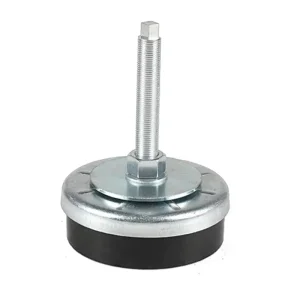
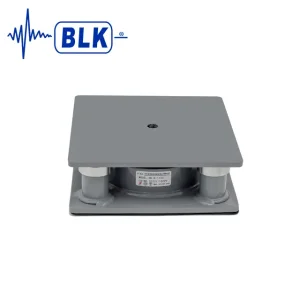
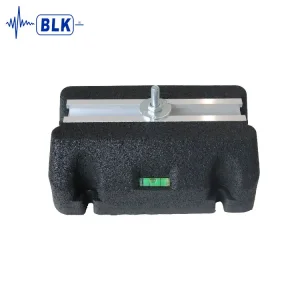
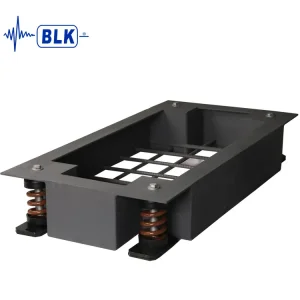
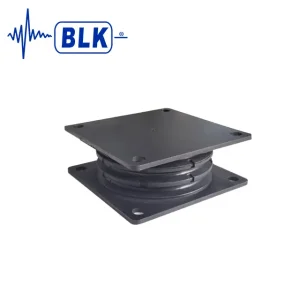
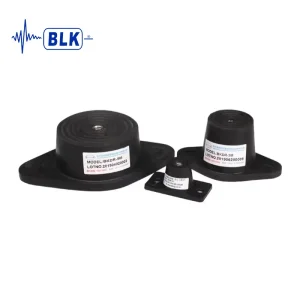
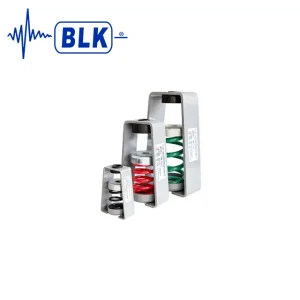
Complete your mechanical isolation setup with our levelling adjustment feet, polymer damping pads, heavy inertia bases, multi-layer dampers, and suspended spring hangers.

Request Engineering Support & Factory Price Quote
Send us your equipment specifications (operating weight, motor RPM, footprint dimensions). Our engineering team will calculate your dynamic isolation requirements and return a tailored mounting proposal within 24 hours.
Contact Bellking Engineering Team