Precision Engineered Vibration Isolation Solutions
Explore standard and customized industrial pump mounts designed for HVAC systems, heavy industrial fluid handling, and precision cleanroom environments.
1. Executive Overview & The Physics of Pump Vibration Dynamics
In industrial fluid handling, HVAC plants, and municipal water distribution, pump vibration represents a primary cause of structural fatigue, catastrophic mechanical failure, and unacceptable acoustic noise transmission.
Harmonic Resonance & Static Deflection
Every operational pump generates complex dynamic forces caused by rotating mass unbalance, hydraulic impellers passing diffuser vanes, and fluid turbulence. When the operational speed (RPM) approaches the natural frequency ($f_n$) of the supporting floor or pipe matrix, severe harmonic resonance occurs. High-quality anti-vibration pump mounts decouple the motor-pump assembly from the building structure by establishing a low system natural frequency.
Achieving effective vibration isolation requires calculated static deflection ($x_{st}$). According to linear elastic dynamics, the natural frequency of an isolator is governed by:
f_n = (1 / 2π) * √(g / x_st)
To reach high isolation efficiency (>92–98%), the ratio of excitation frequency ($f_e$) to natural frequency ($f_n$) must exceed 3:1 ($f_e / f_n \ge 3$).
Transmissibility Curves & Damping Factors
Vibration transmissibility ($T_r$) measures the proportion of force transmitted through the mount to the foundation. Un-damped springs achieve dramatic low-frequency isolation but experience catastrophic amplitude spikes during motor startup and coast-down through resonance.
Advanced anti-vibration pump mounts integrate high-damping elastomeric elements (NBR, EPDM, Neoprene) or viscous internal dampeners. This controlled hysteresis dampens transient resonance spikes while maintaining ultra-low stiffness at continuous operating speeds.
2. Global Industrial Trends & Macroeconomic Demand
The global market for anti-vibration mounts is experiencing rapid growth driven by strict environmental acoustic regulations, urban densification, and advanced industrial automation standards.
ESG & Acoustic Noise Compliance
Global building codes—such as ASHRAE 170, ISO 10816 velocity limits, and EU noise directive 2002/49/EC—mandate lower sound power levels ($dBA$) in commercial and industrial settings. Pumps placed on upper equipment floors or near office units must utilize elastomeric and spring isolators to mitigate structure-borne noise attenuation.
Hyperscale Data Center Cooling
Modern AI data centers require intense liquid cooling systems involving ultra-dense primary and secondary pump loops. Uncontrolled micro-vibrations from these pumps cause harmonic jitter in optical transceivers and high-density disk arrays. High-performance precision pump mounts have transitioned from optional HVAC hardware to mission-critical infrastructure.
Seismic & Typhoon Resiliency
Global procurement teams increasingly require integrated seismic restraint capability (ASCE 7 compliance). Modern pump mounts must absorb vertical static dynamic loads while simultaneously serving as multi-directional seismic snubbers during severe earthquake or hurricane excitation events.
3. China Factory 4.0: Supply Chain Resilience & Efficiency
The manufacturing ecosystem in Kunshan, China, leads global industrial vibration isolation technology. By combining automated elastomer compounding, robotic laser welding, and strict quality control, Chinese factories offer unparalleled technical reliability and cost efficiency.
Advanced Metallurgical & Polymer Synthesis
A high-performance anti-vibration mount relies heavily on its materials science. China Industry 4.0 facilities utilize automated closed-loop rubber injection molding systems, achieving consistent rubber-to-metal bonding strengths exceeding 12 MPa. Natural and synthetic elastomers are engineered for specific environmental oil resistance, ozone stability, and low creeping relaxation over decades of continuous load.
For spring isolators, high-tensile alloy spring steel undergoes shot-peening and Dacromet surface treatments, enduring over 900 hours of continuous neutral salt spray (ASTM B117) exposure without corrosion failure.
Quality Control & Complete Process Traceability
Leading Chinese anti-vibration pump mount factories operate under strict ISO 9001 and IATF 16949 quality management systems. Every manufacturing batch undergoes full dynamic characterization:
- Static Deflection Verification: Hydraulic load testing to confirm exact spring rate ($K_s$).
- Dynamic Stiffness & Damping Test: Servo-hydraulic actuators measure dynamic response under variable frequencies (1 to 200 Hz).
- Finite Element Analysis (FEA): Computer modeling optimizes stress distribution in cast iron housings and rubber pads under multi-axis loading.
4. Anti Vibration Pump Mount Selection Standard
Selecting the optimal mount requires aligning pump operational metrics with isolator mechanical parameters. Review the engineering matrix below:
| Mount Type | Natural Freq ($f_n$) | Deflection Range | Best Application | Environmental Resistance |
|---|---|---|---|---|
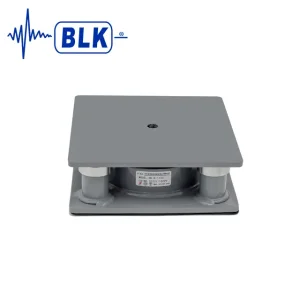
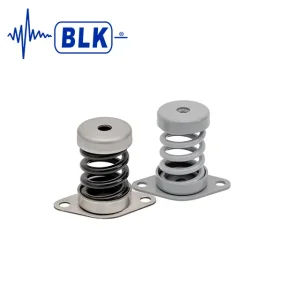
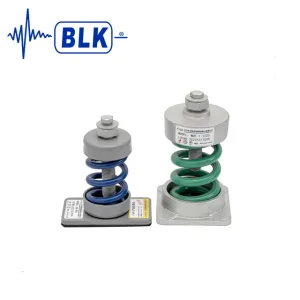
| Enclosed Spring Mounts | 3.0 - 5.0 Hz | 25mm - 50mm | Large chilled water pumps, cooling towers, industrial centrifuges | Excellent (Dacromet / Hot-dip Galvanized) |
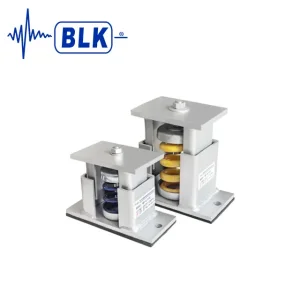
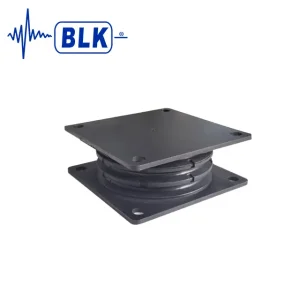
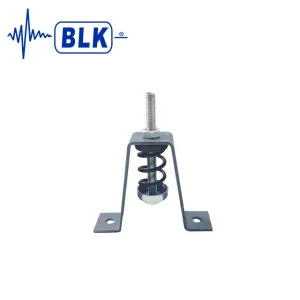
| Viscous Damped Spring Isolators | 2.5 - 4.5 Hz | 25mm - 75mm | Variable frequency drive (VFD) pumps traversing resonance | High chemical & oil resistance |
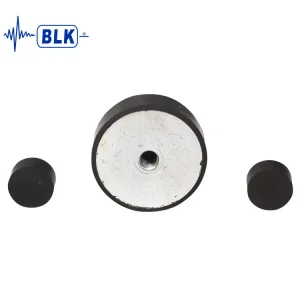
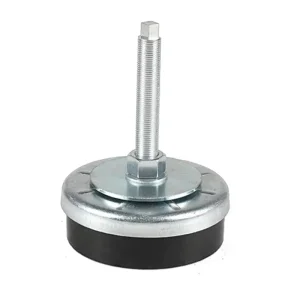
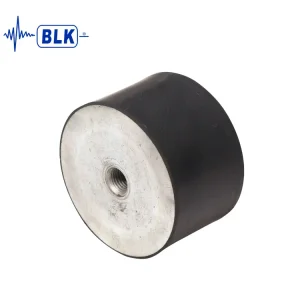
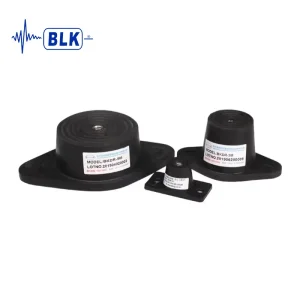
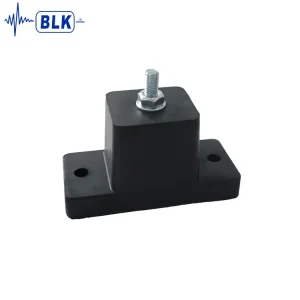
| Rubber Heavy-Duty Mounts | 6.0 - 12.0 Hz | 5mm - 12mm | High-speed small/medium pumps (>1750 RPM), end-suction pumps | Superior oil, UV, and ozone tolerance |
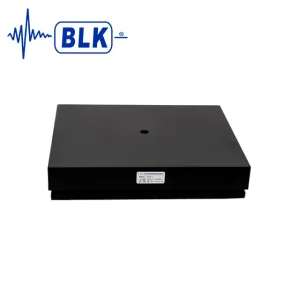
| Inertia Base + Spring Isolators | 2.0 - 4.0 Hz | 50mm - 100mm | High-power industrial pumps, vertical inline pumps with eccentric thrust | Maximum structural rigidity & frame alignment |
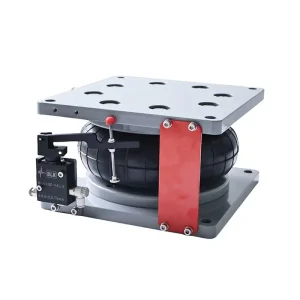
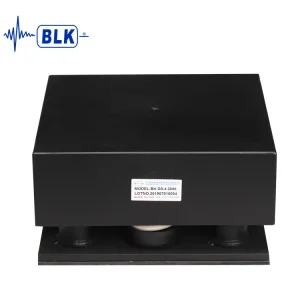
| Pneumatic Precision Air Mounts | 1.7 - 3.0 Hz | N/A (Air level) | Ultra-clean process fluid pumps in semiconductor/lab fabs | Cleanroom compatible, controlled air supply required |
5. Localized Industrial Application Scenarios
Anti-vibration pump mounts perform critical structural roles across diverse technical environments globally.
High-Rise HVAC & Commercial Hydronic Systems
In high-rise commercial towers, mechanical plant rooms are located on upper floors or roof decks. Unmitigated pump excitation transfers down steel beam structures, generating low-frequency humming throughout office floors.
Recommended Solution: Installing enclosed spring mounts with elastomeric acoustic cups beneath a poured concrete inertia base. This setup increases system inertia, lowers the center of gravity, stops piping stress, and reduces noise transmission by over 95%.
Chemical Processing & Municipal Wastewater Plants
Industrial wastewater pumps handle slurries, corrosive liquids, and variable solids, causing unpredictable dynamic unbalance. Standard steel mounts deteriorate rapidly under chemical fumes and moisture.
Recommended Solution: Custom rubber mounts (BKDR / BKDE series) using high-grade Neoprene or EPDM compounds, combined with stainless steel fasteners and anti-corrosive cast steel housings.
6. Total Cost of Ownership (TCO) & Factory Price Framework
Understanding pricing structures allows global procurement teams to optimize cost without compromising engineering integrity.
Raw Material Composition
Direct factory prices vary based on materials: natural rubber versus specialized fluoroelastomers, cast iron versus high-tensile ductile iron housings, and standard zinc plating versus 900-hour Dacromet coating.
Custom Engineering & Tooling
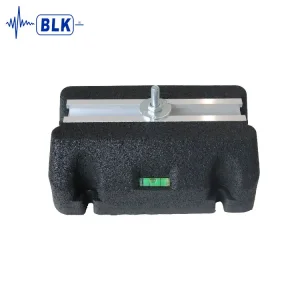
Standard off-the-shelf rubber feet (e.g., BKAL type) benefit from massive production runs, lowering unit costs. Custom spring rates, multi-layer dampers (BKSWA type), or specific seismic snubber integration require small-batch tooling adjustments.
Direct Factory Procurement ROI
Procuring direct from Kunshan manufacturers eliminates distributor markups (often 40-60%). Investing in high-quality mounts prevents premature pump seal destruction, bearing burnouts, and costly pipe flange ruptures.
Procurement Pro-Tip: Always request certified static deflection charts, dynamic stiffness test reports, and salt spray test certifications when evaluating supplier price quotes.
7. Frequently Asked Questions (FAQ)
Direct answers from senior application engineers to assist your design and procurement decisions.
How do I calculate the required static deflection for my pump mount?
Determine the operational speed (RPM) of your pump first. Convert RPM to Hertz ($Hz = RPM / 60$). Identify the required isolation efficiency (typically 90–95%). Using transmissibility formulas, calculate the target natural frequency ($f_n$). Once $f_n$ is known, derive the required static deflection using $x_{st} = g / (2\pi \cdot f_n)^2$. For example, a 1450 RPM pump typically requires a minimum of 25mm static spring deflection to achieve >90% isolation.
When should I specify an Inertia Base instead of mounting pumps directly on isolators?
An inertia base (a heavy steel frame filled with concrete) is recommended when: (1) The pump motor exceeds 15 kW; (2) The pump operates with high horizontal thrust or eccentric loads; (3) The installation is located on an elevated floor slab where structural mass is low; or (4) To keep flexible pipe connectors in perfect alignment during pump startup torque.
What is the difference between Rubber Mounts and Spring Mounts for pump isolation?
Rubber mounts provide high high-frequency noise attenuation and high internal damping, but their static deflection is limited (usually <12mm). They suit high-speed pumps (>1800 RPM). Spring mounts offer high static deflection (25–75mm) and low natural frequencies (2.5–5 Hz), making them necessary for lower-speed pumps (<1500 RPM) or installations on light building structures.
How does China Industry 4.0 manufacturing lower unit prices while maintaining quality?
Integrated supply chain clusters in regions like Kunshan reduce raw material transit costs. Automated rubber vulcanization, robotic spring coiling, and CNC machining minimize manual labor errors. Scale economies allow high-volume automated manufacturing, delivering international certification standards at competitive pricing.
Can Bellking supply custom non-standard dimensions and seismic restraints?
Yes. Bellking offers 1:1 engineering design customization based on actual equipment weight, center of gravity, and seismic acceleration requirements. Non-standard mount solutions can be engineered and verified within 3 to 5 working days.
Advanced Damping & Precision Vibration Isolators
Explore pneumatic platforms, precision air mounts, specialized rubber feet, and heavy-duty spring dampers.