
Featured Anti-Vibration Mounts & Pneumatic Air Systems
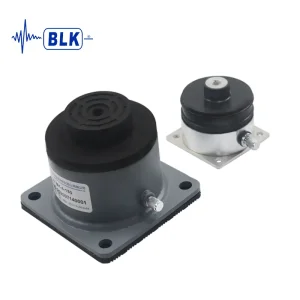
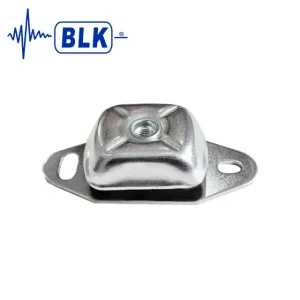
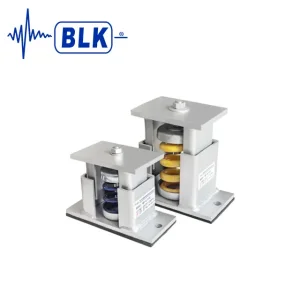
Explore our primary industrial vibration control assemblies engineered for high isolation efficiency, robust shear performance, and extended fatigue lifespan.


Engineering Principles & Market Dynamics of Anti-Vibration Wall Mounts
Understanding structure-borne acoustic transmission, load vector calculations, and dynamic isolation efficiency in wall-hung mechanical infrastructure.
Structure-Borne Noise Attenuation
In modern industrial and commercial facilities, wall-mounted mechanical assets—such as HVAC compressor brackets, hydraulic booster pumps, split-system condensers, and electrical transformer enclosures—exert continuous dynamic forces directly into structural masonry and steel framing. Unmitigated mechanical energy manifests as severe low-frequency vibration and structure-borne noise, radiating across building partitions and violating acoustic thresholds.
High-performance anti-vibration wall mounts act as dynamic mechanical filters. By interposing calibrated elastomeric, spring, or pneumatic damping elements between the wall bracket and structural wall, dynamic energy transmission can be attenuated by up to 99% isolation efficiency.
Cantilever Shear & Tensile Load Vectors
Unlike standard floor isolators operating purely under compression, wall-mounted vibration isolators endure complex vector mechanics combining vertical shear forces ($F_s$) and horizontal tensile/cantilever moments ($F_t$). Engineering anti-vibration wall mounts requires rigid structural backplates, multi-directional damping cores, and anti-tear polymer compounding.
Global Demand Trends & Regulatory Drivers in Anti-Vibration Systems
A strategic overview of industrial adoption across North America, Europe, Asia-Pacific, and emerging manufacturing hubs.
Commercial Building Acoustic Codes
Stringent urban building regulations (such as DIN 4109 in Europe, ASHRAE guidelines in North America, and GB 50096 in China) require strict decibel limits in residential and commercial mixed-use developments. Facility managers are forced to retrofit wall-mounted HVAC outdoor units, booster pumps, and exhaust fans with rated anti-vibration wall mounts to prevent costly noise litigation.
Semiconductor & High-Tech Cleanrooms
With global semiconductor fabrication facilities expanding rapidly across Asia and Western regions, micro-vibration isolation has migrated from floor equipment to wall-suspended gas scrubbers, vacuum pumps, and specialized fluid lines. Sub-micron lithography tolerance demands non-transmissible wall mounting brackets operating down to ultra-low natural frequencies ($f_n \le 2.0\text{ Hz}$).
Electrical Substation & Energy Retrofits
Distribution transformers and power inverters mounted to masonry substations continuously emit low-frequency electromagnetic hum (100 Hz / 120 Hz harmonics). Industrial buyers globally are shifting from rigid steel anchor bolts to high-damping matrix rubber wall mounts capable of withstanding heavy thermal variations while stifling structural harmonic resonance.
Why China & Bellking Set the Global Standard for Vibration Isolation
Unmatched industrial scale, complete supply chain integration, and precision engineering in Kunshan, China.
The Kunshan Precision Industrial Advantage
Located in the premier manufacturing belt of Kunshan, Jiangsu, Bellking Vibration Reduction Equipment Manufacturing Co., Ltd. operates a specialized 2,000 m² production base. China’s advanced industrial cluster enables complete vertically integrated manufacturing—from raw steel processing and spring coiling to proprietary rubber formulation vulcanization and automated assembly.
By leveraging state-of-the-art robotic welding, CNC precision machining, and automated electrostatic powder coating, Bellking achieves superior production efficiency, offering world-class anti-vibration wall mounts at pricing 30% to 45% more competitive than European or North American domestic producers.
- Dacromet Anti-Corrosion Treatment: Steel components pass rigorous 900-hour salt spray testing, ensuring resistance in harsh marine and industrial outdoor environments.
- 37 Proprietary Patents: Driven by continuous R&D including 16 national invention patents for advanced vibration reduction matrix systems.
- ISO 9001 Quality Control: Every batch undergoes strict tension-compression tests, dynamic damping verification, and spectrum analysis.
- Rapid Prototyping: Custom non-standard wall mounts delivered in as fast as 3 working days from initial engineering approval.
Localized Application Scenarios & Industrial Implementation
Tailored anti-vibration wall mounting strategies engineered for challenging structural and operational environments.
1. Wall-Hung Commercial HVAC & Chillers
Multi-story commercial complexes often mount auxiliary air handlers, VRF condensers, and duct blowers onto structural hallway or perimeter walls. Utilizing Bellking heavy-duty spring wall brackets with built-in rubber snubbers isolates rotational vibration from fan impellers running at 900–1800 RPM, stopping low-frequency rumble into executive office suites.
2. Industrial Power Transformers & Genset Enclosures
Dry-type electrical transformers mounted against substations generate continuous magnetic core vibrations (60 Hz / 120 Hz). Bellking matrix rubber damping wall mounts provide high compressive strength combined with exceptional shear stiffness, mitigating hum transmission while keeping equipment anchored securely during seismic occurrences.
3. Precision Metrology & Optical Test Labs
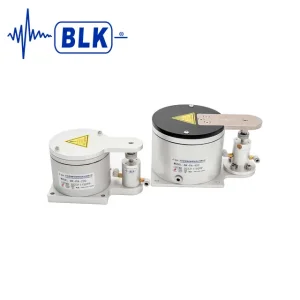
In optical testing rooms and cleanroom corridors, wall-mounted laser benches and specialized inspection cameras require immunity from building floor vibrations. Pneumatic air wall mounts (such as the BK-A and BK-PA series) establish ultra-low natural frequencies ($f_n \approx 1.7\text{ Hz}$), protecting delicate instrumentation from ambient floor shock.
Anti-Vibration Mount Types: Selection & Performance Matrix
A clear technical breakdown comparing natural frequencies, load capacities, deflection characteristics, and ideal deployment scenarios.
| Mount Technology Type | Natural Frequency ($f_n$) | Isolation Efficiency Range | Rated Load Capacity (per point) | Primary Industrial Application | Typical Service Life |
|---|---|---|---|---|---|
| Pneumatic Air Mounts (BK-A / BK-PA) | 1.7 Hz – 3.0 Hz | 98% – 99.5% | 50 kg – 1,200 kg | Metrology, Optical Benches, Cleanrooms | 6+ Years |
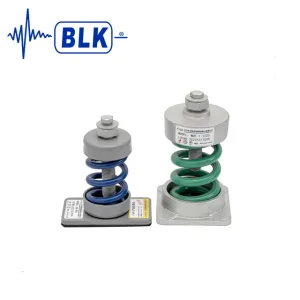
| Spring Vibration Isolators (MB / MD) | 3.0 Hz – 5.0 Hz | 90% – 98% | 150 kg – 3,500 kg | Heavy Chillers, Pumps, Wall Blowers, Gensets | 15+ Years |
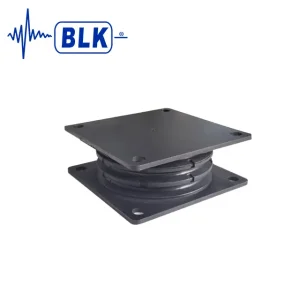
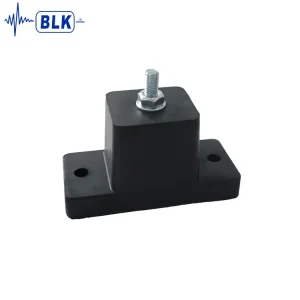
| Matrix Rubber Mounts (BK-MT / BKM) | 6.0 Hz – 12.0 Hz | 82% – 92% | 20 kg – 800 kg | Transformers, Motors, Small HVAC Units | 10+ Years |
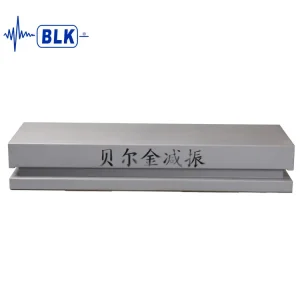
| Polymer & Damped Rubber Pads (BK-PM / BKDJ) | 8.0 Hz – 15.0 Hz | 75% – 88% | 100 kg – 5,000 kg | Acoustic Retrofits, Base Isolation, Heavy Plant | 12+ Years |
Anti-Vibration Wall Mount Price Factors & TCO Analysis
Key variables influencing manufacturing costs, unit pricing brackets, and long-term return on investment for international procurement teams.
Key Cost Drivers in Wall Mount Manufacturing
When procuring high-quality anti-vibration wall mounts from industrial manufacturers, pricing varies based on technical parameters rather than basic steel weight:
- Core Damping Material Quality: Premium Neoprene (CR) or Natural Rubber (NR) compounds formulated for high hysteresis loss and dynamic anti-aging cost more than recycled rubber fillers but prevent catastrophic shear failure under continuous dynamic vibration.
- Surface Treatment Standards: Standard electro-galvanizing ($5\text{–}8\,\mu\text{m}$) is low-cost but degrades in outdoor wall installations within 2 years. High-grade Dacromet coatings ($15\text{–}25\,\mu\text{m}$) passing 900-hour salt spray tests ensure 15+ year operational life with zero maintenance.
- Dynamic Tuning & Damping Elements: Integrated viscous fluid dampers or pneumatic level-sensing valves add mechanical complexity, raising unit costs while delivering sub-2.0 Hz isolation performance.
Procurement Price Bracket Overview (OEM Direct Pricing)
Direct factory wholesale price ranges for global buyers purchasing from qualified manufacturers in China:
- Compact Rubber Wall Mounts (Light Duty): Estimated $3.50 – $12.00 USD per unit depending on durometer hardness, elastomer grade, and bracket sizing.
- Heavy-Duty Spring Wall Brackets (Medium/Heavy Duty): Estimated $18.00 – $65.00 USD per unit, accounting for spring steel rating, Dacromet coating, and snubber assemblies.
- Precision Pneumatic Wall Isolators (Ultra-Low Frequency): Estimated $120.00 – $450.00 USD per system including automatic level sensing valves and pneumatic control manifolds.
*Note: Actual enterprise quotes depend on volume discounts, custom bracket engineering, and freight terms (FOB Shanghai/Ningbo, CIF, or DDP).
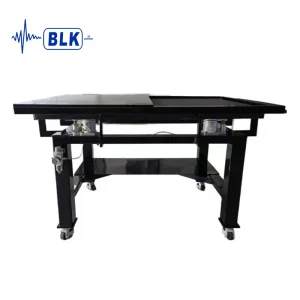
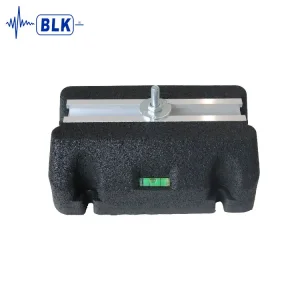
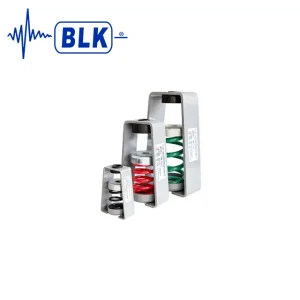
Specialized Mounts, Damping Pads & Platforms
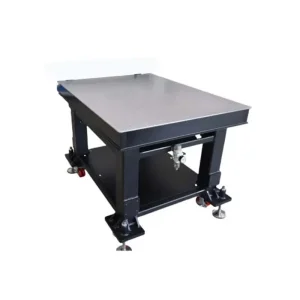
Browse our comprehensive series of rubber pads, spring mounts, polymer dampers, and precision platforms.


How to Size Anti-Vibration Wall Mounts: Engineering Equations
A quick math checklist for mechanical designers calculating dynamic transmissibility and wall anchor torque safety margins.
1. Disturbing Frequency vs. Natural Frequency Ratio
Vibration isolation occurs only when the disturbance frequency $f_d = \text{RPM} / 60$ is greater than $\sqrt{2}$ times the natural frequency ($f_n$) of the chosen isolator mount:
Where natural frequency $f_n$ for static deflection $\delta$ (in cm) is approximated by:
2. Cantilever Tension Load Vector Calculation
For a wall-hung bracket supporting equipment mass $M$ at overhang distance $L$ from the wall, with upper and lower mount spacing $H$:
Ensure that both the top anti-vibration wall mount and expansion anchor bolts have a structural safety margin of at least $3.0\times$ against maximum calculated tensile pull-out forces.
Frequently Asked Questions by B2B Procurement & Engineers
Expert answers from Bellking’s application engineering team regarding wall mount selection, dynamic loads, and installation guidelines.
Work Directly with Bellking Engineers
Eliminate middleman markups and technical misalignments. Partner directly with an ISO 9001 certified manufacturer offering over 13 years of technical expertise, 37 industry patents, and direct factory-direct wholesale pricing.
Bellking Vibration Reduction Equipment Manufacturing (Kunshan) Co., Ltd.
📍 Factory Address: No.28 Chenggong Road, Kunshan City, Jiangsu Province, China (215300)
✉️ Sales & Tech Support Email: [email protected]
📞 Direct Hotline: +86-0512-55002468 | Mobile/WhatsApp: +86 17721514546
Request Engineering Catalog & Price Quote
Get a comprehensive PDF product catalog, CAD dimensions, and factory-direct pricing within 24 hours.