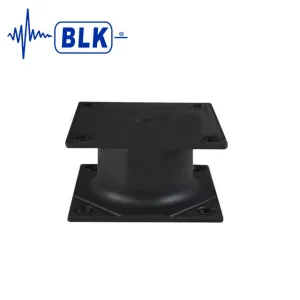
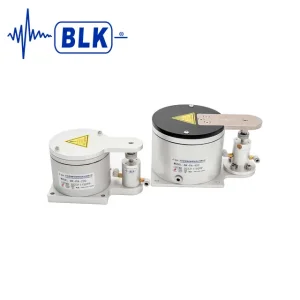
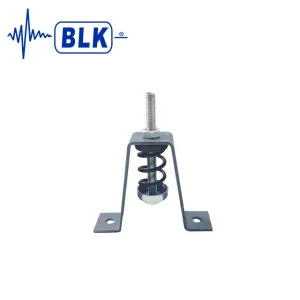
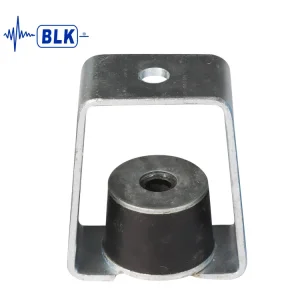
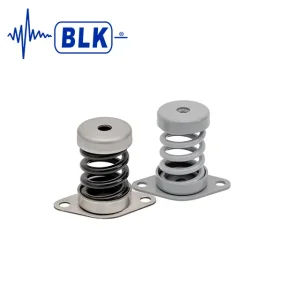
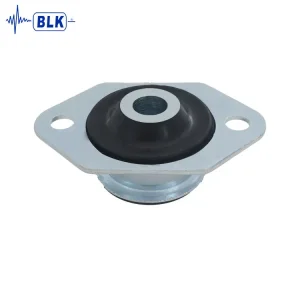
Featured Compressor Vibration Isolators & Mounts
Direct-from-factory vibration isolation systems engineered for rotary screw, reciprocating, and centrifugal air & gas compressors.
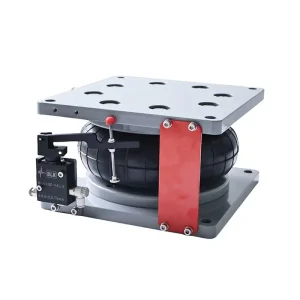

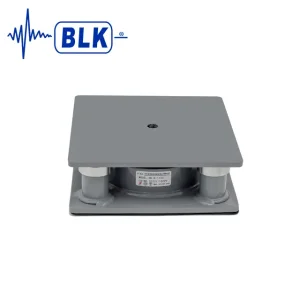



Global Macro Landscape: Industrial Compressor Dynamics & Acoustic Mitigation
An exhaustive engineering synthesis of mechanical vibration isolation, structural fatigue reduction, and total cost of ownership (TCO) optimization in modern industrial compressed air plants.
Executive Engineering Overview
Industrial compressed air and gas systems consume over 10% of total global electricity used in manufacturing facilities worldwide. Within continuous-duty process industries—including petrochemical refining, semiconductor fabrication, pharmaceutical processing, and heavy automotive assembly—compressors function as the operational heartbeat. However, the conversion of electrical energy into mechanical displacement introduces violent dynamic forces, unbalance moments, and gas pulsation harmonics.
Unmitigated structural vibration propagates through building slabs, piping networks, and electrical conduit, accelerating mechanical fatigue, shearing structural fasteners, degrading sensitive measurement instruments, and inducing extreme low-frequency acoustic discomfort (in compliance with ISO 10816 and ISO 20816 severity standards). Deploying high-efficiency, mathematically matched compressor vibration isolators is no longer merely an optional noise abatement measure; it is a critical operational safeguard required to maintain uptime, protect structural integrity, and pass stringent workplace safety audits.
OPEX & TCO Optimization
Vibration energy loss directly correlates with premature bearing wear, seal leakage, and pipe joint cracking. Installing precision-engineered spring or pneumatic mounts extends mean time between failures (MTBF) by up to 340%, significantly reducing unplanned downtime costs.
High-Frequency Harmonics
Rotary screw compressors generate high-frequency meshing vibration (500 Hz – 4,000 Hz), while heavy reciprocating units emit high-amplitude low-frequency primary unbalance forces (4 Hz – 30 Hz). Specialized isolator damping profiles isolate distinct harmonic zones effectively.
Regulatory & Standard Compliance
Modern industrial plants must comply with ISO 3744 acoustic standards, OSHA 1910.95 noise exposure limits, and DIN 4150-3 structural vibration thresholds. Precision isolator systems reduce transmitted structural noise by up to 32 dB.
Vibration Isolation Mechanics & Transmissibility Formulas
Understanding the mathematical relationships governing force transmission ratio (T), static deflection (δ), and natural frequency (f_n).
Mathematical Transmissibility Equation
The primary governing equation for forced vibration transmissibility ($T$) under single-degree-of-freedom (SDOF) steady-state motion is defined as:
T = √ [ (1 + (2 ζ r)²) / ( (1 - r²)² + (2 ζ r)² ) ]
Where:
- r = f_d / f_n (Frequency Ratio: Disturbing frequency divided by Natural frequency)
- ζ (zeta) = Damping ratio of the mounting system
- f_n = 5 / √δ (Natural Frequency in Hz derived from static deflection δ in cm)
Crucial Rule of Isolation: Vibration reduction only occurs when $r > \sqrt{2}$ ($r > 1.414$). For high-efficiency industrial compressor installations (>90% attenuation), optimal design criteria mandate a ratio of r ≥ 3.0 to 5.0.
Inertia Base Mass Tuning
For large reciprocating gas compressors and high-pressure rotary units with unbalanced primary/secondary forces, mounting directly to isolators can result in excessive physical motion during startup and operational surges.
To eliminate excessive amplitude, engineering best practice requires coupling the compressor skid to a reinforced concrete inertia base (e.g., CPB Series). The inertia base provides key dynamic enhancements:
- Lowers Center of Gravity: Stabilizes high-profile compressor assemblies.
- Increases Mass Ratio: Adds 1.5x to 3.0x additional static mass, reducing vibrational displacement amplitude according to $X = F_0 / (k \cdot \sqrt{(1-r^2)^2 + (2\zeta r)^2})$.
- Protects Pipe Connections: Minimizes mechanical flex stress on suction/discharge flanges and flex joints.
Compressor Isolator Technology Matrix
| Isolator Technology Class | Natural Frequency (f_n) | Damping Ratio (ζ) | Target Compressor Type | Isolation Efficiency | Environmental Resilience |
|---|---|---|---|---|---|
| Pneumatic Air Mounts (BK-PF / BK-PA) | 1.7 Hz – 3.0 Hz | 0.05 – 0.12 | Oil-Free Scroll, High-Precision Cleanroom Air Compressors | 98% – 99.5% | Controlled Cleanroom / Indoor |
| Spring Mounts w/ Viscous Damping (MA / ME) | 3.0 Hz – 5.0 Hz | 0.15 – 0.25 | Rotary Screw Chillers, Heavy Reciprocating Gas Compressors | 92% – 98.0% | Dacromet Coated (900h Salt Spray) |
| Neoprene / Elastomeric Pads (BKTS / BKDJ) | 8.0 Hz – 15.0 Hz | 0.08 – 0.15 | High-RPM Small Rotary Units (>1800 RPM), Auxiliary Motors | 80% – 90.0% | Oil, Chemical & UV Resistant Elastomers |
| Inertia Base Systems (CPB Base + Springs) | 2.5 Hz – 4.5 Hz | 0.20 – 0.35 | Unbalanced Industrial Gas Compressors & Heavy Pumps | 95% – 99.0% | Heavy Industrial / Outdoor Rugged |
Factory Direct Sizing Protocols & Global Pricing Dynamics
How tier-1 manufacturers optimize procurement budgets while delivering rigorous 1:1 engineered customization for worldwide deployments.
Step-by-Step Sizing Protocol
1. Calculate total operating weight (Compressor + Skid + Fluid Load).
2. Determine precise Center of Gravity (CG) to accommodate uneven weight distribution.
3. Identify lowest equipment operating speed (RPM / Hz).
4. Select isolator model providing target static deflection ($\delta \ge 25\text{mm}$ for 1200 RPM units).
Factory vs. Distributor Pricing
Sourcing directly from an OEM factory facility (such as Bellking's ISO 9001 Kunshan manufacturing plant) eliminates multi-tier distributor markup, reducing unit procurement costs by 30% to 45% while gaining direct engineering support and customized spring rate options.
Quality Assurance & Certification
Every factory shipment includes certified dynamic load test reports, material traceability certificates, spring fatigue resistance verification (EN 10270-2 compliant), and anti-corrosion salt spray inspection credentials (passing ASTM B117 / Dacromet 900-hour standards).
Localized Industrial Application Scenarios
Tailored vibration isolation strategies designed for distinct environmental conditions, structural constraints, and industry-specific regulations.
Scenario A: High-Tech Semiconductor Cleanrooms
Challenge: Oil-free scroll air compressors serving lithography tools transmitted micro-vibrations through sub-fab floors, disrupting nanometer-scale wafer processing.
Solution: Implementation of BK-PF Type Precision Air Mounts featuring integrated automatic pneumatic leveling and pneumatic damping chambers, achieving a 1.7 Hz natural frequency and eliminating >98.5% of floor disturbance.
Scenario B: Heavy Petrochemical Process Gas Plants
Challenge: Massive multi-stage reciprocating hydrogen compressors created severe low-frequency transient dynamic forces, threatening pipe weld joint integrity.
Solution: Installation of CPB Type Inertia Bases paired with high-deflection MA Series Anti-Vibration Spring Mounts with viscous internal dampers, reducing dynamic displacement amplitudes by 82%.
Scenario C: Rooftop Commercial HVAC Screw Chillers
Challenge: Rooftop screw compressor chillers generated structure-borne acoustic hum into executive office suites immediately below the plant roof slab.
Solution: Utilization of double-deflection spring isolators with high-grade neoprene acoustic cups, raising isolation efficiency to 96% and lowering indoor acoustic readings from 68 dBA to 39 dBA.
Scenario D: Offshore & Coastal Extreme Environments
Challenge: Marine air compressor skids on offshore drilling rigs faced severe saltwater corrosion, high humidity, and wave-induced seismic tilt forces.
Solution: Application of heavy-duty, all-seismic restrained spring isolators constructed with hot-dip galvanized housings and Dacromet 900-hour salt spray tested springs, compliant with seismic IBC/ASCE standards.
Technology Roadmap & Next-Gen Smart Isolation (2025–2035)
The evolution from passive elastomeric and mechanical spring mounts toward AI-driven active pneumatic feedback and smart IoT vibration monitoring networks.
IoT & Embedded MEMS Sensors
Integrating tri-axial MEMS accelerometers directly within the rubber or spring isolator housing allows continuous real-time spectrum monitoring. Dynamic shift signals alert plant managers to bearing breakdown before mechanical failure occurs.
Active Magnetorheological Damping
Next-generation hybrid isolators utilize MR fluids capable of changing viscosity in milliseconds under electromagnetic control, dynamically shifting natural frequencies to avoid resonance during compressor startup ramp-up cycles.
Advanced Bio-Polymer Elastomers
Replacing traditional synthetic rubbers with engineered bio-based polyurethanes offers superior hysteresis loss properties, zero hazardous chemical off-gassing, and extended resistance to industrial compressor synthetic lubricant mist.
Compressor Vibration Isolation: Engineering FAQ
Expert responses to critical engineering, selection, and purchasing questions faced by facility directors and mechanical specifiers.
How do I correctly size vibration isolators for a variable-speed rotary screw air compressor?
What is the difference between open spring mounts and restrained seismic spring isolators?
When is a concrete inertia base required for a compressor installation?
Why do synthetic compressor lubricants damage standard rubber isolators, and how is this avoided?
What factory testing documentation should be requested before issuing a purchase order?
Specialized Rubber, Hanger & Buffer Product Range
Complete line of auxiliary isolation components, rubber buffers, spring hangers, and specialized vibration pads for industrial compressed air plants.