
Primary Anti-Vibration Products & Mount Assemblies
Factory-direct elastomeric isolators, air mounts, spring hangers, and precision pads engineered for maximum mechanical stability and noise reduction.




Global Industrial Status & Commercial Dynamics
An authoritative analysis of the global electric motor vibration isolation market, supply chain shifts, and regulatory compliance imperatives.
Market Growth & Demand Vectors
The global electric motor rubber mount market is undergoing rapid expansion, driven by the global transition toward Industry 4.0 automation, electrification of automotive powertrains, and stringent acoustic comfort regulations in commercial HVAC infrastructure. Electric motors generate both high-frequency rotational vibration and low-frequency structural torque reaction forces. Without precision-engineered elastomeric damping mounts, energy transits directly into supporting frames, accelerating mechanical fatigue, bearing destruction, structural noise propagation, and unplanned facility downtime.
Regulatory & Environmental Compliance
Modern industrial installations must conform to rigorous international standards including ISO 10816 (Mechanical vibration evaluation), ISO 20283 (Shipboard vibration), and OSHA occupational noise exposure limits. OEMs and plant operators are increasingly sourcing vibration mounts from verified factories that utilize RoHS and REACH-compliant elastomer compounds. Low-outgassing, fire-retardant, and non-marking natural rubber and synthetic blends are now mandatory in semiconductor cleanrooms and marine vessel interiors.
Elastomeric Chemistry & Vibration Physics Whitepaper
Understanding dynamic stiffness ratios ($K_d/K_s$), loss factors ($\tan \delta$), and polymer molecular behavior under variable thermal loads.
The Physics of Vibration Transmissibility
Vibration isolation operates by tuning the natural frequency ($f_n$) of the rubber mount assembly to be significantly lower than the disturbing frequency ($f_d$) generated by the rotating electric motor. Transmissibility ($T$), which defines the proportion of force transmitted to the foundation, is mathematically expressed as:
Vibration Transmissibility Formula
T = √ [ (1 + (2ζr)²) / ((1 - r²)² + (2ζr)²) ]
Where r = f_d / f_n (Frequency Ratio) and ζ (Damping Ratio) is determined by the internal molecular friction of the selected rubber compound. Effective isolation requires r > √2 (approx. 1.414). For peak industrial damping performance, engineering standards dictate targeting r ≥ 3.0, achieving over 88% to 99% force attenuation.
Comparative Elastomer Material Dynamics Matrix
| Elastomer Type | Shore A Hardness | Temp Range (°C) | Dynamic Stiffness Ratio (Kd/Ks) | Oil & Chemical Resistance | Primary Application Scenario |
|---|---|---|---|---|---|
| Natural Rubber (NR) | 40 - 75 | -40 to +80 | 1.2 - 1.4 (Excellent) | Fair / Poor | HVAC Motors, Heavy Machinery, Gensets |
| Neoprene (CR) | 45 - 80 | -35 to +100 | 1.4 - 1.6 (Good) | Good | Marine Electric Propulsion, Pumps |
| Nitrile Rubber (NBR) | 50 - 85 | -30 to +110 | 1.5 - 1.8 (Moderate) | Excellent (Oils/Fuel) | Automotive Power Units, Hydraulic Motors |
| EPDM Rubber | 40 - 80 | -45 to +130 | 1.3 - 1.5 (Good) | Excellent (Ozone/Steam) | Outdoor Cooling Towers, Rooftop AHUs |
| Fluoroelastomer (FKM) | 60 - 90 | -20 to +200 | 1.8 - 2.2 (High) | Superior (Corrosive Solvents) | Chemical Processing Electric Drives |
Localized Application Scenarios & Industry Solutions
Tailored vibration isolation architectures configured for specific industrial operating environments and structural demands.
HVAC & Building Services
Electric motors driving heavy centrifugal chillers, cooling towers, and large air handling units generate structural low-frequency hums that travel through building concrete. Utilizing high-deflection rubber pads (such as BKTS and BKDJ types) or combined spring-rubber mounts eliminates harmonic transfer into occupied office spaces or hospital surgical rooms.
Precision CNC Machine Tools
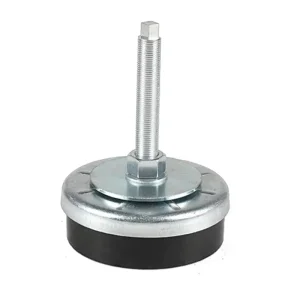
High-speed motor spindles on CNC gantry mills require rigid leveling combined with high-frequency isolation. Leveling rubber feet (such as the BKAL series) incorporate high-durometer vulcanized elastomer bases that absorb spindle harmonics while preventing alignment shear, maintaining sub-micron machining tolerances.
Marine & Heavy Equipment
In auxiliary diesel-electric power generators and thruster motors on marine vessels, mounts must withstand continuous multi-axis shearing forces, roll motion, and oil spillage. Custom captive rubber mounts with fail-safe interlocks ensure the motor remains anchored even during extreme sea turbulence or emergency shock stops.
Technology Roadmap & Future Industry Outlook (2025–2035)
Next-generation active-passive hybrid damping, intelligent IoT condition monitoring, and bio-derived polymer elastomers.
1. Smart Sensor-Embedded Active Mounts
The future of motor mounting lies in smart elastomeric units integrated with micro-electro-mechanical systems (MEMS) sensors. These sensors continuously track multi-axis acceleration, temperature spikes, and dynamic modulus degradation. Real-time data streams feed into AI predictive maintenance platforms, warning engineers of motor bearing imbalance or elastomer aging weeks before catastrophic failure occurs.
2. Bio-Based Thermoplastic Elastomers (TPE-E)
Environmental regulations and corporate Scope 3 decarbonization goals are driving research into sustainable bio-based elastomers derived from non-food agricultural biomass. Modern TPE and TPV compounds provide superior ozone aging resistance, automated injection-molding efficiency, and 100% recyclability at the end of their lifecycle without compromising loss factor performance.
Factory Direct Pricing Intelligence & OEM Engineering
Transparent cost breakdown, minimum order quantities (MOQ), tooling cost factors, and custom design protocols.
Cost Drivers & Pricing Structure
Factory-direct pricing for electric motor rubber mounts is governed by four primary parameters: Elastomer Formulation (Specialty FKM or Silicone costs 3-5x more than standard NR), Metal Substrate Bonding (Dacromet electro-galvanized coating vs. standard painting), Mold Complexity, and Batch Volume. High-volume production runs significantly drop unit tooling amortization costs.
Total Cost of Ownership (TCO)
Low-cost, unverified rubber mounts frequently suffer from premature vulcanization breakdown, bond failure between rubber and metal plates, or severe compression set strain under continuous motor weight. Investing in high-grade factory-tested mounts prevents catastrophic equipment misalignment, motor bearing burnouts, and emergency facility shutdown costs.
OEM/ODM 5-Step Customization
We provide rapid engineering prototyping for non-standard motor footings: 1. Intent & Spec Analysis (Motor RPM, Weight, COG), 2. FEA Dynamic Simulation, 3. Custom Mold Machining, 4. Tension/Compression & Salt Spray Testing, and 5. Mass Production Delivery within 14 Days.
Frequently Asked Questions (FAQ & Engineering Insights)
Technical guidance from our senior vibration control engineers addressing common procurement and sizing inquiries.
Specialized Vibration Isolation & Damping Series
Explore our complete catalog of precision polymer damping pads, spring mounts, inertia pump bases, and heavy-duty buffers.







Optimize Your Motor Mounting System Today
Need custom elastomeric formulations, specific durometer hardness, or specialized mounting bracket dimensions? Our application engineers deliver complete vibration isolation schemes and CAD models within 24 hours.
Consult Our Technical Engineers