
High-Performance Anti-Vibration Isolators & Mounts
Engineered to match and exceed global industry standards including Mason Industries specifications. Direct-from-factory solutions optimized for HVAC, heavy machinery, and critical industrial infrastructure.
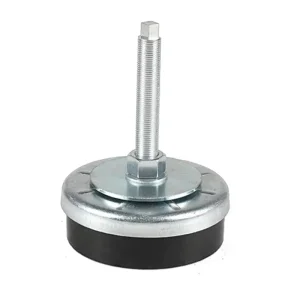


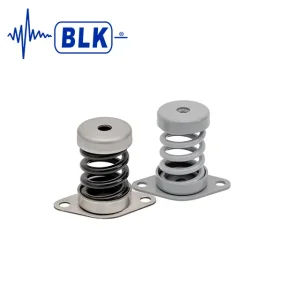




The Macro Evolution of Industrial Vibration Isolation & Acoustic Engineering
In modern mechanical, electrical, and plumbing (MEP) engineering, urban density and strict building acoustics codes have shifted mechanical isolation from an afterthought to a core requirement. Modern high-rise commercial complexes, sub-micron semiconductor fabrication facilities, hospital operating theaters, and hyperscale data centers require near-total dynamic decoupling. Equipment like industrial chillers, cooling towers, high-pressure pumps, and power transformers generate severe low-frequency harmonics (10 Hz to 120 Hz) that propagate through steel and concrete building frames as structure-borne noise and destructive kinetic vibration.
For over half a century, structural engineers, architectural acoustic consultants, and MEP contractors relied on benchmark designs popularized by legacy manufacturers such as Mason Industries. Their spring mounts, neoprene hangers, seismic snubbers, and air-mount isolators established baseline expectations for load capacity, deflection, and natural frequency behavior. However, current global supply chains, aggressive project schedules, and rapid industrial upgrades demand a modern manufacturing paradigm: high-precision OEM engineering, agile customization, dynamic corrosion resistance, and Factory 4.0 cost efficiency without compromising acoustic or structural performance.
Understanding the Mechanics of Low-Frequency Mechanical Vibration
To eliminate kinetic energy transmission into building structures, vibration isolators must be correctly specified according to the mechanical system's disturbing frequency ($f_d$), the isolator's natural frequency ($f_n$), and the required static deflection ($\delta$). The mathematical relationship governing isolator natural frequency is expressed as:
Mathematical Definition of Natural Frequency & Isolation Transmissibility
The natural frequency ($f_n$) of an elastomeric or helical spring isolator depends primarily on static deflection under load:
f_n = (1 / 2π) * √(g / δ) ≈ 5 / √δ (in cm)
Where g is acceleration due to gravity (9.81 m/s²) and δ is static deflection in centimeters. Vibration isolation efficiency ($I_e$) is calculated via dynamic transmissibility ($T$):
T = | 1 / ( (f_d / f_n)² - 1 ) | ==> I_e = (1 - T) * 100%
For isolation to occur, the frequency ratio ($f_d / f_n$) must exceed **√2 (1.414)**. Optimal acoustic and mechanical performance requires a ratio of **3.0 or higher**, delivering over 88% to 99% vibration attenuation across target harmonics.
When selecting Mason-compatible isolators or designing custom high-deflection spring systems, civil engineers must balance spring stability, damping factor, dynamic lateral stiffness ($K_x / K_y \ge 0.8$), and surge frequency behavior to prevent dynamic resonance under variable operating loads.
User Intent & Global Enterprise Procurement Demands
Analyzing what Tier-1 EPC contractors, MEP consultants, and industrial OEM buyers require when sourcing Mason Industries-equivalent vibration isolators worldwide.
1:1 Dimensional & Load Equivalency
Global procurement teams replacing legacy Mason mounts require exact bolt-hole patterns, height adjustability range, and static deflection curves to fit existing architectural footprints without structural redesign.
Seismic & Wind Restraints (IBC Compliance)
High-seismic zone installations require integrated vertical and horizontal restraint snubbers capable of surviving 3G to 5G dynamic impacts per International Building Code (IBC) and OSHPD certification standards.
Advanced Anti-Corrosion Finishes
Exposed rooftop HVAC, offshore marine platforms, and chemical plants demand electro-galvanized, hot-dip galvanized, or Dacromet-coated finishes exceeding 900+ hours of continuous salt spray testing.
China Factory 4.0: Supply Chain Resilience & Manufacturing Precision
Combining automated CNC spring coiling, robotic welding, elastomeric compounding, and rigorous dynamic spectrum testing to supply high-performance vibration isolators worldwide.
Automated Spring Coiling & Metallurgy
Utilizing high-tensile alloy spring steel (60Si2MnA / 51CrV4) subjected to multi-stage shot peening, stress relieving, and computer-controlled heat treatment to eliminate sag and fatigue stress under decades of continuous load.
In-House Elastomeric Compounding
Custom neoprene, natural rubber, and nitrile formulations evaluated for durometer accuracy (30 to 70 Shore A), tear strength, oil resistance, and low compression set under high dynamic strain.
Rapid OEM Customization Cycle
1:1 custom drawings, finite element analysis (FEA) dynamic simulations, and prototype production delivered in as fast as 3 business days, drastically slashing project procurement lead times.
ISO 9001 & Full Quality Traceability
Every batch undergoes automated static deflecting testing, dynamic force spectrum breakdown, and 100% weld integrity verification to guarantee exact rated load capacities before international dispatch.
Localized Engineering Application Scenarios
Real-world application matrices showing how specialized vibration isolators protect structural integrity and operational uptime across critical industries.
1. Commercial Building HVAC: Rooftop Chillers, Air Handlers & Cooling Towers
Large centrifugal chillers and cooling towers operating on elevated roof slabs transmit heavy low-frequency oscillations directly into the structural floor grids. Using unisolated or poorly sized rubber pads causes severe structure-borne hum in occupied floors directly beneath the mechanical plant room.
Solution Matrix: Installing Mason-equivalent MD and ME Type Anti-Vibration Spring Mounts with 25mm to 50mm static deflection provides a system natural frequency of 3 Hz to 4 Hz. Paired with CPB Type Concrete Inertia Bases, the added mass lowers the equipment center of gravity, stabilizes start-up dynamic torque, and protects flexible piping joints from thermal and dynamic stress fatigue.
2. Electrical Infrastructure: Power Transformers & Substation Noise Control
Power transformers emit continuous magnetostrictive hum at fundamental line frequencies (50 Hz / 60 Hz) and high-order harmonics (100 Hz / 120 Hz). Structural vibration traversing through building columns converts into low-frequency airborne acoustic noise in nearby commercial spaces or residential high-rises.
Solution Matrix: Specialized Anti-Vibration Mounts for Transformers and multi-layer damped spring isolators decouple transformer bases from foundation pads. The elastomeric and spring damping matrix achieves up to 98% hum reduction, keeping ambient noise levels comfortably within stringent municipal night-time acoustic noise limits.
3. High-Precision Manufacturing: Semiconductor Cleanrooms & Optical Metrology
Sub-micron lithography tools, scanning electron microscopes (SEM), and coordinate measuring machines (CMM) require near-absolute vibration isolation. Micro-vibrations caused by foot traffic, nearby highway traffic, or building air handling units disrupt nanometer-scale measuring precision.
Solution Matrix: Deploying BK-PF Type Precision Air Mounts and BK-DT Low-Frequency Optical Platforms achieves ultra-low natural frequencies down to **1.7 Hz**. Integrated automated pneumatic level sensors keep optical benches self-leveled to within ±0.01mm even during dynamic stage positioning movements.
| Product Category | Deflection Range | Natural Frequency ($f_n$) | Isolation Efficiency | Primary Localized Application |
|---|---|---|---|---|
| Spring Vibration Isolators (MD/ME) | 25mm – 75mm | 3.0 Hz – 4.5 Hz | 95% – 99% | Chillers, AHUs, Generators, Cooling Towers |
| Pneumatic Precision Air Mounts (BK-PF) | Self-Leveling Air Cushion | 1.7 Hz – 2.5 Hz | 98% – 99.8% | Semiconductor Tools, CMMs, Laser Benches |
| Vibration Isolation Hangers (HR Type) | 12mm – 50mm | 3.5 Hz – 6.0 Hz | 90% – 96% | Suspended Piping, Exhaust Ducts, Inline Fans |
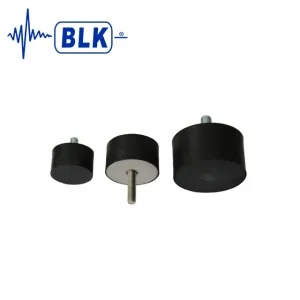
| Elastomeric Rubber Mounts (BKDD/BKVE) | 3mm – 10mm | 8.0 Hz – 12.0 Hz | 85% – 92% | High-Speed Pumps, Compressors, Small Motors |
| Concrete Inertia Base Frames (CPB) | Rigid Mass Frame | System Mass Sizing | Mass Stabilization | End-Suction Pumps, Reciprocating Equipment |
Engineering FAQ & Technical Sizing Guidance
Direct technical answers to common queries from procurement officers, structural designers, and MEP installation teams.
How do I size and choose between spring, elastomeric rubber, and pneumatic vibration isolators?
Are your vibration isolators direct 1:1 replacements for Mason Industries models?
What parameters are required to calculate a custom vibration isolation plan within 24 hours?
What surface treatments are applied to resist outdoor weathering and corrosion?
Why is a concrete inertia base (CPB Type) recommended for pump vibration control?
High-Precision Optical & Custom Isolation Systems
Explore specialized low-frequency optical platforms, high-damping spring mounts, and multi-layer dampers manufactured for extreme operating conditions.







Request a Sized Vibration Isolation Proposal & Engineering Catalog
Send us your equipment specifications (operating weight, RPM, center of gravity, and support points). Our acoustic engineers will return a complete vibration calculation sheet and 1:1 replacement quote within 24 hours.
Connect with an Engineer →