
Precision Anti-Vibration Systems & Mounts (Part I)
Factory-direct pneumatic air mounts, heavy-duty spring dampers, and specialized elastomeric mounts engineered for ultra-low natural frequencies and critical operational stability.







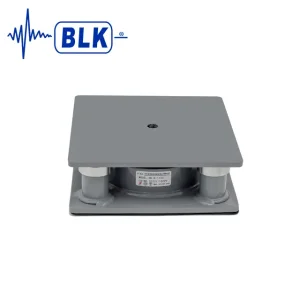
Global Precision Equipment Vibration Control Industry Analysis
The modern industrial landscape demands unprecedented mechanical stability. As semiconductor geometries shrink below 2nm and advanced metrology achieves atomic-level precision, ambient micro-vibrations pose severe operational threats.
Semiconductor Lithography & Probing
Sub-micron lithography tools and automated wafer probers require rigorous VC-E to VC-G micro-vibration criteria. Low-frequency ambient floor vibrations (1–10 Hz) cause line-edge roughness and alignment errors, resulting in yield drops. Pneumatic air isolators with natural frequencies near 1.7 Hz neutralize these low-frequency disturbances effectively.
Nanotechnology & Metrology Systems
Atomic Force Microscopes (AFMs), Scanning Electron Microscopes (SEMs), and Transmission Electron Microscopes (TEMs) operate at angstrom scales. Acoustic noise and structure-borne vibrations ruin imaging clarity. High-damped spring isolators and active air mounts protect these instruments from surrounding equipment harmonic feedback.
Heavy Machinery & Power Infrastructure
Industrial transformers, high-tonnage HVAC chillers, and turbomachinery generate continuous low-frequency hums and structural shocks. If left unisolated, structural resonance degrades building foundations, causes pipe rupture, and violates municipal noise/vibration codes. High-capacity damped springs provide up to 99% isolation efficiency.
Vibration Isolation Physics & Mathematical Framework
Designing an optimal isolation system requires balancing dynamic stiffness, damping ratios, center-of-gravity stabilization, and transmissibility characteristics.
Transmissibility & Resonance Equations
The mathematical formulation for dynamic isolation transmissibility ($T$) with viscous damping is modeled as:
Where $\beta = f_d / f_n$ is the frequency ratio, and $\zeta = c / c_c$ is the damping ratio. Minimizing $f_n$ expands the isolation zone ($\beta > \sqrt{2}$), while optimal damping prevents violent swaying during transient start-up and shut-down phases.
Pneumatic vs. Elastomeric vs. Spring Mechanics
- Pneumatic Air Springs: Achieve ultra-low natural frequencies ($f_n \approx 1.2 - 2.5\text{ Hz}$). Feature self-leveling auto-valves for variable dynamic center-of-gravity compensation.
- Steel Coil Springs: Provide high load capacity with natural frequencies ($f_n \approx 3 - 5\text{ Hz}$). Require integrated viscous dampers to dissipate mechanical energy at resonance.
- Elastomeric Rubber Mounts: Provide excellent high-frequency acoustic attenuation and structural damping ($f_n \approx 7 - 15\text{ Hz}$). Ideal for high-speed machinery ($>1800\text{ RPM}$).
Comprehensive Vibration Isolation Technical Matrix
Match your equipment's operating characteristics with the ideal isolator architecture using our field-validated engineering data matrix.
| Isolator Category | Natural Freq. ($f_n$) | Isolation Efficiency | Primary Industrial Applications | Key Mechanical Advantage |
|---|---|---|---|---|
| Pneumatic Air Mounts (BK-PF / BK-R) | 1.5 Hz – 2.5 Hz | 95% – 99% | Wafer probers, optical benches, SEM/TEM microscopes, CMM systems | Ultra-low natural frequency; automatic pneumatic dynamic height leveling |
| Viscous Damped Springs (BK-DS / MC) | 3.0 Hz – 5.0 Hz | 90% – 98% | Chillers, cooling towers, power transformers, heavy generators | High load capacity; eliminates transient resonance rocking during start-up |
| Multilayer Damping Platforms (BK-VT / BK-AT) | 2.0 Hz – 4.0 Hz | 92% – 97% | Desktop inspection platforms, laser interferometers, analytical balances | Modular tabletop mounting; effectively dampens vertical and horizontal motion |
| Industrial Rubber Mounts (BKVV / BKVD / BKDE) | 8.0 Hz – 15.0 Hz | 80% – 92% | Electric motors, air compressors, fans, electronic enclosures | High acoustic damping; compact footprint; economical fail-safe isolation |
| Leveling Feet & Cone Mounts (BKAL / BKCN) | 10.0 Hz – 18.0 Hz | 75% – 88% | CNC machine tools, automated assembly lines, conveyor supports | Precision height adjustments; oil-resistant durable elastomeric compounds |
Global Engineering Standards & Localized Deployments
Vibration control solutions tailored to stringent international engineering codes and regional operational constraints across major industrial hubs.
North American Regulatory & ASHRAE Standards
In North American commercial and industrial facilities, HVAC mechanical equipment must strictly adhere to ASHRAE Chapter 48 Noise and Vibration Control guidelines. Seismic restraint capabilities are mandatory under the International Building Code (IBC), requiring spring isolators to feature integrated snubber restraints tested for 1.0G lateral shock resistance.
European Union Directives & CE Marking
Deployment across EU member states requires compliance with EU Machinery Directive 2006/42/EC and ISO 20816 evaluation of machine vibration. Elastomeric compounds must conform to REACH and RoHS environmental safety mandates, while dynamic spring systems undergo 900-hour salt spray corrosion testing for harsh offshore environments.
Asia-Pacific Micro-Electronics Hubs
High-density semiconductor wafer fab corridors across Taiwan, South Korea, Japan, and Mainland China enforce rigid BBN VC-A through VC-G Micro-Vibration Curves. Cleanroom installations require zero-outgassing silicone and sealed pneumatic air bellows to preserve ISO Class 1 cleanroom atmospheric purity.
Technology Roadmap & Future Outlook (2025–2035)
Pioneering advancements in smart damping alloys, active piezoelectric control systems, and AI-driven predictive vibration diagnostics.
Embedded tri-axial MEMS accelerometers and pressure transducers integrated directly into air mounts for real-time dynamic load monitoring via Industrial IoT networks.
Deployment of smart fluid mounts capable of altering damping viscosity within milliseconds, adapting instantly to sudden machine acceleration and changing loads.
Combining passive pneumatic springs with active piezoelectric force actuators to neutralize high-frequency micro-vibrations with response times under 1 millisecond.
Transition to zero-carbon bio-synthetic elastomers reinforced with carbon nanotubes, offering superior fatigue resistance and wider operational temperature ranges.
Precision Anti-Vibration Systems & Mounts (Part II)
Specialized desktop platforms, multi-layer dampers, damped spring systems, and heavy-duty adjustable rubber feet engineered for custom equipment configurations.
-

Custom BKSWA Type Multi-Layer Antivibration Dampers Factory, Price
-

Custom BK-VT Type Vibration Isolation Platform Factories, Manufacturer
-

-
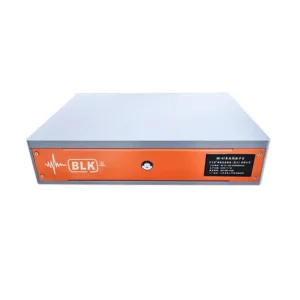
Custom BK-AT Type Desktop Vibration Isolation Platform Manufacturers, Price
-

High-Quality BKDD Type Rubber Mounts Factories, Manufacturers
-

Low Price BK-DS Type Damped Spring Mounts Factory, Manufacturers
-
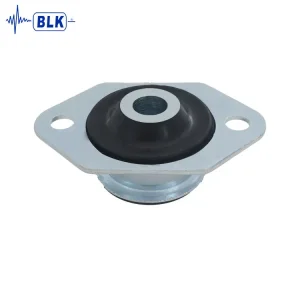
-

Low Price BKAL Type Adjustment Rubber Feet Factory, Manufacturers
Frequently Asked Questions: Technical Engineering
Detailed technical answers from our application engineering team regarding load distribution, natural frequency matching, environmental resistance, and sizing workflows.
How do engineers calculate the precise natural frequency ($f_n$) required for an equipment isolation project?
Natural frequency calculation starts by identifying the lowest operating speed (RPM) or forcing frequency ($f_d$) of the target machine. To achieve effective isolation, the isolator natural frequency ($f_n$) must satisfy $f_n \le f_d / 2.83$ for at least 87% isolation efficiency, or $f_n \le f_d / 3.16$ for over 90% efficiency. For example, a water pump operating at 1,450 RPM generates a primary forcing frequency of $f_d = 1450 / 60 \approx 24.16\text{ Hz}$. Choosing a spring mount with $f_n = 3.5\text{ Hz}$ yields a ratio $\beta = 24.16 / 3.5 \approx 6.9$, delivering over 97% vibration reduction.
What is the key functional difference between a viscous damped spring mount (e.g., BK-DS) and a standard coil spring?
Standard steel coil springs offer exceptionally low static stiffness (yielding desirable low natural frequencies), but suffer from negligible internal damping ($\zeta \approx 0.005$). During equipment start-up or shut-down, the excitation frequency briefly passes through the system's resonant point ($f_d = f_n$), causing uncontained sway and structural shock. Viscous damped spring isolators incorporate specialized synthetic fluid chambers that raise the damping ratio ($\zeta \approx 0.08 - 0.15$), constraining amplitude buildup at resonance without sacrificing high-frequency isolation performance.
When should an engineer specify a Pneumatic Air Mount (BK-PF) instead of a high-grade elastomer mount?
Pneumatic air mounts are necessary when the disturbing frequency is extremely low ($< 10\text{ Hz}$) or when the equipment is extraordinarily sensitive to micro-vibrations (e.g., semiconductor probing, atomic resolution imaging, laser interferometry). Rubber mounts generally have a lower limit of $f_n \approx 8 - 12\text{ Hz}$, which makes them incapable of isolating sub-10 Hz floor vibrations. Pneumatic air springs achieve natural frequencies as low as $1.2 - 2.0\text{ Hz}$ and integrate automatic mechanical leveling valves to maintain constant deck height under moving dynamic loads.
How does uneven weight distribution and center of gravity offset affect isolator selection?
An uneven mass distribution causes unequal static deflection across mounting points, tilting the machine deck and introducing unwanted rocking modes. During the sizing process, our engineering team maps the precise Center of Gravity (CoG) and calculates point loads for each mount. We select custom spring constants ($k_i$) for each corner so that under static load, all mounts deflect equally ($\delta_1 = \delta_2 = \delta_n$), maintaining a level horizontal reference plane and uniform dynamic response.
What anti-corrosion surface treatments are applied to isolators installed in outdoor or cleanroom settings?
For severe industrial and marine environments, steel housings and spring coils undergo a multi-stage Dacromet or hot-dip galvanizing process, achieving 900+ hours of continuous salt spray resistance per ASTM B117 standards. For semiconductor and pharmaceutical cleanrooms, stainless steel housing variants (304 or 316) with nickel-plated leveling hardware are utilized, combined with low-outgassing elastomer seals that prevent particle generation and chemical off-gassing.