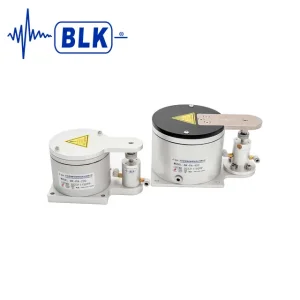
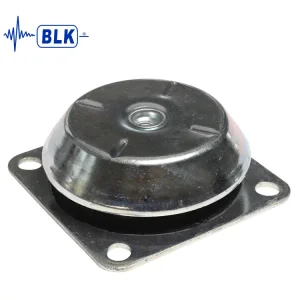
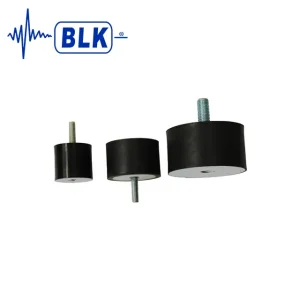
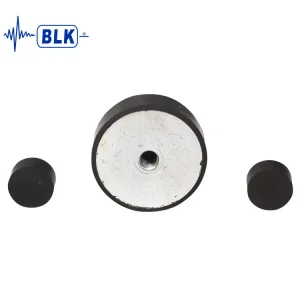
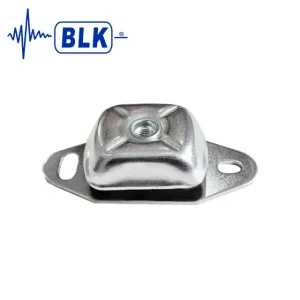
Featured Industrial Vibration Control Systems
Precision engineered anti-vibration mounts, spring isolators, inertia bases, and polymer pads direct from China's OEM/ODM manufacturing hub.






Fundamentals of Rubber Anti Vibration Mat Technology
Understanding viscoelastic isolation dynamics, loss factors, and structural vibration transmission in modern industrial machinery.
Viscoelastic Damping Dynamics
Rubber anti-vibration mats operate via the viscoelastic properties of vulcanized elastomers. Unlike pure steel springs which store mechanical energy, elastomeric mats convert kinetic vibration energy into harmless thermal dissipate heat through internal hysteresis losses. This dual action provides both structural support and active vibration attenuation.
Dynamic Stiffness ($K_d$) vs Static Stiffness ($K_s$)
A crucial metric in isolating precision tools is the Dynamic-to-Static Stiffness Ratio ($K_d / K_s$). Premium elastomeric compounds maintain a ratio close to 1.2 to 1.4. Higher ratios cause localized stiffness under fast cyclic loads, degrading high-frequency isolation performance and shifting the system resonance point unpredictably.
Transmissibility & Frequency Ratios
Vibration isolation only occurs when the disturbing frequency ($f_d$) of the equipment exceeds $\sqrt{2}$ times the natural frequency ($f_n$) of the rubber mat. Engineered rubber mats aim for a frequency ratio ($f_d / f_n \ge 3$), achieving structural isolation efficiency ratings surpassing 92% to 99% across industrial spectrums.
Material Science: Polymer Selection Matrix
Comparing Natural Rubber (NR), Nitrile (NBR), EPDM, and Neoprene compounds for specialized industrial vibration applications.
| Elastomer Type | Shore Hardness (A) | Tensile Strength | Temp Range (°C) | Oil & Chemical Resistance | Primary Industrial Use Case |
|---|---|---|---|---|---|
| Natural Rubber (NR) | 40 - 75 Shore A | 15 - 25 MPa | -40°C to +80°C | Fair / Low | HVAC equipment, chillers, general dynamic damping pads. Highest resilience and fatigue life. |
| Nitrile Rubber (NBR) | 50 - 80 Shore A | 10 - 18 MPa | -30°C to +100°C | Excellent | CNC machine shops, hydraulic pump bases, heavy engine mounts exposed to petroleum products. |
| EPDM Compound | 45 - 80 Shore A | 8 - 15 MPa | -45°C to +130°C | Good (UV/Ozone) | Rooftops, cooling towers, outdoor power sub-stations requiring high ozone and heat endurance. |
| Neoprene (CR) | 50 - 75 Shore A | 12 - 20 MPa | -35°C to +110°C | Moderate High | Acoustic floating floors, marine engine beds, structural bridge bearing pad applications. |
China OEM/ODM Manufacturing Advantages
Why international EPC contractors and global OEMs partner with Kunshan & Jiangsu specialized manufacturing hubs for rubber anti vibration mats.
Complete Polymer Supply Chain
China accounts for over 40% of global synthetic rubber output and raw polymer refinement. Factories in the Kunshan cluster leverage immediate access to specialty carbon blacks, vulcanization catalysts, and high-tensile steel inserts, lowering raw material procurement cycles by 60% compared to Western counterparts.
Automated Injection & Compression Molding
Modern Chinese factories utilize multi-station vacuum compression molding presses capable of 500-ton clamping force. Automated thermal profiling ensures uniform cross-linking density throughout heavy-duty rubber mats, eliminating internal voids and structural micro-cracks under severe cyclic loading.
Rigorous Quality Assurance Protocols
Leading suppliers adhere to ISO 9001 and ISO 14001 guidelines, equipped with in-house static/dynamic stiffness testers, dynamic shear modulus spectrometers, laser displacement meters, and 900-hour Dacromet salt spray testing chambers for metal-to-rubber bonded components.
Localized Industrial Application Scenarios
Tailored anti-vibration solutions operating across diverse environmental and mechanical stress parameters.
1. Commercial HVAC & Building Mechanical Rooms
In high-rise commercial structures, centrifugal chillers, air handling units (AHUs), and chilled water pumps generate low-frequency hums that propagate through concrete floors. Multi-layer cross-ribbed rubber pads paired with spring isolators isolate secondary dynamic forces, keeping acoustic transmission within NC-30 noise rating standards.
2. Semiconductor Cleanrooms & Precision Metrology
Sub-micron lithography equipment, CMMs (Coordinate Measuring Machines), and electron microscopes require VC-E or VC-G micro-vibration criteria. Hybrid pneumatic and high-damping silicone/NBR elastomer mats shield sensitive optics from ambient footfall chatter and external traffic excitation.
3. Stamping Presses & Heavy Forging Machinery
High-energy impact presses deliver severe peak impulse forces to factory foundations. Heavy-duty composite elastomer mats with high shock-absorption capabilities dissipate up to 80% of shock wave energy, preventing structural floor cracking and equipment misalignment.
4. Power Transformers & Electrical Substations
Magnetostriction in transformer core laminations creates continuous 100Hz/120Hz tonal hums. Customized oil-resistant anti-vibration transformer pads mitigate structure-borne acoustic bleeding into adjacent residential zones while resisting hot transformer oil leaks.
Macro Industry Solutions & Structural Integration
How structural engineers combine rubber mats, inertia bases, and multi-layer sandwich designs for optimized vibration isolation.
Concrete Inertia Bases
For pumps with heavy piping loads or offset centers of gravity, rubber pads are integrated beneath concrete-filled steel inertia frames. The added mass increases system inertia, dampens start-up torque rocking, and stabilizes pipe connections.
Waffle & Studded Surface Designs
Flat rubber sheets experience volume constraint under vertical compression. Molded waffle patterns, suction-cup matrices, or studded geometries provide expansion relief, optimizing shear deflection and improving low-load isolation efficiency.
Multi-Layer Steel-Elastomer Sandwich Pads
To support extreme static loads without over-deflecting, rubber pads are interlayered with galvanized steel plates. This constraint technique elevates load capacity up to 50 kg/cm² while maintaining localized damping characteristics.
Global Sourcing & Quality Inspection Framework
A step-by-step checklist for international procurement managers sourcing industrial rubber anti-vibration mats.
Material Testing Compliance (ASTM & ISO)
Ensure your factory supplier provides verified third-party laboratory reports for ASTM D395 (Compression Set), ASTM D412 (Tensile Properties), ASTM D2240 (Durometer Hardness), and RoHS/REACH environmental safety declarations.
Total Cost of Ownership (TCO) Calculations
Factor in tool design charges, compound masterbatch consistency, bulk container loading density, and freight optimization. Direct sourcing from qualified manufacturers in Kunshan reduces total landed costs by 30-45% over domestic distributors.
Frequently Asked Technical Questions (FAQ)
Direct technical answers from senior vibration control application engineers.
How do I choose between rubber anti-vibration mats and steel spring mounts?
Selection depends on equipment disturbing frequency ($f_d$) and required deflection. Rubber anti-vibration mats are ideal for higher speed equipment (>1,200 RPM / 20Hz) such as rotary compressors, electric motors, and high-frequency pumps, providing excellent high-frequency acoustic attenuation. Steel springs offer larger deflections and lower natural frequencies (3-5 Hz), making them better suited for low-frequency equipment (<1,200 RPM) like slow chillers, cooling towers, and diesel generators.
What parameter determines the lifespan of rubber isolation mats under heavy load?
The primary factor is Compression Set Resistance (ASTM D395). Compression set measures the permanent deformation remaining after compressive stress is released. High-quality natural rubber and NBR compounds exhibit low compression set (<20% after 22 hours at 70°C), ensuring mats maintain their elastic spring rate and isolation efficiency for over 15 years.
Can rubber anti vibration mats resist oil, diesel, and outdoor weather exposure?
Standard natural rubber mats degrade when exposed to continuous oil or UV radiation. For oily environments (e.g., machine tool bases, hydraulic skids), specified Nitrile (NBR) compounds must be used. For outdoor HVAC installations exposed to sunlight and ozone, EPDM or specialized Neoprene compounds are recommended.
What is the standard lead time for custom molded rubber mats from China?
Standard catalog models ship within 24 hours. Custom elastomeric compounds or custom-molded sizes require 3 to 5 business days for tooling design and prototype sampling. Mass production orders generally deliver within 10 to 15 business days depending on volume.
How do waffle or ribbed patterns improve rubber mat isolation over flat sheets?
Rubber is an incompressible fluid-like material that deforms under load rather than shrinking in total volume. Flat rubber sheets bounded between rigid surfaces cannot bulge sideways easily, resulting in excessive apparent stiffness. Ribbed, waffle, or studded patterns provide localized relief voids for lateral bulge, allowing proper elastomeric shear deformation and dynamic softness.
Explore Full Range of Vibration Isolation Equipment
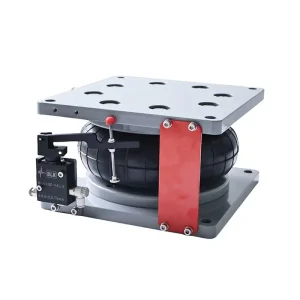
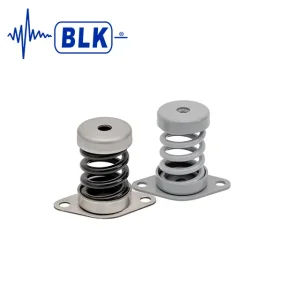
High-performance rubber mounts, air springs, multi-layer dampers, and acoustic hangers for global industrial projects.