
Precision Inventory Portfolio • Tier-1 Selection
Featured Industrial Vibration Isolators & Mount Assemblies
Precision-machined elastomeric mounts, multi-layer viscous dampers, and optical isolation tables configured directly from our Kunshan automated manufacturing base.

High-Quality BKH Type Rubber Mounts
Explore Specifications
High-Quality BKDD Type Rubber Mounts
Explore Specifications
Custom BK-VT Type Isolation Platform
Explore Specifications
Custom BKSWA Multi-Layer Dampers
Explore Specifications
High-Quality BKDJ Type Rubber Pad
Explore Specifications
Custom Anti-Vibration Spring Hangers
Explore Specifications
Custom BKDE Type Rubber Mounts
Explore Specifications>99%
Maximum Dynamic Isolation Efficiency Achieved Across Multi-Axis Resonant Spectra
1.7 Hz
Ultra-Low Natural Resonant Frequency in Pneumatic Active-Ready Systems
900 hrs
Continuous Salt-Spray Corrosion Resistance via Proprietary Dacromet Coatings
15+ Yrs
Operational Service Lifespan Under Continuous Mechanical Fatigue & Dynamic Cyclic Loading
Mechanics of Dynamic Isolation & Transmissibility
Advanced Engineering Principles of Modern Vibration Attenuation
Structural vibration and acoustic emissions represent unwanted kinematic kinetic energy dissipated across building slabs, mechanical housings, and sensitive metrology foundations. A high-efficiency Vibration Damping System serves as a mechanical low-pass filter, decoupling oscillating excitation sources from supporting infrastructure.
Governed by foundational elastodynamic principles, effective mechanical isolation demands that the ratio between disturbing frequency (fd) and system natural frequency (fn) exceeds the theoretical threshold of √2 (≈ 1.414). At operations below this boundary, energy amplification occurs. In contrast, at frequency tuning ratios r = fd / fn ≥ 3.0, theoretical isolation efficiency climbs past 90%, reaching upwards of 99% in high-deflection spring isolators and tuned pneumatic diaphragms.
Bellking leverages comprehensive Finite Element Dynamic Analysis (FEA), multi-axis displacement testing, and proprietary viscous-fluid damping matrices to suppress parasitic lateral resonances, eliminate internal surge harmonics, and neutralize high-frequency structural noise.
System Transmissibility Equation (T)
Dynamic force transmissibility represents the vector ratio of transmitted force to exciting dynamic force:
T = √[ (1 + (2ζr)²) / ((1 - r²)² + (2ζr)²) ]
Where r represents the excitation ratio (fd / fn), and ζ defines the non-dimensional damping ratio. In Bellking damped spring mounts, ζ is strategically calibrated between 0.05 and 0.12 to suppress start-up resonance excursion without compromising high-frequency isolation performance.
Supply Chain Superiority • Kunshan Industrial Hub
China Manufacturing Strengths: Engineering Precision Meets Industrial Scale
Why Tier-1 global EPC contractors, data center builders, and OEM manufacturers partner with Bellking for direct factory-engineered anti-vibration solutions.
Intelligent Automation & CNC Precision
Our 2,000 m² production facility in Kunshan, Jiangsu deploys robotic MIG/TIG welding cells, CNC multi-spindle machining centers, and high-precision laser profiling equipment. This automation eliminates human assembly error, maintains tight dimensional tolerances within ±0.2mm, and ensures uniform load distribution across all multi-spring arrays and welded mounting flanges.
Rigorous Metallurgy & Elastic Materials
We reject recycled scrap rubber and low-grade spring wires that suffer from early fatigue cracking and permanent compression set. Bellking isolators utilize high-tensile 60Si2Mn / 55CrSi alloy spring steels subjected to shot-peening and stress relieving, paired with virgin neoprene or natural rubber compounded specifically to ASTM D2000 specifications for oil, ozone, and chemical resilience.
Rapid 1:1 Engineering Customization
Leveraging our localized Yangtze River Delta industrial ecosystem, non-standard mechanical designs advance from CAD simulation to physical prototypes in as few as 3 working days. With 16 national invention patents and 37 proprietary IP models, our in-house application engineers provide tailor-fit static deflection, seismic restraints, and customized bolt patterns within 24 hours of RFQ submission.
Comparative Technical Matrix
Vibration Isolation Engineering Taxonomy & Application Guidelines
Compare mechanical properties, dynamic ranges, and structural suitabilities across foundational vibration mitigation architectures.
| Damping System Architecture | Resonant Frequency Range | Static Deflection Range | Primary Kinetic Application Scope | Environmental Hardening | Design Operational Life |
|---|---|---|---|---|---|
| Pneumatic Air Mounts & Optical Platforms | 1.7 Hz – 3.0 Hz | Level-Regulated (Air Servo) | Semiconductor Lithography, TEM/AFM Microscopes, Laser Metrology | Cleanroom Class 1-100 Compliant | 6 to 10+ Years |
| Heavy-Duty Open/Housed Spring Isolators | 2.8 Hz – 5.0 Hz | 25 mm – 75 mm Deflection | Centrifugal Chillers, Cooling Towers, Generator Sets, Primary Pumps | Dacromet 900h Salt Spray | 15 to 20+ Years |
| Elastomeric & Shear Rubber Mounts | 6.0 Hz – 14.0 Hz | 3 mm – 12 mm Deflection | Air Handling Units, High-RPM Motors, Compressors, Cabinets | Oil & UV Resilient Neoprene | 8 to 12 Years |
| Seismic Damped Viscous Spring Mounts | 3.0 Hz – 4.5 Hz | 25 mm – 50 mm Deflection | Critical Infrastructure, Seismic Zones 3-4, Rooftop Chiller Plants | Dual-Axis Snubber Restrained | 15+ Years |
| Concrete-Filled Steel Inertia Bases | System Coupled | Base Frame Integrated | End-Suction Pumps, Reciprocating Chillers, Large Roots Blowers | Hot-Dip Galvanized / Epoxy | 25+ Years |
Multi-Sector Field Deployment • 1,000+ Completed Projects
Macro Industry Solutions: Mission-Critical Deployment Scenarios
Tailored structural vibration damping packages safeguarding sensitive microelectronics, urban infrastructure, and heavy energy generation networks.
Semiconductor & Cleanroom Metrology
Sub-micron wafer steppers, SEM/TEM electron microscopes, and coordinate measuring machines (CMM) mandate adherence to stringent VC-E and VC-G vibration criteria. Bellking pneumatic platforms and active micro-vibration mounts eliminate ambient ground tremors down to 1.7 Hz, ensuring zero nanoscale blur in nanometer fabrication nodes.
Hyperscale Data Center HVAC & MEP
Continuous dynamic vibrations from rooftop chillers, axial cooling fans, and primary condenser pumps transmit structure-borne sound into server halls, causing hard drive head drift and server chassis fatigue. Bellking seismic spring hangers and pump inertia bases decouple mechanical rooms, cutting noise transmission by up to 35 dB(A).
Power Substations & Transformers
100 Hz and 120 Hz core magnetostrictive hum from dry-type and oil-immersed transformers induces severe low-frequency structural resonances in commercial complexes and substations. Our specialized high-damping transformer mounts provide dual-deflection isolation, maintaining acoustic and vibration isolation efficiency >96%.
Heavy Industrial Presses & Stamping
Transient shock impulses exceeding 3G to 5G acceleration loads from mechanical stamping presses, forging hammers, and heavy shredders rapidly degrade civil foundation integrity. Bellking engineered viscous-damped shock absorbers arrest transient rebound energies and protect surrounding sensitive CNC machinery.
Global Vibration Damping Industry Trajectories
- AI-Driven Predictive Dynamic Tuning: Integration of embedded MEMS wireless accelerometers within damping mounts to feed real-time vibration spectral drift into plant SCADA systems.
- Eco-Friendly Bio-Polymer Formulations: Transition toward zero-VOC, RoHS-compliant polyurethane and thermoplastic elastomers avoiding toxic plasticizers and halogenated outgassing.
- Hybrid Active-Passive Architectures: Pairing electromagnetic Voice Coil Actuators (VCA) with pneumatic isolators to nullify zero-hertz ambient low-frequency floor motions.
- Stringent Seismic Building Code Compliance: Universal adoption of ASCE 7-22 and IBC seismic/wind restraint certifications across global HVAC and MEP modular packages.
Technology Evolution • Industry 4.0 Focus
Future Trends: Smart Vibration Attenuation & Advanced Damping Materials
The global vibration damping landscape is shifting from static, reactive hardware toward intelligent, predictive motion mitigation ecosystems. As manufacturing processes advance toward sub-2nm semiconductor lithography and extreme-tolerance robotic assembly, traditional passive isolation mounts encounter physical displacement limitations.
At Bellking, our dedicated 10+ engineer R&D team actively collaborates with leading materials research institutes to pioneer next-generation gradient viscous silicones, magneto-rheological fluid dampers, and ultra-high-damping matrices. By combining real-time spectral analysis with automated mechanical dampening, modern factories secure absolute mechanical uptime, reduce equipment MTBF, and eliminate catastrophic resonance-induced structural failures.
EPC Engineering Procurement Guide
Global Enterprise Procurement: Vibration Isolator Technical Audit Checklist
Mitigate structural risk and prevent site audit rejections by verifying critical dynamic calculation parameters prior to placing factory purchase orders.
1. Total Mass & Exact Center of Gravity
Do not size isolators based on nominal machine weight alone. Calculating precise dynamic Center of Gravity (CG) offsets prevents uneven corner deflections. Asymmetrical loads (e.g., chillers with offset compressors) necessitate individually rated spring rates at each corner to maintain horizontal alignment without binding.
2. Operational RPM vs. Deflection Math
Ensure static deflection matches operating RPM. A 1,750 RPM motor requires ≥12mm deflection for 90% isolation efficiency; a slow 350 RPM cooling tower fan mandates ≥50mm deflection. Sizing an undersized spring with inadequate deflection amplifies vibrations directly into the building floor structure.
3. Environmental & Seismic Restraint
Audit environmental exposure. Coastal and outdoor marine rooftop systems require minimum 900-hour Dacromet or hot-dip galvanizing to prevent rust degradation. Furthermore, verify whether regional building codes require all-directional snubber restraints rated for 1G to 3G lateral seismic acceleration forces.
Technical Knowledge Base • Application Engineering
Frequently Asked Questions: Industrial Vibration Damping Engineering
Clear, empirically backed answers addressing system selection, installation protocols, and lifecycle calculations from our chief engineering desk.
How do I determine whether my application requires elastomeric rubber mounts or helical steel spring isolators?
The decision is primarily dictated by the lowest excitation frequency of the machinery. Rubber mounts exhibit natural frequencies between 6 Hz and 14 Hz and offer high internal damping, making them optimal for high-speed rotational machinery (>1,200 RPM) such as compact centrifugal pumps, small blowers, and motor housings. Conversely, helical steel springs provide larger static deflections (25mm to 75mm) yielding ultra-low natural frequencies (2.5 Hz to 5.0 Hz), which are mathematically essential for low-speed chillers, reciprocal compressors, cooling towers, and rooftop gensets running at or below 900 RPM.
Why is an inertia base necessary when installing heavy pumps and industrial compressors on spring mounts?
A concrete-filled structural steel inertia base accomplishes three vital mechanical goals: First, it adds deadweight (typically 1.0 to 2.0 times equipment weight), significantly lowering the system's Center of Gravity to stabilize rocking modes during initial motor startup. Second, it maintains rigid alignment between the motor, gearbox, and driven shaft, preventing coupling shear and frame distortion. Third, it acts as a massive kinetic barrier that absorbs pipe reaction forces, ensuring uniform compression across all supporting spring isolators.
What is the practical mechanical significance of the 900-hour Dacromet salt-spray rating?
Standard industrial paint or electro-galvanizing often fails within 2 to 3 years on outdoor coastal cooling towers and industrial rooftops due to exposure to moisture, sulfur dioxide, and salt spray, leading to spring pitting corrosion and premature structural fracture under dynamic cyclic fatigue. Bellking uses an advanced inorganic zinc-aluminum Dacromet coating that withstands 900+ hours in ASTM B117 salt spray chambers without red rust formation, guaranteeing full structural safety and fatigue resistance for over 15 years.
Can Bellking custom-engineer vibration isolation systems for seismic zone installations?
Yes. Bellking designs and manufactures restrained seismic vibration isolators featuring heavy-duty ductile iron and structural steel housings fitted with replaceable elastomeric snubbers. These assemblies allow omnidirectional thermal and dynamic movements during standard steady-state operation while mechanically limiting lateral and vertical travel during earthquake events (rated for 1.0G to 3.0G lateral accelerations), fully satisfying California OSHPD, IBC, and Chinese GB 50981 seismic resistance standards.
Direct Factory Supply • Heavy-Duty & Metric Range
Specialized Shock Absorbers, Matrix Mounts & Precision Platforms
Broad-spectrum dynamic protection: from high-frequency matrix dampening pads to sub-Hertz optical isolation tables shipped factory-direct worldwide.
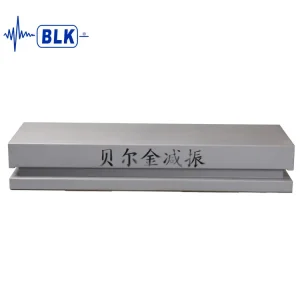
BK-MT Type Matrix Mount
Explore Specifications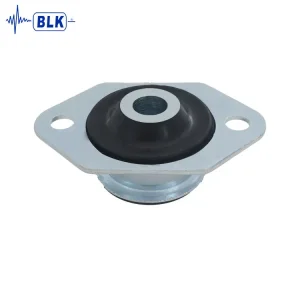
High-Quality BKCN Type Cone Mounts
Explore Specifications
High-Quality ME Type Spring Mounts
Explore Specifications
Low Price HR Type Rubber Hangers
Explore Specifications
Custom BKSW Type Rubber Buffer
Explore Specifications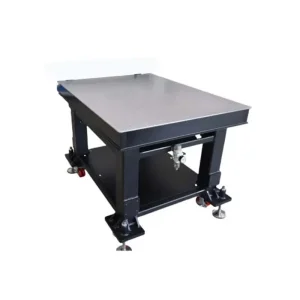
BK-DT Low-Frequency Optical Platform
Explore Specifications
Custom BKVD Type Rubber Mounts
Explore Specifications
BK-DS Damped Spring Mounts
Explore SpecificationsRequest a Custom Vibration Isolation Sizing Plan Within 24 Hours
Our Senior Application Engineering team calculates static deflection, dynamic resonance safety margins, and Center of Gravity load distributions for global industrial projects. Send your equipment specifications today.