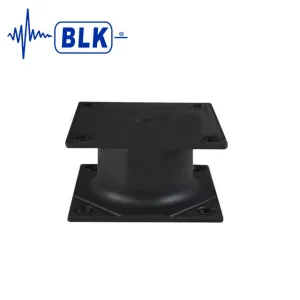
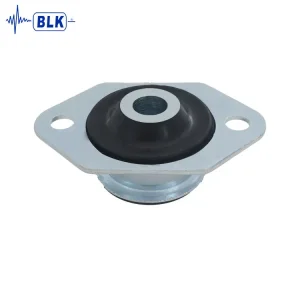
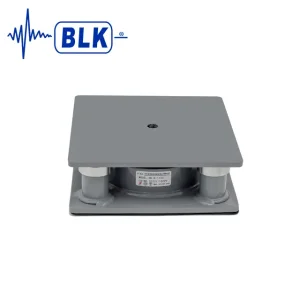
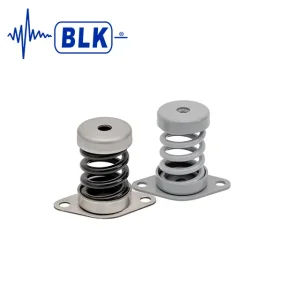
Standard & Custom Vibration Control Products
Explore our core lines of high-performance isolators engineered for critical vibration suppression, extreme shock attenuation, and multi-axis damping.




Executive Technical Overview: Wire Rope Vibration Isolators
A comprehensive examination of dynamic shock mitigation, thermal endurance, and non-linear damping physics for critical industrial systems.
The Engineering Paradigm of Wire Rope Isolation
Wire rope vibration isolators (also termed helical cable mounts or wire cable isolators) represent the pinnacle of mechanical shock and structural vibration isolation technology. Unlike conventional elastomeric rubber mounts that degrade under oil exposure and extreme temperatures, or rigid steel coil springs that suffer from high-frequency surge resonances, wire rope isolators harness the frictional sliding dynamics between individual stainless steel strands to deliver non-linear multi-axis protection.
Manufactured by weaving high-tensile stainless steel aircraft cable through heavy-duty aluminum alloy or stainless steel retaining bars, these devices provide simultaneously low dynamic stiffness under small displacement vibrations and rapid energy dissipation during high-magnitude impact events.
Key Information Gain Metric: Friction-Driven Hysteresis Damping
During compression, tension, or shear deflection, the individual wire filaments within the cable slide against one another. This micro-rubbing action generates substantial Coulomb damping (friction damping), converting kinetic vibration energy into harmless thermal dissipation with loss factors (η) ranging from 0.15 to 0.25.
Core Technical Supremacy Factors
- Multi-Directional Damping: Simultaneous isolation across Roll, Pitch, Yaw, and Heave axes without mechanical binding.
- Broadband Frequency Isolation: Effectively isolates low-frequency disturbances (down to 5 Hz) while suppressing high-frequency shock impacts up to 500 Gs.
- Environmental Immunity: Fully immune to ozone, oil, hydraulic fluids, salt spray, mold, and radiation exposure.
- Extreme Operational Range: Operates flawlessly across extreme temperature windows from -150°C to +300°C (-238°F to +572°F).
- Maintenance-Free Operational Life: Lifespans exceeding 25+ years without stiffening, creep, or structural fatigue degradation.
Global Enterprise Procurement & Sourcing Metrics
Analyzing procurement requirements, quality verification protocols, and global compliance mandates for industrial buying entities.
Strict Regulatory Compliance
Global procurement teams in defense, marine, and energy sectors require strict adherence to international standardizations. Factory suppliers must guarantee compliance with MIL-STD-810G (Environmental Engineering Considerations and Laboratory Tests), MIL-S-901D (High-Impact Mechanical Shock for Shipboard Equipment), ISO 9001:2015 quality management systems, RoHS, and REACH directives.
Supply Chain Resilience
Original Equipment Manufacturers (OEMs) and EPC contractors demand factory transparency, batch traceability, material mill test certificates (EN 10204 3.1), and short prototyping lead times. Modern factories utilize automated CNC cable winding, robotic spot welding, and automated load-deflection testing to ensure 100% batch uniformity across volume manufacturing orders.
Custom Engineering Capability
No two dynamic applications present identical center-of-gravity (CG) distributions or spectral excitation frequencies. Leading factories offer rapid 1:1 engineering design services—utilizing Finite Element Analysis (FEA) and 3D simulation tools to model dynamic response curves and deliver customized prototype mounts within 3 to 5 business days.
Cross-Industry Engineering Solutions
Deploying specialized wire rope mounts and anti-vibration platforms across high-demand mission-critical environments.
1. Defense, Avionics & Mobile Radar Systems
Naval combat vessels, military transport vehicles, and unmanned aerial vehicles (UAVs) experience extreme shock loads from weapons recoil, terrain roughness, and blast waves. Wire rope vibration isolators isolate sensitive command-and-control electronics, thermal imaging cameras, guided radar arrays, and avionics boxes from destructive shock pulses, maintaining operational readiness under MIL-S-901D Navy Heavy Shock standards.
2. Precision Sub-Micron & Semiconductor Manufacturing
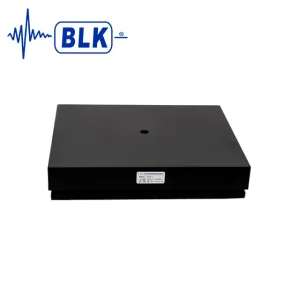
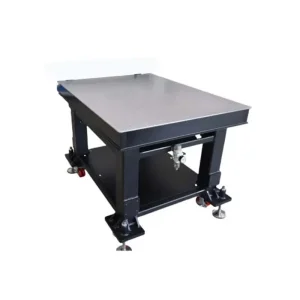
In semiconductor lithography, atomic force microscopy (AFM), and coordinate measuring machines (CMMs), ambient floor vibrations as small as a few micro-g can destroy process accuracy. Integrating wire rope isolators with high-damping optical vibration isolation platforms creates a multi-stage vibration barrier that cancels out low-frequency footfall noise, HVAC acoustic rumble, and machinery harmonics.
3. Heavy Power Generation & Transformer Isolation
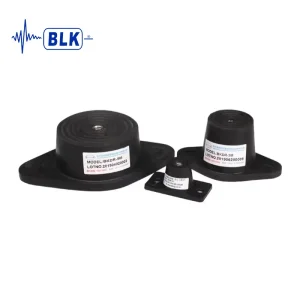
Electrical power transformers, industrial diesel generator sets, and large centrifugal chillers transmit severe structure-borne noise and continuous low-frequency hum (100 Hz / 120 Hz electrical harmonics) into building foundations. Wire rope and matrix anti-vibration mounts prevent structural noise propagation, protecting surrounding architectural spaces and expanding equipment service life by over 50%.
4. Marine, Subsea & Offshore Energy Platforms
Offshore oil rigs and subsea pumping modules operate under relentless wave impact, aggressive salt mist corrosion, and heavy engine torsional oscillation. Stainless steel 316 wire rope isolators feature exceptional salt-spray immunity (exceeding 900+ hours in ASTM B117 testing), providing dependable non-linear isolation for marine exhaust systems, deck pumps, and offshore piping manifolds.
Selecting the Right Isolation Technology
Evaluating mechanical isolator categories across critical engineering parameters to guide technical procurement decisions.
| Performance Criteria | Wire Rope Isolators | Rubber Mounts | Coil Spring Mounts | Pneumatic Air Mounts |
|---|---|---|---|---|
| Natural Frequency Range | 5 Hz – 15 Hz | 10 Hz – 25 Hz | 3 Hz – 6 Hz | 1.5 Hz – 3 Hz |
| Multi-Axis Damping (X,Y,Z) | Excellent (All Directional) | Moderate (Shear Limited) | Poor (Lateral Instability) | Good (Pneumatic Damped) |
| Extreme Shock Attenuation | Superior (>500 G Shock Capacity) | Fair (Bottoms Out) | Poor (Rebound Spike) | Fair (Over-pressure Risk) |
| Environmental Resistance | Immune (Oil, UV, Chemical, Salt) | Poor (Degrades with Oil/UV) | Good (Coating Dependent) | Moderate (Seal Vulnerability) |
| Temperature Range | -150°C to +300°C | -20°C to +80°C | -40°C to +120°C | 0°C to +50°C |
| Damping Loss Factor (η) | 0.15 – 0.25 (High Hysteresis) | 0.05 – 0.10 (Moderate) | 0.01 – 0.02 (Very Low) | 0.06 – 0.12 (Adjustable) |
| Maintenance & Life Span | Zero Maintenance (25+ Yrs) | Replace Every 3–5 Yrs | 15+ Yrs (Corrosion Risk) | Requires Air Supply Monitoring |
Technology Roadmap & Future Innovations (2025–2035)
Previewing upcoming advancements in smart damping, active-passive hybrid architectures, and novel alloy strands.
Smart IoT-Enabled Wire Isolators
Integration of embedded micro-piezoelectric sensors and RFID condition monitoring nodes into wire rope mounting bars. Smart isolators will continuously stream real-time shock pulse data, FFT vibration spectra, and fatigue accumulation metrics to predictive maintenance dashboards in Industry 4.0 factories.
Shape Memory Alloy (SMA) Hybrid Cables
Next-generation helical isolators incorporating Nitinol (Nickel-Titanium) Shape Memory Alloy strands. SMA wire rope dampers actively adapt their dynamic stiffness ($K_d$) and loss factor (η) in response to temperature variations or electrical current triggers, preventing resonance amplification during heavy transient startup sequences.
Additive Manufactured Custom Mounts
Leveraging 3D metal printing (Direct Metal Laser Sintering - DMLS) to create topologically optimized mounting blocks and multi-layered wire cable crimping geometries. This reduces overall isolator weight by 35% while increasing shear-load strength for aerospace payload integration.
Localization Support & Regulatory Compliance Safeguards
Ensuring seamless international deployment through comprehensive engineering documentation and cross-border logistics support.
Regional Technical Support & Engineering Sizing
Sourcing isolators for international infrastructure projects requires clear technical communication. Leading manufacturing partners maintain field application engineering teams fluent in North American (ANSI/ASHRAE), European (EN/DIN), and Asia-Pacific industrial codes. Engineering teams assist buyers with dynamic modeling, center-of-gravity calculation verification, and specialized anti-seismic restraint layout plans.
Rigorous Factory Quality Verification
Every factory batch undergoes mandatory mechanical testing prior to international dispatch, including:
- Dynamic Stiffness & Hysteresis Loop Testing: Verifying natural frequency and energy dissipation.
- Ultimate Tensile & Shear Strength Testing: Ensuring load carrying capabilities exceed 300% of rated capacity.
- Salt Spray & Environmental Chamber Testing: 900-hour continuous salt mist exposure to ensure corrosion-proof performance.
- 3D Coordinate Inspection: Ensuring mounting hole dimensions match customer CAD drawing files within ±0.1mm tolerance.
Frequently Asked Questions: Wire Rope Isolation Engineering
Clear, definitive technical responses to common engineering, procurement, and installation queries.
How do wire rope isolators achieve multi-directional shock and vibration attenuation?
What parameters are required to properly size a wire rope isolator for heavy equipment?
Why choose wire rope isolators over elastomeric rubber anti-vibration mounts?
What is the difference between static natural frequency and dynamic natural frequency?
Are wire rope isolators compliant with military shock testing standards such as MIL-STD-810 and MIL-S-901D?
How does salt spray corrosion testing impact the selection of wire rope isolators?
Can custom wire rope isolator prototypes be delivered for specialized OEM equipment design?
Explore Additional Shock & Vibration Damping Mounts
Complete your structural isolation system with our comprehensive portfolio of specialized spring, pneumatic, and polymer mounts.