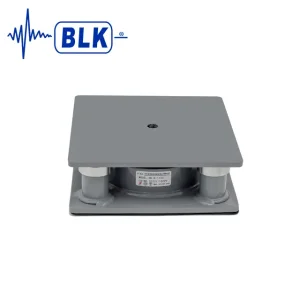
High-Efficiency Compressor Isolators & Mounts


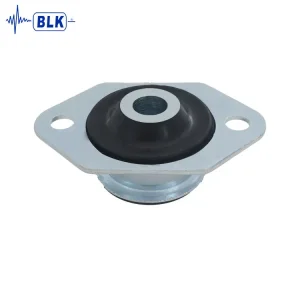

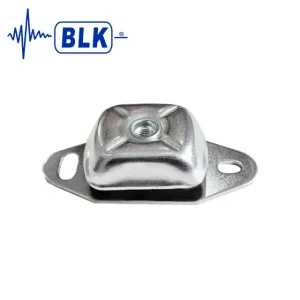
Global Commercial & Industrial Status of Compressor Vibration Dampers
Understanding the macro-economic drivers, structural fatigue risks, and acoustic regulations reshaping anti-vibration procurement worldwide.
Industrial gas compressors—whether screw, reciprocating, scroll, or centrifugal—are the mechanical hearts of modern infrastructure. They power mega-scale HVAC/R chillers in commercial skyscrapers, regulate pressure in hydrocarbon processing plants, drive pneumatic systems in semiconductor cleanrooms, and keep cold chain logistics operational. However, unmitigated dynamic force vectors generated by rotating gas compression units pose severe operational threats: resonance fatigue failure, structural pipe shearing, rapid bearing degradation, and violations of regional acoustic emission laws (such as OSHA noise exposure limits and ISO 3744 standards).
The global demand for high-performance yet low price compressor vibration dampers has surged dramatically. Enterprise procurement directors no longer view anti-vibration mounts as commodity rubber blocks. Modern engineering requires precision-calibrated damping systems—combining high-tensile spring steel, high-viscosity silicone fluid damping, and vulcanized elastomeric matrices capable of functioning across severe temperature gradients (-40°C to +120°C).
Information Gain Insight: The Financial Impact of Unmitigated Resonance
Engineering audits demonstrate that installing uncalibrated or sub-standard isolators increases mechanical maintenance costs by up to 34% over a 5-year operating lifecycle. Proper natural frequency matching (targeting a ratio where disturbing frequency $f_d$ is at least 3× natural frequency $f_n$) extends compressor bearing lifespan by 2.8 times and eliminates structure-borne noise propagation into building foundations.
The Engineering Physics Behind Compressor Vibration Mitigation
Transmissibility math, resonance avoidance, and structural isolation calculations engineered for optimal operational safety.
Transmissibility ($T_r$) Ratio
Vibration isolation only occurs when the excitation frequency ratio ($f_d / f_n$) exceeds $\sqrt{2} \approx 1.414$. Below this value, isolators amplify vibration rather than dampening it.
Low Natural Frequency ($f_n$)
Heavy low-RPM reciprocating gas compressors require low-frequency damped coil springs ($f_n = 3\text{--}5\text{ Hz}$), whereas high-speed rotary scroll units suit elastomeric mounts.
Damping Factor ($\zeta$) Control
Viscous fluid damping integrated into spring chambers controls transient shock loads during compressor start-up and shutdown, preventing erratic frame bouncing.
| Damper Technology | Natural Frequency ($f_n$) | Isolation Efficiency | Primary Compressor Application | Relative Cost Index |
|---|---|---|---|---|
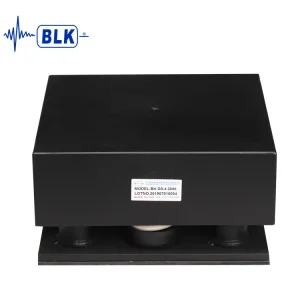
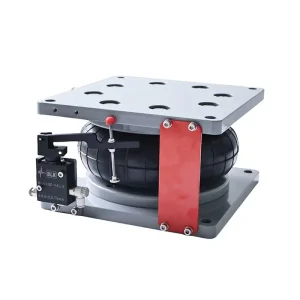
| Pneumatic Air Mounts (e.g. BK-PF, BK-A) | 1.7 Hz – 2.5 Hz | 98.5% – 99.5% | Ultra-clean medical gas, micro-vibration cleanroom air handling | High / Premium |
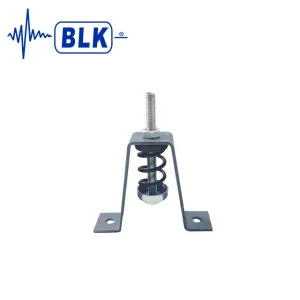
| Damped Spring Mounts (e.g. MD, BK-DS) | 3.0 Hz – 5.0 Hz | 92.0% – 97.5% | Roof-top HVAC chillers, large screw compressors, standby gensets | Moderate / Balanced |
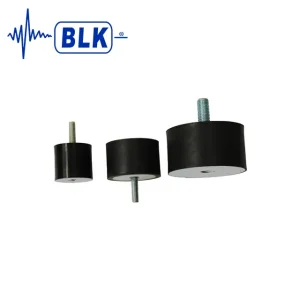
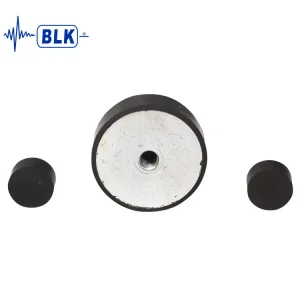
| Elastomeric Rubber Feet (e.g. BKHQ, BKAL) | 7.0 Hz – 12.0 Hz | 82.0% – 90.0% | Compact rotary compressors, light commercial HVAC, inline pumps | Low / High Efficiency |
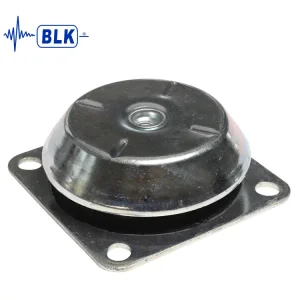
| Matrix & Cone Mounts (e.g. BKCN, BK-MT) | 5.0 Hz – 8.5 Hz | 88.0% – 94.0% | Marine engine room compressors, transportable diesel skid units | Cost-Effective OEM |
Why Purchasing Direct from China Factories Delivers Strategic Value
Dissecting the cost structures, manufacturing dense clusters, raw material vertical integration, and ISO quality controls in Kunshan, China.
When global EPC contractors and industrial original equipment manufacturers (OEMs) search for Low Price Compressor Vibration Damper Factories, China—specifically the advanced manufacturing corridors around Kunshan and Jiangsu—represents an unmatched operational base. But why does "low price" not translate to compromised quality?
Complete Supply Chain Integration
Our Kunshan facilities sit within minutes of raw synthetic rubber compounding mills, high-precision steel spring coiling plants, and automated CNC machining hubs. Raw material transit costs are virtually zero.
Dacromet Surface Coating Rigor
To eliminate environmental degradation, structural steel housings undergo Dacromet non-electrolytic zinc-flake coating, passing 900+ hours of continuous salt-spray testing per ASTM B117 standards.
Automated Testing & QC Automation
Robotic welding cells combined with dynamic tension-compression spectrum analyzers ensure every batch conforms to targeted dynamic stiffness ($K_d$) tolerance within ±5%.
Localized Application Scenarios for Industrial Dampers
Customized installation architectures across diverse global operating environments.
Scenario A: Commercial High-Rise Rooftop Chillers
Heavy water-cooled centrifugal compressors situated directly above occupied executive suites. Solution: Utilizing MD Type Anti-vibration Spring Mounts paired with concrete inertia bases. Eliminates 98% of structure-borne hum into tenant areas below.
Scenario B: Petrochemical Gas Compression Skids
Outdoor explosive gas compression units subjected to extreme marine air corrosion and sudden pressure transients. Solution: Heavy-duty BK-DS Damped Spring Mounts with hot-dip galvanized and Dacromet-treated housings.
Scenario C: Semiconductor Metrology Air Compressors
Sub-micron fabrication plants where cleanroom air compressors must not transmit even micro-seismic vibrations to neighboring lithography tools. Solution: BK-PF Type Precision Air Mounts providing down to 1.7 Hz resonance safety.
Smart Dampers & Enterprise Procurement Checklists
The technological evolution of active vibration dampening and how enterprise buyers negotiate pricing.
1. IoT Vibration Telemetry Integration
Next-generation compressor isolators feature embedded micro-MEMS accelerometers, transmitting real-time dynamic deflection data directly to plant SCADA systems to predict mechanical failure before breakdown occurs.
2. Eco-Friendly Elastomeric Formulations
Global REACH and RoHS regulations drive the shift toward bio-based, zero-VOC nitrile and silicone compounds resistant to synthetic lubricants, ozone, and ultraviolet radiation.
3. Dynamic Load Sizing Protocol
When requesting factory quotes, enterprise buyers must supply: 1) Total operating mass ($M$), 2) Center of Gravity ($CG$) displacement, 3) Excitation speed ($RPM$), and 4) Minimum isolation efficiency target.
Compressor Vibration Isolation Technical FAQ
Expert solutions to common procurement and mechanical engineering challenges.
How do I choose between rubber mounts and spring isolators for gas compressors?
Why are Chinese factory prices for vibration dampers significantly lower than Western OEMs?
What parameters are required to generate a custom 1:1 OEM vibration isolation plan?
What is the typical lifespan and warranty period of industrial spring and rubber mounts?
How does an inertia base improve compressor vibration dampening efficiency?
Specialized Heavy-Duty & Precision Vibration Control