
Engineered Industrial Vibration Isolators & Elastomeric Mounts
Select from our ISO 9001 factory-direct elastomeric, pneumatic, and matrix vibration isolation products designed for extreme dynamic stability and high acoustic attenuation.

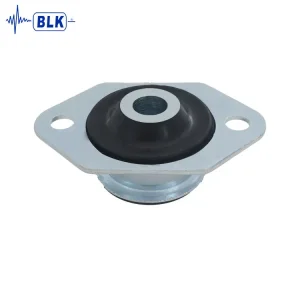
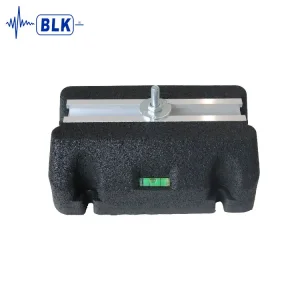


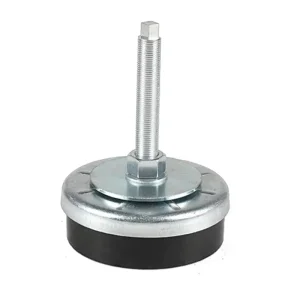


Navigating Industrial Vibration Control: Cost Optimization Meets Precision Engineering
In modern industrial ecosystems, mechanical vibration and unwanted structural acoustic transmission represent severe operational vulnerabilities. Left unmitigated, high-frequency harmonics and low-frequency dynamic forces induce mechanical fatigue, compromise dimensional tolerances in precision manufacturing, accelerate bearing wear, and violate stringent workplace health and safety (OSHA) noise pollution standards.
Historically, global procurement managers faced an unsatisfactory tradeoff: accept inflated pricing from legacy Western brands or risk high failure rates from uncertified commoditized suppliers. Today, advanced manufacturing hubs in Eastern China—specifically led by high-precision specialized enterprises like Bellking Vibration Reduction Equipment Manufacturing (Kunshan) Co., Ltd.—have redefined the cost-performance ratio. Through automated vulcanization control, finite element analysis (FEA) elastomer compounding, and integrated Industry 4.0 supply networks, industrial buyers can now secure direct-from-factory pricing while attaining dynamic isolation efficiencies exceeding 95% to 99%.
Macro Trends Shaping the Global Rubber Vibration Isolation Market
The global anti-vibration mount market is experiencing rapid technological convergence. Driven by industrial automation, HVAC retrofitting, EV assembly tooling, and semiconductor cleanroom expansion, elastomeric isolation is shifting from simple passive damping to sophisticated compound formulations.
Advanced Elastomer Chemistry
Modern anti-vibration mounts utilize tailored blends of Natural Rubber (NR), Nitrile (NBR), Neoprene (CR), and Ethylene Propylene Diene Monomer (EPDM). Compounding optimization regulates Shore A durometer hardness (ranging from 30 to 80 Shore A) while controlling static-to-dynamic stiffness ratios ($K_d/K_s \le 1.4$).
Hysteresis & Damping Optimization
Elastomeric isolators rely on internal molecular friction to dissipate energy as heat (hysteresis loss). By selecting engineered polymers with optimized loss factor ($\tan \delta \approx 0.1 - 0.25$), structural amplification at natural resonance frequencies ($f_n$) is reduced without compromising high-frequency isolation performance.
Environmental & Thermal Resistance
Global industrial sites present severe environmental stressors including ozone exposure, oil contamination, hydraulic fluids, and thermal cycling from -40°C to +120°C. Modern factory-grade mounts integrate anti-ozonant additives and bonding agents that maintain structural integrity across decades of continuous dynamic shear and compression loading.
China Industry 4.0: Factory Direct Cost Efficiency Without Quality Compromise
Why are industrial buyers worldwide transitioning their supply chain origin to specialized manufacturers in Jiangsu, China?
The answer lies in the hyper-dense industrial infrastructure of Kunshan, China. As a dedicated high-tech manufacturing hub adjacent to Shanghai, Kunshan concentrates raw polymer refining, precision CNC machining, metal surface treating, and automated rubber-to-metal vulcanization within a 15-kilometer radius.
At Bellking Vibration Reduction Equipment Manufacturing (Kunshan) Co., Ltd., we leverage this ecosystem to streamline the entire production lifecycle. By deploying robotic welding, multi-cavity injection compression molding, and automated Dacromet anti-corrosion coating directly in-house, Bellking eliminates multi-tier intermediary markup. The result is a direct 30% to 50% cost advantage compared to Western distributors, paired with full traceability and compliance under ISO 9001 standards.
The Bellking Manufacturing Ecosystem Advantage
- Vertical Integration: Stamping, metal surface phosphating, elastomer compounding, and vulcanization under one roof.
- Dacromet Coating Excellence: Superior surface treatments passing 900-hour salt spray corrosion testing without structural degradation.
- Rapid Customization Engineering: Turnaround non-standard 1:1 OEM drawings into functional physical prototypes in as little as 3 working days.
- Scalable Stocking Strategy: High-volume automated lines support standard model shipments within 24 hours of PO confirmation.
How to Size Rubber Vibration Mounts: Mathematical Principles
Achieving optimal vibration isolation requires strict evaluation of disturbing frequencies ($f_d$), static deflection ($\delta_s$), and natural frequencies ($f_n$).
Core Mechanical Equations for Vibration Isolation
The system's natural frequency ($f_n$ in Hz) is primarily governed by static deflection ($\delta_s$ in millimeters) under equipment load:
To ensure positive isolation (rather than harmonic amplification), the frequency ratio ($f_d / f_n$) must strictly exceed $\sqrt{2} \approx 1.414$. For high-efficiency industrial applications (isolation efficiency $\eta > 90\%$), target a ratio between 3.0 and 5.0:
| Isolator Category | Natural Freq ($f_n$) | Max Load Range (per point) | Primary Industrial Application | Expected Life |
|---|---|---|---|---|
| BKM / BKP Cylindrical Rubber Mounts | 8.0 Hz – 15.0 Hz | 10 kg – 1,200 kg | Electric motors, small pumps, compressors, fans | 10+ Years |
| BKCN Cone Mounts | 6.0 Hz – 12.0 Hz | 50 kg – 2,500 kg | Off-highway cabs, engine mounts, marine propulsion | 12+ Years |
| BK-MT Matrix Anti-Vibration Mounts | 5.0 Hz – 10.0 Hz | 100 kg – 5,000 kg | Heavy industrial presses, HVAC chillers, transformers | 15+ Years |
| BKDJ / BK-PM Polymer Pads | 12.0 Hz – 25.0 Hz | 10 kg/cm² – 50 kg/cm² | Impact isolation, foundation decoupling, structural pads | 20+ Years |
| BK-PF / BK-PA Precision Air Mounts | 1.7 Hz – 3.0 Hz | 50 kg – 3,000 kg | Semiconductor tools, metrology CMMs, optical tables | 6+ Years |
Localized Application Scenarios & Real-World Engineering Use Cases
Different operational environments demand targeted isolation characteristics. Below are primary field implementations where Bellking elastomeric mounts provide critical structural protection.
Commercial HVAC & Mechanical Rooms
Chillers, cooling towers, and air handling units (AHUs) situated on upper building levels generate structure-borne hum that travels through concrete slabs. Utilizing BK-MT Matrix Mounts and BKDJ Pads cuts low-frequency hum transfer into occupied tenant spaces, keeping site acoustics well within NC-30 rating standards.
Power Transformers & Electrical Grid
Magnetostriction in transformer cores causes continuous 100 Hz / 120 Hz hum. Bellking transformer anti-vibration mounts combine oil-resistant elastomeric cores with fail-safe shear restraints, mitigating up to 25 dB of structure-borne vibration in urban substations and data center power rooms.
Precision Semiconductor & Metrology
Sub-micron lithography tools and optical CMM inspection benches require total floor isolation. Deploying active-ready passive BK-PF Precision Air Mounts achieves ultra-low resonance frequencies down to 1.7 Hz, safeguarding delicate wafer measurements against ambient micro-seismic floor vibration.
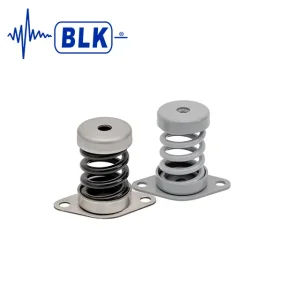
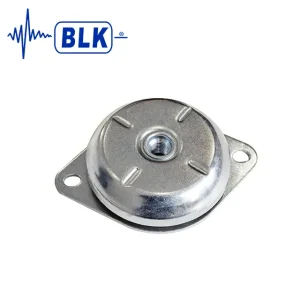
High-Performance Damped Spring & Rubber Isolation Solutions
Explore additional factory-direct vibration control catalog items engineered for heavy machinery, suspended piping, and desktop optical platforms.






Frequently Asked Questions: Procurement & Sizing
Direct answers from Bellking application engineers regarding rubber mount selection, factory pricing factors, and installation guidelines.
Optimize Your Equipment NVH Performance Today
Consult with our application engineering team in Kunshan, China. Request full technical datasheets, finite element stiffness models, or an instant factory-direct bulk price quotation.
Request Technical Consultation & Quote