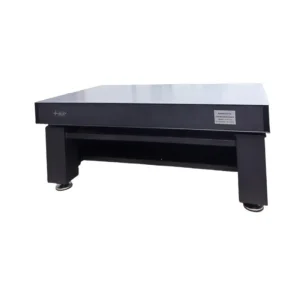
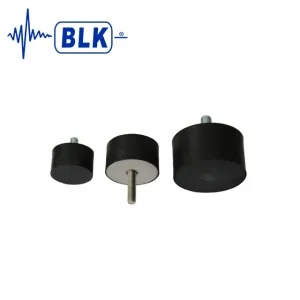
High-Efficiency Small & Micro-Vibration Isolator Lineup
Comprehensive elastomeric, spring-damped, and precision pneumatic modules engineered to deliver over 95% attenuation efficiency at competitive unit economics.







Global Vibration Dynamics & Small Isolator Market Realities
Analyzing high-precision electromechanical trends, micro-resonance vulnerability, and total cost of ownership (TCO) optimization across next-generation automated assembly.
Miniaturization & Acoustic Strictness
As industrial automation shifts toward micro-actuators, semiconductor cleanroom sorting robots, and medical lab analyzers, parasitic micro-vibrations threaten high-throughput precision. Small vibration isolators serve as the definitive mechanical low-pass filter, preventing high-frequency jitter from corrupting sensor precision and optical alignment.
The "Low-Price" Sourcing Paradigm
Procuring low-cost small isolators does not necessitate sacrificing elastomer durability or spring fatigue limits. By standardizing mold geometries, adopting automated vulcanization injection, and operating directly from dedicated industrial clusters, manufacturers slash production costs by 30–45% compared to multi-tier middleman supply lines.
Severe Environment Longevity
Micro-isolators placed near cooling channels or exterior ventilation face chemical sprays and high humidity. Utilizing advanced Dacromet conversion coatings (surpassing 900 hours of continuous ASTM B117 salt spray) prevents galvanic degradation and premature mechanical failure, securing uninterrupted 24/7 uptime.
Small Vibration Isolator Pricing & Specification Parameters
A granular breakdown of industrial unit costs, dynamic load ceilings, and technical selection equations to protect your mechanical budget.
| Isolator Series | Core Composition | Dynamic Load Range | Natural Frequency (fn) | Avg. Factory Tier Price | Target Installation Scenarios |
|---|---|---|---|---|---|
| BKHQ Rubber Mount | NBR / High-Damping EPDM | 1.5 kg – 45 kg / point | 8 Hz – 14 Hz | $1.80 – $6.50 | PCB test rigs, micro pumps, small blowers |
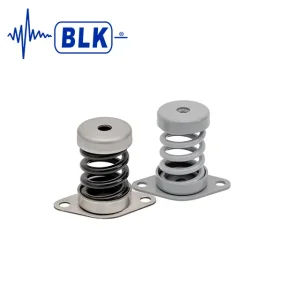
| ME Helical Spring Mount | Fatigue-Tough 60Si2Mn + Elastomer | 5 kg – 120 kg / point | 3.2 Hz – 5.0 Hz | $7.20 – $18.50 | Miniature compressors, small diesel gensets |
| BK-DSR Damped Isolator | Multi-axial Rubber-Metal bonded | 3 kg – 85 kg / point | 6 Hz – 11 Hz | $4.10 – $11.00 | In-line robotic arms, CNC control enclosures |
| BK-PF Precision Air Mount | Multi-ply Nylon Neoprene Diaphragm | 15 kg – 350 kg / point | 1.7 Hz – 2.8 Hz | $65.00 – $180.00 | Optical metrology, SEMs, wafer probers |
| BK-PM Polymer Pad | Crosslinked Viscoelastic Polymer | 0.1 – 1.8 MPa compression | 12 Hz – 22 Hz | $0.40 – $2.20 / pc | Under-base decoupling, transformer footing |
Dynamic Transmissibility & The Frequency Rule
Optimal dynamic dampening requires operating far beyond structural resonance. System isolation initiates strictly when the forcing excitation frequency (fd) satisfies the condition fd / fn > √2. For high-attenuation designs exceeding 90% vibration reduction, engineers must calibrate mounting specifications such that fd / fn ≥ 3.0.
Primary Unit Price Determinants
Small vibration isolator price structures are fundamentally regulated by dynamic elastomer grades (Standard Natural Rubber vs. Fluorinated Viton/Silicone), spring coating integrity (Zinc-plated vs. Electro-deposited Dacromet), and built-in multi-directional snubbing. Specifying direct factory volumes unlocks steep tiered economies of scale.
Localized Engineering Integration & Global Compliance
Eliminating operational risk with certified material safety, full trace testing, and rapid localized custom sizing turnaround.
Regional Code & Seismic Restraint
Global equipment integration demands compliance with stringent geographic codes. Sizing procedures integrate building standard ASHRAE guidelines alongside international building codes (IBC), ensuring small isolator footprints can handle transverse wind shear and horizontal seismic acceleration thresholds up to 3–5 G.
Material Directives: RoHS & REACH
Precision electronic machinery deployed within European and North American markets must eliminate hazardous toxic off-gassing. Our vulcanized compounds are fully validated against EU RoHS Directive 2011/65/EU and REACH (EC 1907/2006), protecting cleanroom environments from silicone contamination and outgassing failures.
Rapid 24-Hour Custom Prototyping
Complex OEM machines frequently require unique non-standard bolt hole arrangements or atypical deflection heights. Operating specialized CNC machining centers and direct-injection tooling allows us to deliver fully configured, custom-engineered 3D CAD models and prototype samples within 3 business days.
Mission-Critical Applications for Small Isolators
Demonstrated dynamic stability across diverse high-performance sectors requiring micro-displacement control.
Semiconductor Metrology & Cleanrooms
Wafer inspection instruments and wire bonders are vulnerable to low-amplitude floor tremors generated by external factory logistics. Sizing low-frequency pneumatic micro-isolators eliminates micro-blurring, preserving sub-nanometer critical dimension (CD) accuracy.
Medical Diagnostics & Centrifuges
Benchtop diagnostic centrifuges and spectrophotometers generate internal imbalances. Small high-damping rubber mounts isolate rotational shear forces from transmitting into the surrounding counter laboratory surface, preserving adjacent analytical accuracy.
Precision HVAC & Variable-Speed Pumps
Small-footprint split chillers and fluid circulation loops often cause severe structure-borne noise complaints. Installing compact spring-damped isolators under mounting ears prevents dynamic acoustic hum from entering architectural structural framing.
Engineering Evolution: The Next Era of Micro-Vibration Control
Pioneering advancements across smart elastomers, electromagnetic counter-deflection, and sustainable composite matrices.
Magnetorheological Active Adaptation
Integrating compact electromagnetic fluid damping into small isolator cores allows dynamic tuning of damping ratios within milliseconds. This effectively bypasses low-frequency resonance during machine run-up while maintaining absolute decoupling at steady operational RPMs.
IoT-Enabled Predictive Health Mounts
Embedding micro-piezoelectric sensors within the elastomeric base plate enables real-time structural health monitoring. Factory predictive maintenance systems receive automated telemetry identifying spring fatigue or rubber hardening before physical failure occurs.
Circular Bio-Based Polymers
Transitioning toward recyclable polyurethane elastomers and sustainably synthesized polymers significantly reduces structural carbon footprint without compromising dynamic shear stability, tear propagation strength, or high damping coefficients.
Frequently Asked Questions on Small Vibration Isolator Sourcing
Essential guidance covering technical calculations, dynamic selection, and order customization.
Complete Heavy & Precision Vibration Attenuation Catalog
Explore heavy-spring isolators, laboratory-grade optical tables, suspended acoustic hangers, and high-efficiency polymer pads.