
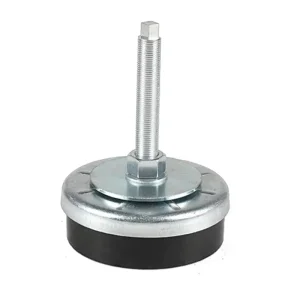
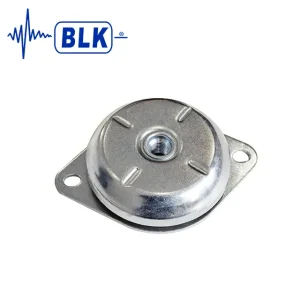
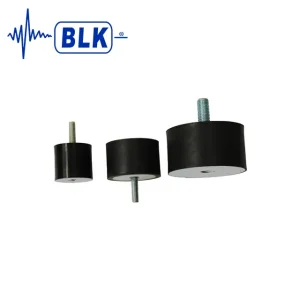
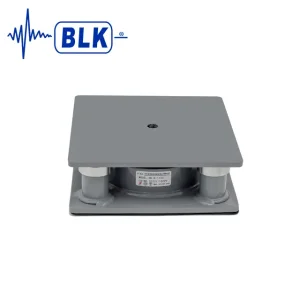
Featured Precision Vibration Isolation Products (Batch 1)
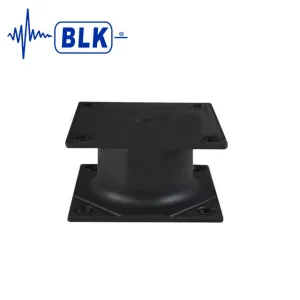
Explore our factory-direct industrial dampeners, high-deflection spring hangers, and matrix rubber mounts designed for ultra-low natural frequencies and maximum isolation efficiency.




Understanding Vibration Isolation Efficiency: An Engineering Perspective
In industrial engineering, Vibration Isolation Efficiency ($E$) measures the percentage of dynamic force or motion prevented from transferring from a operating machine into its supporting structure, or vice versa. Achieving optimal efficiency (often exceeding 95% to 99% in critical installations) requires precise calculations balancing system load, static deflection, stiffness, and disturbing frequency.
The Governing Physics of Transmissibility ($T$) and Deflection ($\delta$)
The effectiveness of any vibration isolator (whether rubber elastomeric, coil spring, or pneumatic air mount) is dictated by its Transmissibility ($T$). Transmissibility represents the ratio of transmitted force to input force. Vibration Isolation Efficiency ($E$) is mathematically expressed as:
Where Transmissibility T = sqrt[ (1 + (2 * damping_ratio * r)^2) / ((1 - r^2)^2 + (2 * damping_ratio * r)^2) ]
r = Frequency Ratio (disturbing_frequency f_d / natural_frequency f_n)
To achieve positive isolation ($E > 0$), the ratio $r = f_d / f_n$ MUST be greater than $\sqrt{2} \approx 1.414$. If $r < 1.414$, the system enters the amplification zone, exacerbating structural vibration and mechanical wear. For industrial HVAC chillers, transformers, and heavy stamping presses, professional engineers target $r \ge 3.0$, yielding theoretical efficiency over 88% to 98%.
| Frequency Ratio ($r = f_d / f_n$) | System Behavior Zone | Theoretical Transmissibility ($T$) | Isolation Efficiency ($E$) | Recommended Engineering Application |
|---|---|---|---|---|
| r < 1.0 | Near-Rigid Coupling | > 1.0 | 0% (No Isolation) | Structural Bolting / Base Frame Anchoring |
| r = 1.0 | Resonance Amplification Zone | Uncontrolled peak (Damping dependent) | Severe Negative Efficiency | Dangerous - Strictly Avoided in System Design |
| r = 1.414 ($\sqrt{2}$) | Isolation Threshold Point | 1.0 | 0% Isolation | Transition Boundary |
| r = 2.5 | Moderate Isolation Zone | ~0.19 | ~81.0% Efficiency | Standard Industrial Equipment & High-RPM Fans |
| r = 3.0 to 5.0 | High Efficiency Zone | 0.12 - 0.04 | 88.0% - 96.0% Efficiency | HVAC Chillers, Power Transformers, Gensets |
| r > 5.0 | Ultra-Precision Isolation | < 0.02 | 98.0% - 99.5% Efficiency | Semiconductor Lithography, Metrology & Cleanrooms |
Global Procurement Trends: Total Cost of Ownership (TCO) vs Factory Unit Price
International procurement managers for EPC (Engineering, Procurement, Construction) contractors and OEM machinery builders are increasingly looking beyond basic unit price. While acquiring "Low Price Vibration Isolation Efficiency Products" from factory sources in Asia significantly lowers initial capital expenditures (CAPEX), smart buyers evaluate the total cost lifecycle.
CAPEX Optimization
Direct factory sourcing from manufacturing clusters like Kunshan, China eliminates tier-2 trading markups, cutting hardware procurement expenditures by 30% to 50% without compromising tensile strength or elastomer formulation quality.
Structural Fatigue Mitigation
Unmitigated micro-vibrations cause dynamic stress cycles on building foundations, piping welds, and mechanical bearings. High-efficiency damping extends equipment operational life from 7 years to over 15 years.
Regulatory Compliance
Global environmental noise standards (such as OSHA noise exposure limits and ISO 3744 acoustic guidelines) mandate low structure-borne noise levels. High isolator efficiency ensures compliance during site audits.
China Supply Chain Advantage: The Kunshan Precision Manufacturing Cluster
Located in Kunshan, Jiangsu Province, our production ecosystem sits at the epicenter of East Asia's precision hardware and elastomeric polymer supply chain. This localized concentration offers global buyers unmatched technical, financial, and logistical competitive benefits:
Advanced Metallurgy & Polymer Chemistry
We utilize high-tensile spring steel (60Si2Mn / 55CrSi) engineered for millions of dynamic deflection cycles without permanent set. Our proprietary rubber compounds utilize premium natural rubber and neoprene with anti-aging, oil-resistant, and high-damping dynamic modifiers.
Rapid Prototyping in 3 Days
Leveraging in-house CNC machining hubs, automated robotic welding, and vulcanization presses, custom non-standard isolators (specific load capacities, unique mounting bolt patterns, tailored dynamic stiffness) progress from engineering drawing approvals to physical prototypes in as few as 3 working days.
Localization Support, Compliance & International Standards
Deploying vibration control devices in global industrial facilities requires strict adherence to international building codes, environmental directives, and anti-corrosion benchmarks. Our factory compliance framework provides seamless integration for multinational engineering projects:
ISO 9001:2015 Quality Controls
Every manufacturing batch undergoes stringent quality gates, including tension-compression load testing, static deflection verification, dynamic stiffness spectrum analysis, and strict dimensional tolerances.
Environmental Standards (RoHS / REACH)
Elastomer formulations are zero-gassing, non-toxic, and fully compliant with EU RoHS and REACH regulations, making them completely safe for installation inside pharmaceutical cleanrooms and semiconductor fabs.
900-Hour Dacromet Corrosion Rating
For outdoor cooling towers, marine installations, and highly humid chemical plants, our steel components utilize multi-layer Dacromet and hot-dip galvanized coatings tested to withstand over 900 hours of continuous salt spray testing.
Industry Trends: The Future of High-Efficiency Vibration Control
As automated manufacturing, nanometer-scale photolithography, and high-density mega-data centers evolve, vibration isolation technology is undergoing significant technological shifts:
Smart IoT-Enabled Active Damping Platforms
Modern pneumatic isolators are increasingly integrated with real-time piezoelectric sensors and fast-acting electromagnetic actuators. These passive-active hybrid systems actively detect floor micro-tremors and counter them in real-time, holding micro-g stability levels.
Eco-Friendly Elastomeric Compounds
Next-generation vibration damping pads feature recyclable, bio-derived thermoplastic elastomers (TPE) that match the low static-to-dynamic stiffness ratio ($K_d / K_s$) of premium natural rubber while providing superior resistance to ozone, UV radiation, and synthetic oils.
Localized Application Scenarios & Real-World Engineering Field Deployment
Vibration isolators must be selected based on the specific physical environment and operating conditions of the target equipment. Below are key real-world deployment scenarios where high isolation efficiency is mandatory:
Rooftop & Upper-Floor HVAC Plant Rooms
Commercial high-rise buildings house heavy water chillers, centrifugal pumps, and cooling towers on elevated concrete slabs. Unisolated low-frequency hum (20 Hz - 100 Hz) travels down structural columns into office spaces. Open-spring vibration isolators with 25mm to 50mm static deflection isolate up to 98% of dynamic energy.
Semiconductor Cleanrooms & Inspection Labs
Sub-nanometer measuring tools, Coordinate Measuring Machines (CMM), and optical microscopes are hypersensitive to environmental foot-traffic and nearby air handlers. Desk-type pneumatic platforms ($f_n \approx 1.7 \text{ Hz}$) eliminate ground vibrations, protecting yield rates.
Electrical Power Grid Transformers
Power transformers generate continuous magnetostrictive core hum at double line frequencies (100 Hz / 120 Hz). Specialized transformer anti-vibration mounts isolate core vibrations, preventing ground transmission into nearby residential structures.
Frequently Asked Questions (FAQ) - Procurement & Engineering
Answers to critical technical questions asked by global consulting engineers and procurement directors when selecting low-cost, high-efficiency vibration control systems:
Featured Precision Vibration Isolation Products (Batch 2)
Explore our secondary line of specialized rubber buffers, precision desktop platforms, rubber hangers, and high-deflection spring mounts engineered for low-cost, maximum-efficiency vibration suppression.







Request Your Custom Vibration Control Selection Calculation
Send us your equipment weight, center of gravity layout, and operating RPM. Our application engineers in Kunshan will return a detailed calculation sheet showing natural frequency ($f_n$), estimated transmissibility ($T$), and a direct factory quotation within 24 hours.