
High-Performance Ceiling-Mounted & Suspended Isolators
Direct factory engineered solutions for HVAC, piping, suspended equipment, and architectural acoustics.






Structural Physics of Ceiling-Mounted Vibration Isolation
Understanding mechanical resonance, static deflection, and structure-borne acoustic attenuation in suspended systems.
The Mechanics of Suspended Dynamics
Ceiling-mounted vibration dampers—commonly referred to as ceiling vibration isolators or spring hangers—are engineered critical components designed to disrupt the path of mechanical kinetic energy transmitted from overhead equipment to the building superstructure. When suspended machinery such as Air Handling Units (AHUs), inline exhaust fans, chilled water pipes, or industrial ductwork operate, they generate rotational and turbulent forces. Left unchecked, these low-frequency micro-vibrations traverse threaded steel rods directly into concrete floor slabs, converting into structure-borne noise that radiates throughout the building structure.
Harmonic Isolation & Natural Frequency Formulation
To successfully achieve structural decoupling, a custom ceiling damper must be sized so that its system natural frequency ($f_n$) is substantially lower than the disturbing rotational frequency ($f_d$) of the connected equipment. Effective isolation begins only when the frequency ratio ($f_d / f_n$) exceeds $\sqrt{2} \approx 1.41$. For industrial-grade acoustic efficiency exceeding 90% to 98%, engineers specify a minimum ratio of 3.0 or higher.
1. System Natural Frequency ($f_n$): Derived directly from static spring deflection ($\delta_{st}$ in mm):
f_n = \frac{1}{2\pi} \sqrt{\frac{g}{\delta_{st}}} \approx \frac{5}{\sqrt{\delta_{st} \text{ (in cm)}}} \text{ [Hz]}
2. Vibration Transmissibility ($T$): Quantifying force transferred to the ceiling structure (where $\zeta$ is damping ratio):
T = \sqrt{\frac{1 + (2\zeta \cdot f_d/f_n)^2}{(1 - (f_d/f_n)^2)^2 + (2\zeta \cdot f_d/f_n)^2}}
Information Gain Insight: Standard steel springs exhibit near-zero structural damping ($\zeta \approx 0.01$), which creates extreme resonance amplitudes during motor start-up and shut-down phases. Bellking custom ceiling-mounted dampers integrate engineered high-viscosity elastomeric inserts (neoprene/nitrile) in series with the steel coil, providing dual-action damping that truncates resonance spikes while terminating high-frequency acoustic wave bridging.
Global Enterprise Sourcing & OEM/ODM Engineering Framework
Optimizing Total Cost of Ownership (TCO), Bill of Materials (BOM) compliance, and global delivery schedules for EPC contractors and OEMs.
Custom OEM/ODM Engineering
Global HVAC and equipment manufacturers require bespoke bracket geometries, custom spring rates, and custom color-coded load indicators. Our engineering department operates 3D CAD/FEA simulation suites (ANSYS, SolidWorks) to prototype non-standard suspension housings in as few as 72 hours, drastically reducing product launch lifecycles.
Supply Chain TCO Optimization
By shifting from regional distributors to factory-direct procurement with an ISO 9001 certified manufacturer, enterprise buyers eliminate multi-tier distributor markups, securing a 25% to 40% reduction in total project unit costs while establishing rigorous quality control at the source.
BOM Traceability & Export Compliance
Every shipment includes standardized mill test reports (MTR), dynamic stiffness laboratory test data, raw rubber compound analysis certificates, and full compliance documentation (RoHS, REACH, CE) required by international customs and tier-1 construction project managers.
China Supply Chain Edge & Manufacturing Mastery
Inside Bellking’s specialized Kunshan manufacturing hub: Advanced metalworking, elastomer chemistry, and stringent testing protocols.
Automated Spring Coiling & Heat Treatment
Our facility utilizes CNC multi-axis spring coiling machinery handling high-tensile alloy spring steel wire diameters up to 30mm. Springs undergo shot-peening, stress-relief heat treatment, and computerized load-deflection testing to ensure zero permanent set under 150% rated load capacity.
Advanced Surface Anti-Corrosion (900H Salt Spray)
Suspended ceiling isolators often operate in unconditioned, humid plenum spaces, coastal buildings, or chemical plants. Steel frames and springs receive heavy Dacromet, powder coating, or hot-dip galvanizing, passing 900+ hours of continuous neutral salt spray testing (ASTM B117) without red rust formation.
Precision Elastomer Injection Molding
Bellking formulates proprietary synthetic nitrile and neoprene rubbers in-house. Utilizing vacuum vulcanizing presses, our rubber elements feature exact durometers (40 to 70 Shore A) designed for maximum aging resistance, low creep, and zero ozone degradation over 15+ years of active duty.
Versatile Field Scenarios for Ceiling-Mounted Damper Systems
Custom ceiling vibration hangers engineered to meet stringent acoustic and structural tolerances across key sectors.
Suspended Commercial HVAC & AHUs
Heavy air handling units, heat recovery ventilators, and inline centrifugal blowers suspended in ceiling plenums generate significant low-frequency structural excitation. Installing pre-compressed ceiling spring hangers (e.g., HV Type or Custom Spring Hangers) prevents rumble from transferring to tenant spaces directly below.
High-Pressure Chilled Water Piping Racks
Fluid turbulence, water hammer, and thermal expansion forces in suspended chilled/hot water pipes transmit damaging vibration to structural ceilings. Flexible ceiling dampers decouple pipe trapeze hangers, compensating for axial movement while trapping fluid-borne harmonics.
Acoustic Ceilings, Recording Studios & Auditoriums
High-end architectural spaces utilize "box-within-a-box" construction. Custom ceiling-mounted rubber and spring hangers isolate drywall ceiling grids, preventing airborne sound from flanking through structural concrete and maintaining NC-25 or lower ambient noise criteria.
Data Centers & Server Facility Piping
Data center CRAC/CRAH unit piping networks require non-interrupted dampening to safeguard sensitive storage hardware from micro-vibration-induced head crashes. High-rigidity steel frame ceiling dampers provide reliable structural hold with continuous dynamic dampening.
Industrial Exhaust Ductwork & Collectors
Heavy metal ductwork connected to industrial dust collectors or fume exhaust pumps vibrates violently due to internal air turbulence. Pre-loaded ceiling dampers prevent mechanical fatigue failures at duct weld joints and roof penetration points.
Cleanroom Recirculation Fan Filter Units (FFUs)
Semiconductor cleanrooms demand pristine sub-micron environmental stability. Ceiling grid systems supporting hundreds of FFUs use precision elastomeric ceiling dampers to prevent aggregate motor vibration from disrupting optical lithography equipment.
International Building Codes, Seismic & Acoustic Compliance
Ensuring global engineering specifications are met across North American, European, and Asian jurisdictions.
| Standard / Regulation | Geographic Region | Engineering Scope & Requirement | Bellking Factory Compliance Guarantee |
|---|---|---|---|
| ASHRAE HVAC Applications Handbook | Global / North America | Specifies minimum static deflection requirements for equipment based on span and RPM. | Full range of 25mm, 50mm, and 75mm deflection ceiling hangers meeting Chapter 48 guidelines. |
| IBC (International Building Code) | North America / Middle East | Requires seismic-restrained suspension assemblies capable of lateral force resistance. | Integrated seismic snubbers and heavy-gauge steel housing preventing rod pull-out during seismic events. |
| Eurocode 8 (EN 1998) | European Union | Seismic design and structural safety of non-structural suspended building components. | CE certified steel fabrications with dynamic load capacity certificates verified by third-party labs. |
| ISO 3741 / ISO 3744 | International | Acoustic sound power level measurements and structure-borne sound isolation criteria. | High acoustic insertion loss rubber elements reducing sound bridge transmission by up to 28 dB. |
| RoHS & REACH Directives | European Union / Worldwide | Prohibits hazardous substances (heavy metals, phthalates) in synthetic rubber formulations. | 100% eco-compliant elastomer compounds with zero toxic off-gassing, certified safe for cleanrooms. |
Next-Generation Technology in Overhead Vibration Control
How smart sensors, hybrid damping materials, and sustainable engineering are redefining suspended isolator design.
1. IoT-Enabled Predictive Health Monitoring
Modern smart buildings are adopting ceiling dampers embedded with micro-wireless MEMS accelerometers. These smart hangers transmit real-time vibration telemetry to the Building Management System (BMS), alerting facility managers to motor bearing wear or fan imbalance before catastrophic structural failure occurs.
2. Magnetorheological & Hybrid Elastomer-Spring Systems
The boundary between passive and active isolation is blurring. Advanced ceiling hangers utilize hybrid high-viscosity composite polymers encapsulated within variable-pitch steel coils, providing dynamic tuning across both low-frequency mechanical thrust and high-frequency acoustic hiss.
3. Sustainable Eco-Polymers & Zero-LEED Impact
Green building certifications (LEED v4.1, BREEAM) reward manufacturers utilizing recycled high-density elastomers and zero-VOC anti-corrosion coatings. Bellking leads this shift by formulating sustainable rubber compounds with low embodied carbon profiles without compromising physical durometer longevity.
Frequently Asked Questions by Specifying Engineers & Buyers
In-depth responses covering sizing, static deflection calculations, installation nuances, and custom manufacturing capability.
How do I accurately size ceiling-mounted spring hangers for an overhead Air Handling Unit (AHU)?
Accurate sizing requires four core parameters: total operating weight of the suspended unit (including water filled coils), location of the Center of Gravity (CG), number of suspension points, and the operating speed (RPM) of the equipment motor.
First, calculate the static load per point ($W_i = \text{Total Weight} / N$, adjusted for CG bias). Second, determine the disturbing frequency ($f_d = \text{RPM} / 60$). Third, select a hanger model whose static deflection ($\delta_{st}$) yields a natural frequency ($f_n$) that maintains a ratio $f_d / f_n \ge 3.0$. For example, a fan operating at 1,200 RPM (20 Hz) requires a hanger with at least 25mm static deflection ($f_n \approx 3.16 \text{ Hz}$), providing a frequency ratio of 6.33 and an isolation efficiency over 97%.
What is the engineering difference between pure rubber ceiling mounts and spring-rubber combination hangers?
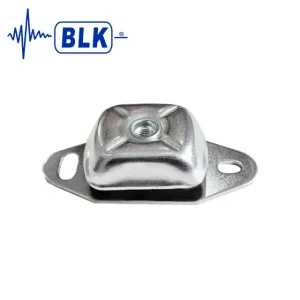
Pure rubber ceiling mounts (such as the BKM or BKVE series) offer high structural dampening and are exceptional at blocking high-frequency noise (>15-20 Hz) and structural vibration. However, they are physically limited to smaller static deflections (typically 3mm to 8mm), giving them a higher natural frequency ($f_n > 8-10 \text{ Hz}$).
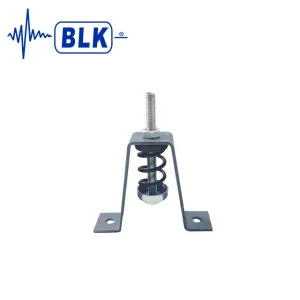
Spring-rubber combination hangers (such as the HV or MD series) pair a steel coil spring with a rubber cup/bushing. The steel spring achieves large static deflections (25mm to 50mm+), yielding ultra-low natural frequencies (2 Hz to 4 Hz) required for low-RPM equipment. The elastomeric insert acts as a high-frequency acoustic break, preventing audio-frequency sound waves from traveling down the steel wire coil into the structure. Combination hangers provide the definitive dual-spectrum solution.
Why are pre-compressed (pre-loaded) ceiling hangers necessary in mechanical piping installations?
During the installation phase of large chilled water pipes or suspended boilers, the piping system is installed empty without fluid weight. Standard spring hangers would expand upward under light weight, causing severe misalignment and stress at equipment connection flanges.
Pre-compressed ceiling hangers are factory assembled under a pre-load corresponding to the dry weight or full operating weight using restraint bolts. When the system is filled with water, the springs transfer load smoothly within their operating range without vertical elevation changes, preserving piping geometry and avoiding expansion joint rupture.
Can Bellking manufacture custom hanger mounting brackets for unique structural beam profiles?
Yes. As a direct factory manufacturer, Bellking routinely customizes the steel housing cage, top fixing eyelets, thread rod diameter clearances, and bracket geometry. Whether your project requires attachment to C-channel strut grids, heavy I-beams, or angled steel roof trusses, our engineering team can modify the housing design, perform FEA stress analysis, and manufacture custom units in 3 to 5 working days.
How does outdoor coastal environment exposure affect ceiling damper lifespan, and how is it mitigated?
Outdoor plenums or coastal rooftop suspensions expose dampers to salt fog, humidity, and atmospheric industrial sulfur, leading to rapid steel oxidation and premature spring fatigue failure. Bellking mitigates environmental degradation through multi-layer corrosion protection: high-tensile spring steel is treated with Dacromet coating or hot-dip galvanizing passing 900+ hours of ASTM B117 salt spray testing, while structural steel frames are powder coated or stainless steel (SS304/SS316) fabricated.
Precision Hangers, Air Mounts & Inertia System Components
Explore the remainder of our engineered product lines for complete facility vibration control.






Request Custom Engineering Calculations & OEM Quotation
Send our application engineering team your equipment weights, center of gravity schedules, and dimensional constraints. We deliver custom 3D CAD models, dynamic deflection calculations, and factory-direct pricing within 24 hours.
Connect with Application Engineers