Precision Light-Load Rubber Dampers & Vibration Isolators
Explore standard, rapid-shipment, and precision-engineered light-load elastomer mounts manufactured at our Kunshan facility with ISO 9001 quality controls.


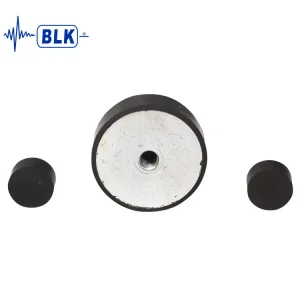


Engineering Light-Load Dynamic Elastomers: From Polymer Chemistry to Micro-Vibration Isolation
In precision manufacturing, micro-electronics, analytical laboratories, and sensitive aerospace sensor pods, structural vibration is no longer merely an acoustic nuisance—it is a critical failure vector. While heavy industrial equipment requires stiff coil springs or pneumatic air bags designed for ton-scale dynamic loads, sub-system assemblies carrying payloads between 0.2 kg and 120 kg present entirely distinct vibrational mechanics. These sensitive payloads include PCB optical inspection rigs, medical hematology centrifuges, semiconductor wafer handling robotics, drone gimbal stabilizers, and high-frequency fluidic pumps.
A specialized custom light-load rubber damper factory must transcend generic commercial molding. Bellking Vibration Reduction Equipment Manufacturing (Kunshan) Co., Ltd. combines advanced hyperelastic constitutive modeling (Mooney-Rivlin, Ogden, and Yeoh parameters), proprietary compound curing, and precision metal-elastomer vulcanization bonding. By modulating the elastomer's Shore A durometer (from ultra-soft 30A to rigid 75A), static-to-dynamic stiffness ratio ($K_d / K_s$), and internal loss factor ($\eta$), our engineering team designs bespoke elastomeric dampers that eliminate high-frequency harmonics without inducing low-frequency resonance rocking.
Fundamental Governed Equation: Elastomeric Transmissibility & Damping Ratio
The isolation transmissibility ($T$) across single-degree-of-freedom light-load elastomeric isolators is governed by the excitation frequency ratio ($r = f_d / f_n$) and the mechanical damping ratio ($\zeta$):
T = \sqrt{ \frac{1 + (2\zeta r)^2}{(1 - r^2)^2 + (2\zeta r)^2} }
Isolation occurs strictly when $r > \sqrt{2} \approx 1.414$. For high-performance instrumentation, Bellking targets an excitation frequency ratio of $r \ge 3.0$ through proprietary elastomer formulations, achieving over 90% to 99% transmissibility reduction.
Global Sourcing Realities: Why Standard Off-the-Shelf Dampers Fail Sensitive Payloads
Original Equipment Manufacturers (OEMs) and tier-one defense, medical, and robotics integrators operate under demanding reliability criteria that generic commercial rubber components cannot fulfill.
Ultra-Narrow Durometer Tolerances (±3 Shore A)
Standard industrial molded rubber products allow durometer swings of ±5 to ±8 Shore A. Under light static loads (e.g., 1.5 kg per mount), an 8-point variation drastically shifts the mount's natural frequency ($f_n$), turning a designed 8 Hz anti-vibration mount into a resonant 14 Hz amplifier. Bellking guarantees tight ±3 Shore A durometer batches through computerized automated ingredient dispensing.
Dynamic vs. Static Stiffness Ratio Control ($K_d / K_s$)
Elastomers exhibit dynamic stiffening when subjected to high-frequency cyclic loading. An isolator with adequate static deflection may stiffen by 200% to 400% under 100 Hz micro-excitations. Our laboratory formulates polymers with dynamic stiffness ratios as low as $K_d / K_s \approx 1.25$ to $1.4$, guaranteeing true high-frequency isolation for precision laser and optical scanning sensors.
Non-Linear Creep & Compression Set Resistance
Continuous static pre-load leads to polymer chain disentanglement and permanent height loss (creep). For sensitive optical lenses and robotic axes, a 1.0 mm vertical sag misaligns high-resolution inspection cameras. Bellking applies post-curing thermal cycles and high-grade curing systems yielding compression sets under 12% across 1,000 hours at 70°C (ASTM D395 Method B).
Cleanroom Outgassing & Chemical Purity
Semiconductor photolithography cleanrooms (ISO Class 3 to 5) and vacuum instrumentation reject volatile organic compounds (VOCs) and sulfur blooming. We engineer medical-grade platinum-cured VMQ silicone and low-sulfur fluorinated elastomers (FKM) compliant with NASA outgassing requirements (SP-R-0022A) and semiconductor SEMI standards.
Extreme Temperature & Environmental Resilience
Dampers installed in outdoor telemetry units, military drones, or refrigeration chillers must survive temperatures from -50°C to +150°C, ozone exposure, oil splashes, and UV degradation. Bellking custom matches polymers—from Chloroprene (Neoprene) and EPDM to Fluorosilicone—ensuring damping stability without polymer embrittlement.
Engineered Vibration Control Architectures Across High-Tech Verticals
How customized light-load rubber dampers resolve micro-vibrations, structure-borne acoustics, and mechanical shocks in global high-precision systems.
| Target Sector | Typical Payload / Dynamic Profile | Primary Excitation Mode | Bellking Engineered Damper Architecture | Quantified Performance Deliverable |
|---|---|---|---|---|
| In-Vitro Diagnostics & Medical Analyzers | 0.5 kg – 15 kg per point; micro-pumps, stepper motors | High-frequency fluidic pulsation (60–300 Hz) | Ultra-soft 35A VMQ silicone shear-bushing mounts with brass anti-friction inserts | Transmissibility < 4%; acoustic sound pressure reduced by > 18 dB(A) |
| Semiconductor Wafer Handling & AGVs | 5 kg – 40 kg; robotic end-effectors, cleanroom AGVs | Transient floor jolts & servo acceleration shocks (up to 4.5 G) | High-damping BKDE/BKAL conical shear-compression mounts with conductive rubber | Static discharge < 10&sup6; Ω; residual settling time reduced from 420 ms to 45 ms |
| Optical Metrology, CMMs & Laser Scanners | 10 kg – 80 kg; laser interferometers, granite tables | Micro-seismic background rumble (2–50 Hz) | Multi-axis BK-AT / BK-RT matrix hybrid mounts combining internal elastomer cells with leveling pads | Attenuates ambient micro-vibrations down to VC-E cleanroom vibration criteria |
| Unmanned Aerial Vehicles & Sensor Gimbals | 0.2 kg – 6 kg; LiDAR, multispectral thermal cameras | Propeller motor harmonics & aerodynamic buffet (80–650 Hz) | Omnidirectional hollow silicone teardrop dampers with molded safety interlock pins | Completely eliminates camera rolling shutter jelly artifacts; survived 50G drop shock |
| Compact Electronics & Server Cabinets | 2 kg – 30 kg; high-RPM cooling fans, HDD racks | Rotational unbalance vibrations (2,400–7,200 RPM / 40–120 Hz) | BKM/BKTS dual-stud cylindrical shear mounts with Dacromet corrosion-proof studs | Structural transmission cutoff of 94%; prevents adjacent drive track head offsets |
Material Science: Selecting the Optimal Polymer Backbone for Light-Load Damping
A damper's mechanical performance is bounded by polymer viscoelasticity. Bellking's custom compounding facility matches exact application requirements to the ideal polymer backbone.
Natural Rubber (NR / Polyisoprene)
Attributes: Unmatched resilience, exceptional dynamic fatigue life (> 10&sup7; cycles), low mechanical hysteresis, and superior static-to-dynamic modulus linearity.
Target Use: General laboratory precision mounts, high-cycle robotic isolators.
Operating Range: -40°C to +80°C. High tear strength and tensile endurance.
Silicone Elastomer (VMQ / PVMQ)
Attributes: Outstanding temperature stability, near-constant stiffness curve across wide thermal spans, odorless, cleanroom compliant, non-conductive.
Target Use: Aerospace telemetry, medical imaging, cleanroom automation, outdoor sensors.
Operating Range: -60°C to +200°C. High resistance to UV, corona, and ozone degradation.
Nitrile Butadiene (NBR) & Hydrogenated NBR
Attributes: Exceptional resistance to petroleum oils, synthetic lubricants, fuels, and hydraulic fluids. Excellent tensile strength and abrasion resistance.
Target Use: Gearboxes, hydraulic sub-assemblies, cooling compressors, industrial oil environments.
Operating Range: -30°C to +110°C (up to 150°C for HNBR compounds).
Ethylene Propylene Diene (EPDM)
Attributes: Superb resistance to weathering, ozone, polar solvents, water vapor, and phosphate-ester hydraulic fluids. Excellent long-term outdoor weatherability.
Target Use: Outdoor HVAC light-load sensors, marine diagnostic enclosures, solar trackers.
Operating Range: -45°C to +135°C. Impervious to cracking under ambient ozone attack.
Chloroprene (Neoprene / CR)
Attributes: Balanced mechanical profile combining moderate flame resistance, moderate oil resistance, good weatherability, and robust metal adhesion.
Target Use: General electronics packaging, marine instrument consoles, railway rolling stock cabin modules.
Operating Range: -35°C to +100°C. Naturally flame-retardant formulation capability.
Factory Floor Engineering: Inside Bellking's 2,000 m² Precision Production Hub
Discover how direct-from-factory manufacturing provides rigorous quality assurance, zero trading-intermediary markup, and rapid 3-to-7 day custom tooling turnaround.
High-Pressure Vacuum Compression Molding
Micro-voids, trapped air bubbles, and parting line flash ruin light-load isolator sensitivity. Bellking operates automated high-vacuum (under -0.098 MPa) vulcanizing hydraulic presses. Vacuum evacuation prior to mold closure guarantees uniform elastomer density, isotropic deflection curves, and flawless dimensional surface finishes.
Automated Chemlok® Bonding & Metal Preparation
Delamination between metal inserts and rubber is the #1 cause of catastrophic isolator failure under shear loading. Our CNC metal inserts (AISI 304/316 stainless steel, aluminum 6061, brass, or carbon steel) undergo automated degreasing, grit blasting, primer application, and Chemlok adhesive dipping. The chemical vulcanization bond exceeds the tear strength of the rubber itself (ASTM D429 Method B 100% rubber tear).
In-House 900-Hour Salt Spray & Dacromet Coating
Exporting to coastal, marine, or chemical processing plants demands robust corrosion defense. While electro-galvanizing often fails in under 72 hours of ASTM B117 salt spray exposure, our hardware features Dacromet / Geomet zinc flake surface treatments verified for over 900 hours of salt spray exposure with zero red rust.
Dynamic Spectrum Analysis & Static Servohydraulic Testing
Every custom damping prototype undergoes multi-axis dynamic characterization. Our QC lab is equipped with servohydraulic static tension-compression load cells, multi-axis electrodynamic shakers, and FFT vibration spectrum analyzers, validating actual dynamic stiffness ($K_d$), transmissibility ($T$), and natural frequency ($f_n$) before high-volume serial production.
Rapid 1:1 Tooling & Prototyping in 3 Days
Need custom non-standard dimensions, specific thread studs (M3, M4, M5, M6, 1/4-20 UNC), or tailored geometrical geometry? Our in-house CNC wire EDM and high-speed CNC milling workstations generate custom single-cavity prototype molds within 72 hours, drastically shrinking OEM development cycles.
The Future of Precision Elastomer Isolation: 2026–2030 Roadmap
How cutting-edge research in polymer nanocomposites, non-linear hyperelastic finite element analysis (FEA), and smart dampening materials is transforming the industry.
Carbon Nanotube (CNT) & Graphene Reinforced Elastomers
By integrating functionalized multi-walled carbon nanotubes (MWCNTs) and graphene nanoplatelets into silicone and NBR matrixes, Bellking's R&D lab is synthesizing nanocomposite dampers that demonstrate a 40% increase in mechanical loss factor ($\eta$) without sacrificing tear strength or increasing permanent static creep.
Predictive FEA Hyperelastic Material Modeling
Eliminating trial-and-error tooling through digitized non-linear simulation: we conduct multi-axial tensile, planar shear, and volumetric compression tests to extract exact Mooney-Rivlin ($C_{10}, C_{01}$), Ogden, and Yeoh material coefficients. This enables virtual prototype stress distribution and shape-factor optimization prior to mold machining.
Bio-Based & Recyclable Thermoplastic Elastomers (TPE/TPV)
Addressing global sustainability initiatives and EU Circular Economy mandates, our development pipeline is formulating high-damping bio-monomer vulcanizates and recyclable dynamic TPEs that deliver traditional vulcanized rubber isolation characteristics with a 55% reduction in embedded manufacturing carbon footprint.
Regulatory Compliance, Localization Support & Direct Export Architecture
Seamless international integration for OEM procurement departments across North America, Europe, East Asia, and the Middle East.
RoHS 3 & REACH SVHC Strict Adherence
All raw elastomer compounds, curing agents, process oils, and metal surface passivations are certified free from heavy metals (lead, cadmium, mercury, hexavalent chromium), phthalates, and SVHC chemical hazards. Full SGS third-party laboratory testing dossiers accompany every production order.
UL 94 V-0 Flame Retardance Capabilities
For rail transit consoles, defense avionics, and medical equipment requiring fire containment, Bellking compounds halogen-free, antimony-free flame-retardant silicone and neoprene dampers meeting UL 94 V-0 self-extinguishing criteria and EN 45545-2 railway fire protection ratings.
Direct-from-Factory Logistics & 24h Fast-Track Dispatch
Located in Kunshan, adjacent to Shanghai's international deep-water logistics port and Pudong air freight hub, standard catalog rubber isolators ship globally within 24 hours. Custom batch orders benefit from dedicated DDP/FOB/CIF express delivery options with real-time tracking.
Frequently Asked Engineering & Procurement Questions
In-depth responses authored by Bellking application engineers covering sizing formulas, dynamic ratios, tooling, and environmental survival.
What parameters are mathematically necessary to calculate and size a custom light-load rubber damper?
1. Total Operating Mass & Center of Gravity (CG): The total payload (e.g., 8.4 kg) and weight distribution across mounting points. Symmetrical 4-point layouts require 2.1 kg per mount, whereas asymmetrical CG locations require differential durometer distribution to prevent static tilt.
2. Excitation Frequency Spectrum ($f_d$): The motor RPM or disturbing frequency of vibrating sub-elements (e.g., a brushless cooling fan at 3,600 RPM generates a primary disturbing frequency of $f_d = 60\text{ Hz}$).
3. Target Natural Frequency ($f_n$): To secure > 90% isolation efficiency, the mounted natural frequency must satisfy $f_d / f_n \ge 3.0$. For a 60 Hz excitation source, the natural frequency should be calculated around 15 Hz to 20 Hz.
4. Static Deflection ($\delta_{st}$): Governed by the classic elastomeric formula $\delta_{st} \approx 25 / (f_n)^2 \text{ cm}$. A 15 Hz system requires approximately 1.1 mm of static compression.
5. Environmental Exposure & Installation Plane: Direction of loading (compression vs. shear vs. tension) and exposure to oils, high operating temperatures, ozone, or chemical cleaning washdowns.
Why is shear loading generally preferred over pure compression for light-load vibration isolation?
By designing cylindrical or conical mounts that load the elastomer in shear, the shear modulus ($G$) is approximately one-third of Young's modulus ($E \approx 3G$). This provides a softer spring rate, lower natural frequency ($f_n$), and greater mechanical deflection under minimal static loads without causing localized strain concentrations.
What is the difference between static stiffness ($K_s$) and dynamic stiffness ($K_d$), and why does it matter?
Standard commercial fillers (such as low-grade carbon black) can cause the $K_d / K_s$ dynamic ratio to surge up to 2.5 or 4.0, causing the mount to stiffen excessively and transmit high-frequency harmonics into sensitive camera frames or sensor boards. Bellking optimizes compound plastification and nanofiller distribution to maintain an exceptionally low dynamic stiffness ratio ($K_d / K_s \approx 1.25$ to $1.4$), preserving true high-frequency isolation performance.
Can Bellking formulate food-grade, FDA-compliant, or cleanroom-certified low-load rubber dampers?
What is the standard lead time for bespoke tooling, sampling, and full container-load production?
Once samples are approved by the client's engineering laboratory, serial volume production batches of 5,000 to 100,000 pieces typically complete within 10 to 18 business days. Standard inventory catalog products ship globally within 24 hours of purchase order receipt.
Heavy-Duty, Damped Rubber & Hybrid Isolation Solutions
Comprehensive anti-vibration series manufactured by Bellking—from compact rubber buffers and matrix platforms to high-deflection spring isolators.