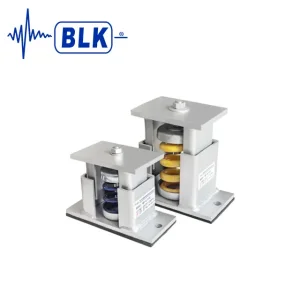
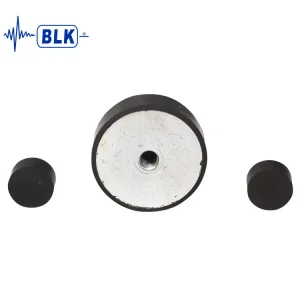
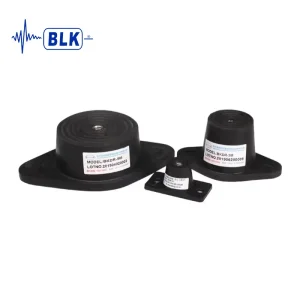
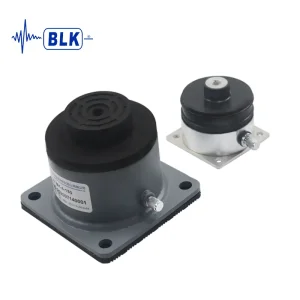
Featured Industrial Vibration Control Systems (Series I)
High-efficiency anti-vibration mounts, low-frequency spring dampers, and specialized rubber pads engineered for industrial machinery, HVAC, and power generation.
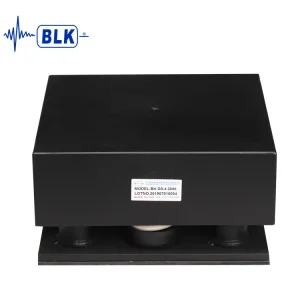
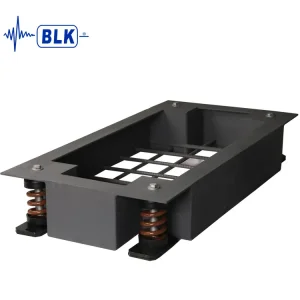
Global Landscape of Industrial Vibration Control & Custom Mounting Dampers
In modern industrial infrastructure, mechanical resonance, structural fatigue, and unwanted micro-vibrations pose critical risks to operational continuity, equipment precision, and environmental acoustics. Modern high-speed machining centers, HVAC centrifugal chillers, power distribution transformers, and semiconductor photolithography scanners operate under intense dynamic loads. Without scientifically engineered isolation systems, kinetic energy generated by internal rotating or reciprocating masses transfers directly into surrounding structures, resulting in catastrophic structural fatigue, acoustic non-compliance, and elevated component failure rates.
The global industrial vibration damper market has evolved from generic off-the-shelf rubber grommets to highly sophisticated, custom-engineered dynamic mounts. Modern procurement teams and structural engineers no longer seek superficial dampening; they require verified dynamic stiffness, precisely calculated natural frequencies ($f_n$), multi-axis dynamic shock absorption, and extreme environmental durability (such as resistance to chemical exposure, elevated temperatures, and atmospheric corrosion).
A custom mounting vibration damper serves as a dynamic mechanical barrier. By interposing an elastic medium—whether formulated elastomeric compounds, high-tensile alloy springs, or pressurized air bladders—between the vibrating mass (source) and the supporting substructure (receiver), the natural frequency of the overall mechanical system is tuned significantly below the disturbing frequency ($f_d$) of the operating machinery.
Engineering Principles & Mathematical Foundations of Vibration Isolation
To achieve high-efficiency vibration isolation (exceeding 90% to 99%), dynamic calculations must govern the custom design process. The fundamental behavior of a single-degree-of-freedom (SDOF) damped mechanical system subjected to harmonic excitation is expressed by the mathematical equation for Transmissibility ($T$):
T = √[ (1 + (2ζr)²) / ((1 - r²)² + (2ζr)²) ]
Where: r = f_d / f_n (Frequency Ratio of disturbing frequency $f_d$ to system natural frequency $f_n$), and ζ (zeta) represents the damping ratio of the isolator material.
Isolation occurs only when the frequency ratio $r > \sqrt{2} \approx 1.414$. When $r < 1.414$, the system enters the amplification region, where mounting isolators actually amplify vibration forces transmitted to the foundation. Bellking’s engineering methodology targets an optimal frequency ratio $r \ge 3.0$ to $5.0$, reducing force transmissibility below 5% (isolation efficiency $>95\%$).
| Isolator Technology | Natural Frequency Range ($f_n$) | Damping Ratio ($\zeta$) | Primary Application Matrix | Key Advantage |
|---|---|---|---|---|
| Pneumatic Air Mounts | 1.7 Hz - 3.0 Hz | 0.03 - 0.08 | Semiconductor inspection, optical benches, CMMs | Ultra-low frequency isolation, automatic leveling |
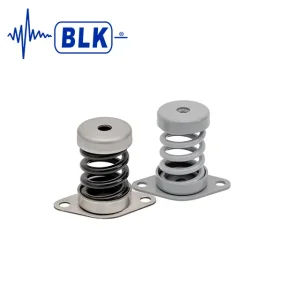
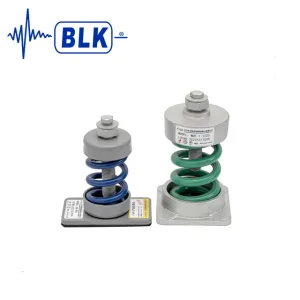
| Damped Spring Isolators | 3.0 Hz - 5.0 Hz | 0.01 - 0.15 (Viscous) | Chillers, cooling towers, power generators | High static deflection, extreme weight loads |
| Rubber & Polymer Pads | 7.0 Hz - 15.0 Hz | 0.10 - 0.25 | Air compressors, small pumps, electric motors | High intrinsic damping, high-frequency acoustic attenuation |
| Inertia Bases + Springs | 2.5 Hz - 4.0 Hz | 0.05 - 0.20 | Reciprocating pumps, large industrial fans | Lowers center of gravity, stabilizes start-up torque |
China OEM/ODM Factory Efficiency & Custom Engineering Leadership
How Bellking Vibration Reduction Equipment Manufacturing (Kunshan) Co., Ltd. combines advanced industrial clusters, automated manufacturing, and rapid engineering turnaround.
Full-Chain Precision Manufacturing
Situated in Kunshan, Jiangsu, Bellking operates a modern 2,000 m² production facility featuring automated CNC spring coiling machines, robotic welding systems, rubber vulcanization presses, and laser cutting centers. This vertical integration drastically reduces lead times and guarantees dimensional accuracy.
Severe Environment Dacromet Coating
Industrial installations often fail due to spring rusting and surface oxidation. All Bellking steel mounting components undergo proprietary Dacromet multi-layer surface treatment, certified to withstand over 900 hours of continuous salt spray testing—ideal for coastal HVAC, marine engines, and humid plant rooms.
Rapid 1:1 Engineering Customization
Unlike conventional factories requiring 6-8 weeks for customized tooling, Bellking’s dedicated 10-person R&D engineering team delivers custom vibration damper designs, FEA stress modeling, and 3D CAD step files within 24 hours, with physical prototypes delivered in as few as 3 working days.
Localized Application Scenarios & Engineering Case Studies
1. HVAC Mechanical Rooms & High-Rise Buildings
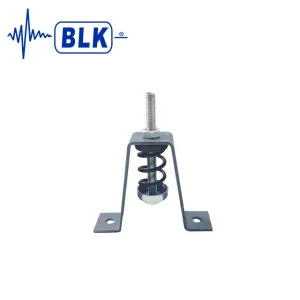
In modern commercial skyscrapers, data centers, and hospital complexes, rooftop cooling towers, basement centrifugal chillers, and ceiling-suspended Air Handling Units (AHUs) operate continuously. Unmitigated low-frequency vibrations travel through building columns, manifesting as structure-borne noise in upper floors. Bellking spring isolators and HV-type suspension hangers decouple these machines, achieving up to 98% vibration isolation efficiency and meeting stringent NC-30 acoustic ratings.
2. Power Transformers & Electrical Substations
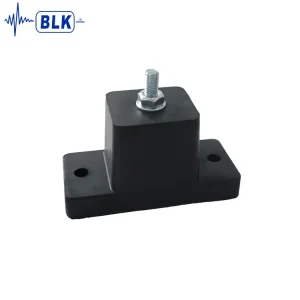
Dry-type and oil-immersed power transformers emit persistent magnetostrictive hums at fundamental power line frequencies (100 Hz / 120 Hz) along with low-frequency harmonics. This continuous acoustic vibration causes residential complaints and structural fatigue at anchor joints. Bellking’s specialized anti-vibration transformer mounts feature high-damping elastomeric cores that absorb severe vertical and shear force pulses, guaranteeing over 15 years of maintenance-free isolation performance.
3. Semiconductor Cleanrooms & Precision Metrology
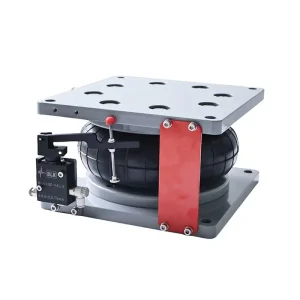
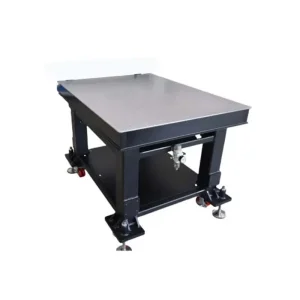
In sub-nanometer semiconductor fabrication facilities, scanning electron microscopes (SEM), coordinate measuring machines (CMM), and optical inspection tools are extremely sensitive to ambient micro-seismic vibrations caused by nearby foot traffic, HVAC equipment, or traffic outside the facility. Bellking’s BK-PF and BK-A pneumatic vibration mounts feature passive dynamic leveling and natural frequencies down to 1.7 Hz, keeping delicate metrology systems rock-steady inside cleanrooms.
4. Heavy Forging Presses, Stamping Machines & Dynamometers
Impact equipment subjects foundations to extreme transient shock forces (3G to 5G acceleration load peaks). Standard rigid mounting rapidly fractures concrete foundations and misaligns nearby tooling. Installing high-capacity BK-DS damped spring isolators coupled with reinforced concrete inertia bases absorbs peak kinetic shock forces, transforming violent transient impulse loads into smooth, harmless low-amplitude displacements.
Global Procurement Checklist: How to Evaluate a Vibration Damper Manufacturer
Global Engineering, Procurement, and Construction (EPC) contractors and Original Equipment Manufacturers (OEMs) must conduct rigorous supplier audits before specifying mounting isolators. Key technical verification criteria include:
- Material Traceability & Elastomer Formulation: Ensure the manufacturer utilizes virgin Neoprene, EPDM, Nitrile (NBR), or Natural Rubber with anti-aging compounds, avoiding cheap recycled rubber fillers that crack under UV radiation and dynamic stress.
- Spring Fatigue & Static Deflection Compliance: Springs must be manufactured from high-tensile alloy steel (such as 60Si2Mn), cold-coiled or hot-coiled according to strict heat treatment protocols, capable of 50% overload reserve without permanent set.
- Seismic & Wind Restraint Rating: For earthquake-prone regions or outdoor rooftop equipment, mounts must incorporate integrated seismic snubbers capable of resisting vertical and lateral seismic forces per IBC/ASCE 7 guidelines.
- Third-Party Dynamic Testing & Certification: Verify ISO 9001 quality management compliance along with third-party dynamic stiffness test reports, fatigue lifecycle test reports, and salt spray anti-corrosion certificates.
Emerging Trends in Industrial Vibration Control & Smart Damping
The industrial vibration isolation sector is transitioning rapidly from traditional passive isolation toward intelligent, adaptive, and sustainable damping systems:
1. Smart Sensor Integration (IoT Monitoring)
Modern custom mounting dampers are increasingly outfitted with embedded MEMS tri-axial accelerometers and wireless IoT telemetry nodes. These smart isolators collect real-time vibration spectral data, allowing plant engineers to perform predictive maintenance and detect bearing wear, rotor unbalance, or structural loosening before equipment failure occurs.
2. Hybrid Active-Passive Damping
For sub-micron semiconductor lithography and nano-scale research, passive air mounts are combined with active electromagnetic or piezoelectric actuators. These hybrid systems continuously apply counter-forces in real time, neutralizing low-frequency micro-seismic disturbances from 0.5 Hz to 10 Hz.
3. Eco-Friendly & Thermally Stable Polymers
Next-generation elastomeric dampers utilize recyclable thermoplastic vulcanizates (TPVs) and eco-compliant synthetic rubber matrixes that maintain stable dynamic shear modulus ($G*$) across extreme ambient temperature swings (-40°C to +120°C).
Frequently Asked Questions (Q&A)
Detailed answers to essential engineering, selection, and procurement queries regarding custom mounting vibration dampers.
How do I determine whether my application requires rubber mounts, spring isolators, or pneumatic air mounts?
Selection depends primarily on the disturbing frequency ($f_d$) of your equipment (determined by operating RPM) and required isolation efficiency. Rubber mounts are ideal for higher speed equipment (>1,200 RPM / 20 Hz) requiring moderate deflection. Spring isolators offer larger static deflections (25mm to 75mm) and low natural frequencies (3 Hz to 5 Hz), making them necessary for low-speed machinery like HVAC chillers, pumps, and gensets running at 300 to 1,800 RPM. Pneumatic air mounts achieve natural frequencies down to 1.7 Hz, making them essential for high-precision metrology, semiconductor tools, and optical platforms sensitivity to sub-Hz vibrations.
What key technical parameters must I provide to receive a dynamic isolator calculation from Bellking?
To perform precise sizing, provide: (1) Total operating weight of the equipment, (2) Center of gravity (CG) location and weight distribution across support points, (3) Equipment operating speed range (RPM) or forcing frequency (Hz), (4) Number and spatial layout of mounting locations, (5) Environmental factors (temperature, outdoor exposure, oil/chemical contact), and (6) Any required seismic or wind load restraint constraints. Bellking engineers will return a complete mathematical isolation calculation and product recommendation within 24 hours.
What is the typical operating lifespan of Bellking vibration isolators in industrial environments?
Under standard operating parameters, Bellking heavy-duty spring isolators and transformer mounts deliver an operational service life exceeding 15 years. Pneumatic air mount bladders maintain superior performance for 6+ years before routine maintenance inspection. Furthermore, all structural steel housings treated with our Dacromet coating survive 900+ hours of ASTM B117 salt spray testing without red rust formation.
Can Bellking manufacture custom non-standard vibration dampers for unique OEM machinery?
Yes. Bellking specializes in 1:1 tailored OEM/ODM engineering. We design custom mounting baseplates, specialized elastomeric durometers, custom spring rates, integrated height-adjusting leveling bolts, and dynamic viscous damping channels. Custom CAD 3D models are completed within 24 hours, and custom prototypes can be fabricated and tested in as few as 3 to 5 business days.
What quality assurance certifications and factory testing reports accompany your products?
Bellking operates under strict ISO 9001:2015 certified quality systems. Every production batch undergoes rigorous load-deflection static stiffness testing, dynamic spring rate analysis, dynamic elastomer shear verification, and non-destructive weld testing. Full material test certificates (MTRs), factory acceptance test (FAT) reports, and third-party lab inspection certifications are supplied with shipments upon request.
Featured Industrial Vibration Control Systems (Series II)
Advanced damped spring mounts, polymer damping pads, pneumatic isolation systems, and acoustic suspension hangers engineered for heavy industry.