
Precision HVAC & Industrial Vibration Control Products
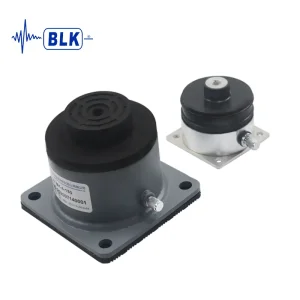
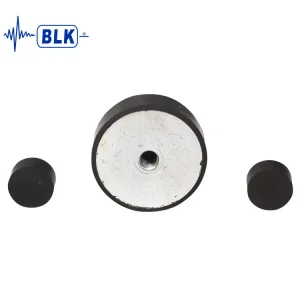
Explore our top-tier rubber mounts, precision pneumatic air isolators, dynamic spring hangers, and polymer pads engineered for extreme structural dampening.


Engineering Principles of HVAC Vibration Elimination
Understanding mechanical resonance, structure-borne noise attenuation, and dynamic force transmissibility in commercial heating, ventilation, air conditioning, and industrial process systems.
In modern architectural engineering and high-performance industrial facilities, HVAC machinery—such as centrifugal chillers, air handling units (AHUs), cooling towers, rotary screw compressors, and circulating pumps—serves as the core operational engine. However, these dynamic machines generate significant periodic forces, rotational imbalance, and hydrodynamic turbulence. Left unchecked, unattenuated mechanical vibrations transfer directly into the building structure as structure-borne acoustic noise, causing structural fatigue, joint shear, pipe rupture, and severe degradation of indoor environmental quality (IEQ).
Selecting a premier custom vibration eliminator HVAC factory & manufacturer is not merely a component procurement decision; it is a critical dynamic system engineering choice. Vibration isolation relies on inserting a flexible element (springs, elastomers, or pneumatic cushions) between the operating equipment and its supporting structure to alter the system's natural frequency ($f_n$). When the ratio of the forcing frequency ($f_d$) to the natural frequency ($f_n$) exceeds $\sqrt{2}$ (approximately 1.414), vibration isolation begins. Achieving higher isolation efficiency (>95% to 99%) requires precise tuning where $f_d / f_n \ge 3.0$.
Transmissibility quantifies the fraction of vibratory force transmitted into the sub-structure:
$$T = \left| \frac{1}{1 - (f_d / f_n)^2} \right|$$
Where $f_n = \frac{1}{2\pi} \sqrt{\frac{k}{m}} \approx \frac{4.98}{\sqrt{\delta_{st}}}$ (with static deflection $\delta_{st}$ in centimeters). Designing custom HVAC vibration eliminators demands tailoring static deflection under actual operating wet weight to guarantee isolation efficiency across all variable frequency drive (VFD) speed spectrums.
Macro Industry Solutions & System Integration
Tailored vibration control architectures engineered for critical facilities, sensitive industrial environments, and high-load commercial complexes.
Hyper-Scale Data Centers
High-density liquid cooling units, CRAH units, and emergency diesel generators create low-frequency harmonics that risk head-skips in hard disk drives (HDDs) and stress structural slabs. Custom dynamic spring isolators with viscous damping control transient startup loads and eliminate micro-vibrations across IT server floors.
Semiconductor & Nanotech Cleanrooms
Fab facilities require strict adherence to Vibration Criterion (VC-A through VC-E) curves. Our pneumatic air-mount isolators with active levelling control deliver natural frequencies down to 1.7 Hz, safeguarding photolithography tools, CMM metrology, and electron microscopes from HVAC duct and pump disturbance.
Commercial High-Rise Complexes
Roof-mounted chillers, cooling towers, and ceiling-suspended air handlers pose acoustic challenges for luxury hotels and premium office towers. Integrated inertia bases combined with pre-compressed spring hangers prevent acoustic bridging and maintain compliance with stringent ISO 3744 acoustic standards.
Vibration Isolator Selection & Performance Matrix
Compare isolation technologies, dynamic characteristics, and target HVAC applications to determine optimal specification.
| Isolator Technology | Natural Freq ($f_n$) | Max Deflection | Damping Coefficient ($\zeta$) | Primary HVAC & Industrial Application | Environmental Durability |
|---|---|---|---|---|---|
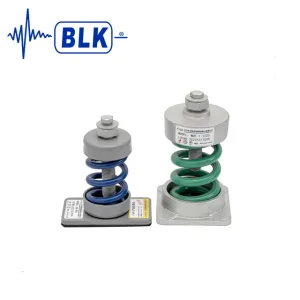
| Spring Mounts (MD Type) | 3.0 Hz – 5.0 Hz | 25 mm – 75 mm | 0.01 – 0.05 (Steel Spring) | Chillers, Large Pumps, Cooling Towers, Gensets | Hot-Dip Galv / Dacromet (900h Salt Spray) |
| Viscous Damped Spring Mounts | 2.5 Hz – 4.5 Hz | 25 mm – 50 mm | 0.15 – 0.25 (Viscous Liquid) | Variable-Speed Compressors, High-Seismic Zones | Enclosed Cast Iron / Epoxy Coated |
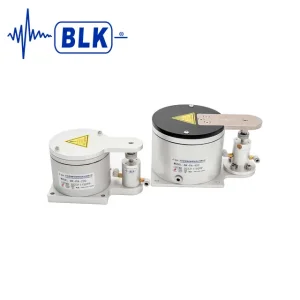
| Precision Air Mounts (BK-PA) | 1.7 Hz – 2.5 Hz | Self-Leveling | 0.06 – 0.12 (Pneumatic Damping) | Sub-micron Cleanroom HVAC, Optical Benches | Anodized Aluminum / High-Spec Elastomer |
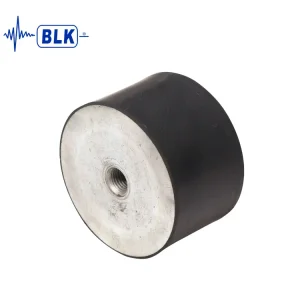
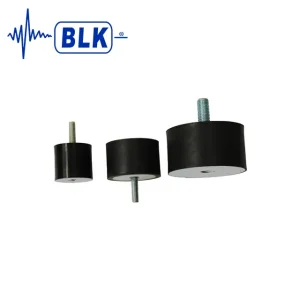
| Elastomeric Rubber Mounts (BKH/BKDD) | 6.0 Hz – 12.0 Hz | 5 mm – 15 mm | 0.08 – 0.15 (High Internal Hysteresis) | Small Fans, Inline Pumps, Piping Brackets, Cabinet HVAC | Neoprene / EPDM / Silicone Formulations |
| Inertia Base Assemblies (CPB) | System Dependent | Custom Concrete Base | High System Mass Inertia | End-Suction Pumps, Split-Case Water Pumps | Structural Steel Frame with Reinforced Rebar |
Technology Roadmap: Next-Gen HVAC Isolation Systems
Transitioning from conventional passive damping to smart, adaptive, and environmentally robust isolation solutions for Industry 4.0.
IoT-Enabled Condition Monitoring
Embedding wireless tri-axial accelerometers, temperature sensors, and strain gauges directly within custom isolator housings. Real-time fast Fourier transform (FFT) dynamic spectrum analysis detects bearing degradation, unbalance, and spring sagging before physical failure occurs.
Magnetorheological (MR) Adaptive Damping
Integrating semi-active MR fluids that adjust viscosity in milliseconds under magnetic fields. Adaptive damping modulates stiffness dynamically during HVAC compressor startup/shutdown resonance phase transitions, eliminating violent transient displacement.
Sustainable High-Molecular Elastomers
Replacing petroleum-derived rubber compounds with bio-based high-hysteresis synthetic polymers. Engineered for extreme zero-VOC off-gassing, high thermal range (-40°C to +120°C), and resistance to ozone, oil mist, and chemical degradation in harsh coastal environments.
China Factory 4.0: Supply Chain Resilience & OEM Advantages
Leveraging advanced manufacturing clusters in Kunshan, China to deliver precision-engineered, cost-competitive vibration control products worldwide.
Automated Production & Precision Testing
Our 2,000 m² modern facility operates multi-axis robotic welding cells, CNC machining centers, and automated electrostatic spraying lines. Every production batch undergoes dynamic tension-compression testing, resonant frequency spectrum verification, and 900-hour salt spray corrosion analysis to guarantee zero-defect shipment.
Rapid Prototyping & 3-Day Turnaround
Backed by strong local raw material supply chains (high-tensile alloy steel spring wire, premium natural/synthetic rubber polymers, and specialized casting foundries), we achieve non-standard custom engineering turnarounds in as little as 3 business days, reducing procurement lead-times by up to 60% compared to Western counterparts.
Global Enterprise Procurement: TCO Analysis
Why initial component purchase price represents less than 5% of long-term lifecycle value in commercial and industrial HVAC operations.
For global EPC (Engineering, Procurement, and Construction) contractors, facility managers, and original equipment manufacturers (OEMs), procuring vibration eliminators purely based on upfront unit cost introduces major operational risk. Sub-standard isolators suffer from early elastomer degradation, spring compression fatigue, metal corrosion, and improper deflection tuning.
Failure of a single vibration isolation system leads to severe cascade risks across the facility infrastructure:
- Refrigerant Piping Fatigue & Leaks: Uncontrolled pump or chiller vibration causes cyclic stress on copper and steel suction/discharge headers, leading to refrigerant loss, EPA environmental fines, and expensive system re-charging.
- Compressor Shaft Misalignment: Excessive mechanical motion damages shaft seals and internal scroll/screw tolerance, causing premature motor burnout and unplanned plant shutdown.
- Structural Acoustic Non-Compliance: Structure-borne low-frequency hum transmitted into occupied commercial spaces leads to tenant lease disputes, non-compliance with municipal noise ordinances, and costly emergency retrofit work.
Bellking provides global clients with full Finite Element Analysis (FEA) vibration modeling, 1:1 parameter verification, customized mounting footprints, rigid seismic restraint options (conforming to IBC seismic requirements), and a 15-year operational design life.
Localization Support & Global Compliance Standards
Rigorous alignment with international engineering codes, environmental directives, and local structural specifications.
ASHRAE Applications Handbook
Designed strictly per ASHRAE Chapter 48 guidelines (Sound and Vibration Control). Selection tables match minimum static deflection requirements based on equipment type, horsepower, RPM, and building span vulnerability.
Seismic & Wind Restraints (IBC)
All restrained spring isolator series are engineered to meet International Building Code (IBC) seismic design categories (A through F). Built-in snubbers absorb multi-directional seismic forces up to 2.0g acceleration vector loads.
ISO 9001, CE, RoHS & REACH
Full traceability across raw material certs, heat treatment documentation, dynamic fatigue testing reports, and REACH/RoHS environmental hazardous substance compliance for worldwide import and audit peace of mind.
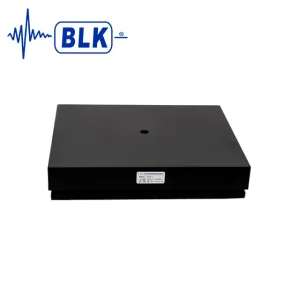
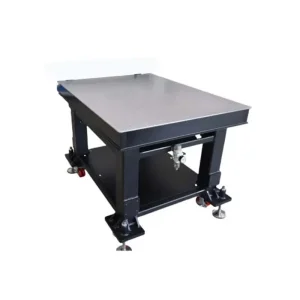
Specialized Damping Pads, Bases & Precision Platforms
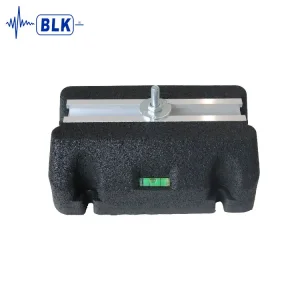
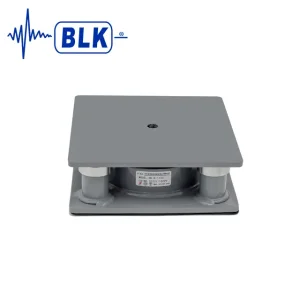
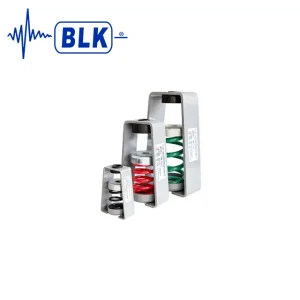
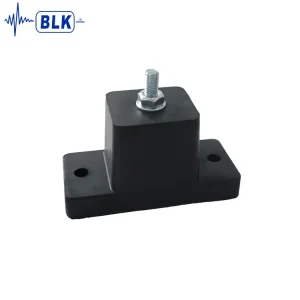
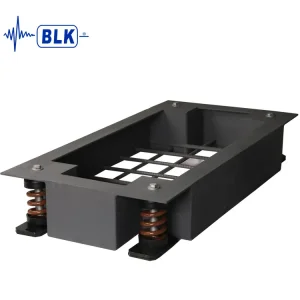
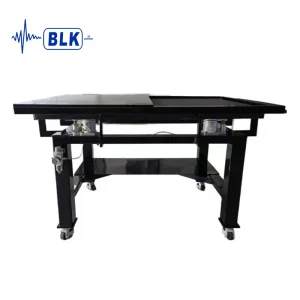
Browse our extended product lines including custom inertia bases, transformer mounts, high-damping optical platforms, and polymer pads.
Frequently Asked Engineering & Procurement Questions
Clear, authoritative insights from Bellking application engineers regarding isolation selection, customization processes, performance calculations, and factory lead times.