Featured Industrial Shock Isolation Systems
Engineered anti-vibration mounts, spring isolators, and precision pneumatic bases engineered to exceed ISO 9001 and industrial load tolerances.






1. Executive Overview: The Engineering Paradigm of Industrial Shock Absorption
Analyzing kinetic energy dissipation, micro-vibration mitigation, and lifecycle management in modern production environments.
In contemporary industrial manufacturing, mechanical vibration and uncontrolled shock pulses represent two of the primary drivers of premature equipment failure, energy loss, and processing inaccuracies. An industrial grade shock absorber factory operates at the intersection of material science, structural dynamics, and kinetic fluid mechanics. Far beyond simple rubber stoppers or basic steel springs, heavy-duty industrial shock absorbers are precision-engineered devices calibrated to control harmonic resonance and absorb high-G deceleration forces.
Modern factories utilizing high-speed stamping presses, heavy HVAC chillers, power transformers, and automated CNC machining lines generate significant dynamic forces. Unchecked, these forces propagate through facility foundations, causing structure-borne noise, structural fatigue, and calibrated alignment shifts in nearby precision machinery. Selecting an expert manufacturing partner specializing in customized anti-vibration mounts and dampening platforms is essential to maintaining operational continuity and achieving strict regulatory acoustic compliance.
Kinetic Energy Conversion
Industrial shock absorbers dissipate kinetic energy by forcing hydraulic fluids or viscous compounds through precision orifice passages, transforming mechanical shock into harmless thermal energy smoothly.
Harmonic Resonance Attenuation
By engineering elastomeric matrix compounds and spring deflections, specialized mounts isolate delicate cleanroom and metrology equipment from external ambient floor vibrations down to 1.7 Hz.
Transient Load Deceleration
Designed for multi-axis impacts, industrial shock absorbers cushion sudden start-stop inertial surges in automated gantry robotics, heavy stamping lines, and turbine emergency shutdown protocols.
2. Global Enterprise Procurement: Technical Evaluation Metrics
Key parameters required by global EPC contractors, OEM design engineers, and facility procurement officers.
Heavy Infrastructure & Facilities
Commercial HVAC networks, cooling towers, and power generation substations require anti-vibration spring mounts capable of enduring static loads up to tens of tons while providing anti-corrosive performance under extreme weather exposure.
- Dacromet surface treatment passing 900+ hour salt spray testing.
- Custom spring deflections from 25mm to 75mm for ultra-low natural frequencies.
- Viscous damping options to control motion during equipment start-up/shutdown.
Semiconductor & Micro-Metrology
Semiconductor fabrication lines, CMM units, and optical testing platforms demand sub-micron micro-vibration isolation platforms capable of active or passive pneumatic self-leveling.
- Natural frequencies as low as 1.7 Hz via pneumatic chamber design.
- Cleanroom class 10/100 compatible elastomeric seals and anodized components.
- Integrated leveling valves returning platforms to planar equilibrium within seconds.
Technical Matrix: Comparing Shock Absorber & Isolator Technologies
| Isolator / Absorber Type | Natural Frequency Range ($f_n$) | Primary Damping Mechanism | Typical Applications | Expected Service Life |
|---|---|---|---|---|
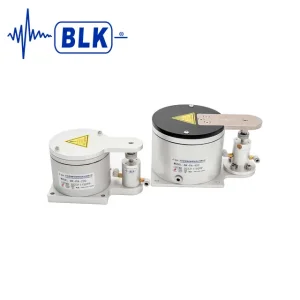
| Pneumatic Air Mounts | 1.7 Hz - 3.0 Hz | Compressed Air / Diaphragm Cushion | Lithography, CMM, Laser Metrology | 6 - 10 Years |
| Spring Vibration Isolators | 3.0 Hz - 5.0 Hz | Helical Steel Spring / Viscous Fluid | Chillers, Pumps, Generators, HVAC | 15+ Years |
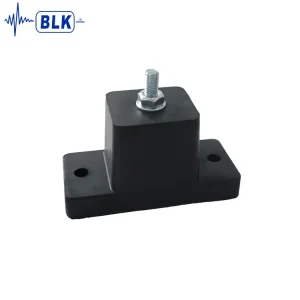
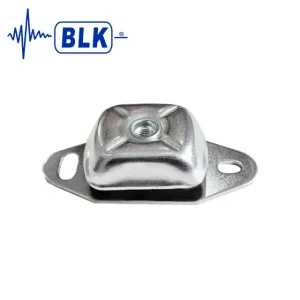
| Transformer Anti-Vibration Mounts | 4.0 Hz - 8.0 Hz | Matrix Elastomer + Metal Plate | Power Sub-stations, Electrical Transformers | 15+ Years |
| Heavy Inertia Base Systems | Varies by Spring Selection | Mass Load Redistribution + Spring Base | End-Suction Pumps, Reciprocating Compressors | 20+ Years |
| Matrix Rubber Pads & Feet | 8.0 Hz - 15.0 Hz | Polymer Hysteresis Loss | Motors, Conveyors, Small Air Compressors | 8 - 12 Years |
3. China Factory 4.0: Supply Chain Resilience & Manufacturing Synergy
How automated production, advanced FEA simulation, and regional industrial clustering deliver uncompromised quality at global scale.
China’s industrial transformation into Factory 4.0 has redefined the global supply chain for specialized mechanical components like shock absorbers and anti-vibration systems. Anchored in precision manufacturing clusters such as Kunshan, Jiangsu, advanced shock absorber factories integrate vertically from raw material steel processing and rubber vulcanization to robotic welding, automated powder coating, and full-spectrum dynamic testing.
FEA Stress & Damping Simulation
Before physical tooling begins, 3D Finite Element Analysis (FEA) simulates static load distribution, spring fatigue limits, and dynamic stress points under peak multi-axis shock conditions.
ISO 9001 End-to-End Quality
Automated CNC lathe machining, laser cutting, robotic welding arms, and 100% tension-compression testing guarantee that every product batch meets exact spring rate tolerances.
Rapid OEM Customization
Flexible modular tooling setups allow Chinese factories to turn around customized OEM shock absorbers—matching tailored mounting hole dimensions or non-standard load ratings—in days rather than months.
4. Field Engineering: Localized Application Scenarios
Exploring real-world installation requirements across heavy industry, electrical infrastructure, and high-tech manufacturing.
HVAC Plants & Commercial Roof Installations
Large centrifugal chillers, cooling towers, and variable air volume (VAV) systems installed on building rooftops require specialized heavy-duty spring vibration mounts fitted with neoprene friction pads.
Field Challenge: Wind loads and equipment start-up torque can cause excessive lateral motion.
Solution: Restrained spring isolators with built-in limit stops prevent over-extension during maintenance drainage or high wind conditions while preserving >95% low-frequency vibration isolation during normal operation.
Electrical Transformer Vibration Hum Mitigation
Step-down and distribution transformers emit constant low-frequency magnetostrictive hum (typically 50 Hz / 60 Hz and harmonics). Uninsulated installations suffer structure-borne acoustic amplification inside concrete substations.
Field Challenge: High thermal output combined with continuous micro-vibration degradation.
Solution: Transformer anti-vibration mounts constructed from high-temperature synthetic elastomers combined with load-bearing steel top-plates eliminate rigid floor contact, cutting noise pollution by up to 25 dB(A).
End-Suction Pumps & Inertia Base Assembly
Heavy water pumps experience dynamic fluid turbulence, uneven mass distribution, and pipe strain. Direct attachment to concrete slabs leads to pipe joint shear and floor resonance.
Field Challenge: Unbalanced rotational mass during pump start-up cycles.
Solution: CPB Type structural steel inertia bases filled with concrete lower the center of gravity, reduce pump rocking motion, and provide a rigid platform supported by open-spring vibration mounts.
Precision Metrology Platforms & Optical Benches
Nanometer-scale inspection systems, semiconductor wafer probers, and optical laser benches are vulnerable to ambient floor disturbances caused by foot traffic, elevators, and nearby traffic.
Field Challenge: Sub-micron positional drift rendering imaging and measurements inaccurate.
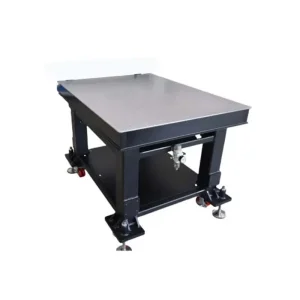
Solution: Precision air-mount isolation platforms featuring low-frequency air springs maintain precise leveling through auto-tuning pneumatic sensors, dampening floor vibrations down to 1.7 Hz.
5. Mathematical Selection Framework for Industrial Shock Isolators
A step-by-step engineering methodology for calculating transmissibility and selecting optimal spring constants.
To accurately select a shock absorber or vibration isolator, mechanical engineers must follow a rigorous mathematical verification process based on single-degree-of-freedom (SDOF) dynamic systems.
Key Mathematical Formulas:
1. System Natural Frequency ($f_n$)
f_n = (1 / 2π) * √(k / m) = 4.98 / √δ
Where $k$ is the spring stiffness (N/m), $m$ is the supported mass (kg), and $\delta$ is the static deflection of the isolator in centimeters.
2. Transmissibility Ratio ($T$)
T = 1 / | (f_d / f_n)² - 1 |
Where $f_d$ is the disturbing excitation frequency of the motor or pump (RPM / 60). Isolation occurs only when $T < 1$.
6. Frequently Asked Questions (FAQ)
Direct technical answers from senior vibration control engineers for common procurement and design questions.
- Rubber Mounts: Ideal for high-speed equipment (>1,200 RPM) requiring small deflections where high frequency noise dampening and compact footings are needed.
- Spring Isolators: Best for low-frequency equipment (300 to 1,800 RPM) such as chillers, heavy pumps, and cooling towers, offering static deflections from 25mm to 75mm ($f_n$ between 3–5 Hz).
- Pneumatic Air Mounts: Essential for delicate micro-vibration applications (<300 RPM excitation or sub-micron metrology) requiring ultra-low natural frequencies (1.7–3.0 Hz).
- They add rigid mass to the pumping assembly, keeping dynamic equipment movement within acceptable physical limits during start-up torque surges.
- They significantly lower the overall center of gravity, preventing top-heavy rocking.
- They act as a rigid structural frame, preventing alignment shifts between the motor drive shaft and pump housing, thereby extending pipe coupling and mechanical seal lifespans.
Complete Industrial Damping & Isolation Product Range
Explore our specialized vibration damping pads, precision air mounts, and customizable rubber feet manufactured to exact industrial metrics.