Featured Precision Isolation Mounts & Damping Assemblies
Explore engineered anti-vibration solutions manufactured to ISO 9001 standards for immediate global distribution.






The Global State of Industrial & HVAC Vibration Isolation
Understanding structural acoustics, dynamic transmissibility, and the economic shift toward high-performance Mason-type elastomeric pads.
In modern architectural, industrial, and civil engineering, the mitigation of structural noise and mechanical vibration has evolved from an optional comfort design standard into a strict regulatory necessity. Heavy rotating equipment—such as centrifugal chillers, air handling units (AHUs), cooling towers, industrial compressors, high-voltage transformers, and stamping presses—generates substantial dynamic forces. If left unattenuated, these dynamic disturbances propagate through building floor slabs, steel girders, and piping connections as structure-borne acoustic energy, resulting in severe structural fatigue, equipment miscalibration, and intolerable noise pollution.
Among the various elastomeric vibration isolation products globally deployed, the Mason Vibration Isolation Pad style (waffle pads, cross-ribbed neoprene pads, and steel-interleaved composite elastomer pads) remains the international benchmark for mid-to-high frequency isolation. As global infrastructure expands across North America, Europe, the Middle East, and Asia-Pacific, procurement managers, MEP engineering consultants, and acoustic contractors face a complex sourcing dilemma: securing high-durability, compliant vibration control pads at competitive direct-from-factory prices without sacrificing elastomeric integrity, creep resistance, or fire retardancy.
The global market for acoustic isolation pads is undergoing significant technological restructuring. Driven by stringent municipal noise legislation (e.g., ASHRAE 170 standards, DIN 4109 sound insulation criteria, and ISO 20283 marine/industrial vibration mandates), building engineers can no longer rely on unverified commercial rubber scrap pads. Sourcing from certified direct manufacturers allows engineering buyers to review full viscoelastic hysteresis data, shore hardness compliance (typically 40 to 70 Durometer Shore A), and dynamic stiffness multipliers before installation.
Mechanical Design & Viscoelastic Elastomer Mechanics
How geometric waffle patterns, steel shim interleaving, and polymer compounding determine isolation efficiency.
Cross-Ribbed Waffle Geometry
Standard rubber blocks lock up under high vertical loads due to the shape factor restraint. Mason-style pads utilize alternating, perpendicular square ribs that provide lateral space for the elastomer to bulge under strain, maintaining low dynamic stiffness and preventing pad lockup under high loading.
Steel Interleaved Sandwich Assemblies
For high-pressure heavy industrial loads exceeding 100 PSI (0.7 N/mm²), multiple layers of ribbed elastomeric pads are bonded or stacked with galvanized or stainless steel shims. This composite construction multiplies static deflection capacity without compromising lateral stability.
Viscoelastic Polymer Compounding
High-grade Neoprene (Chloroprene) and EPDM compounds are specifically formulations engineered to resist oil, ozone, UV radiation, and permanent compression set. Unlike cheap natural rubber compounds, industrial Neoprene pads maintain consistent durometer hardness across extreme temperature spans.
Mathematical Principles of Vibration Transmissibility
The performance of a Mason vibration isolation pad is defined by its dynamic transmissibility ($T$), expressed mathematically as:
Where $f_d$ is the operating frequency of the machine (Hz) and $f_n$ is the natural frequency of the elastomeric pad assembly (Hz). Dynamic isolation occurs only when $f_d / f_n > \sqrt{2} \approx 1.414$. When $f_d / f_n \ge 3.0$, the transmissibility drops below 12.5%, yielding an isolation efficiency exceeding 87.5%. For critical hospital, cleanroom, and residential tower HVAC installations, engineers select composite or thicker stacked pad configurations to lower $f_n$ down to 5–7 Hz, pushing isolation efficiency beyond 95%.
Mason Pad vs. Alternative Vibration Control Technologies
Evaluate static deflection, load capacity, dynamic frequency ranges, and cost-benefit profiles across isolator classes.
| Isolator Technology | Natural Frequency ($f_n$) | Max Load Capacity | Static Deflection Range | Primary Application Field | Cost Factor |
|---|---|---|---|---|---|
| Mason Waffle Neoprene Pad | 8.0 Hz – 12.0 Hz | Up to 120 PSI (0.83 MPa) | 2.5 mm – 5.0 mm | HVAC units, pumps, small fans, transformers | Low / Factory-Direct |
| Steel-Interleaved Composite Pad | 5.5 Hz – 8.0 Hz | Up to 250 PSI (1.72 MPa) | 6.0 mm – 12.0 mm | Chillers, heavy cooling towers, stamping presses | Moderate |
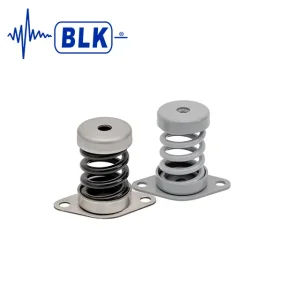
| Damped Spring Mounts (BK-DS Type) | 3.0 Hz – 5.0 Hz | Up to 5,000 kg per point | 25.0 mm – 50.0 mm | Low-RPM chillers, rooftop AHUs, emergency gensets | Mid-to-High |
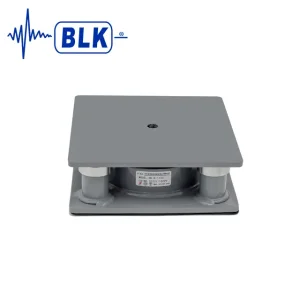
| Precision Air Mounts (BK-PA Type) | 1.2 Hz – 2.5 Hz | Up to 3,000 kg per point | Active pneumatic height controls | Semiconductor tools, CMMs, electron microscopes | High / Precision |
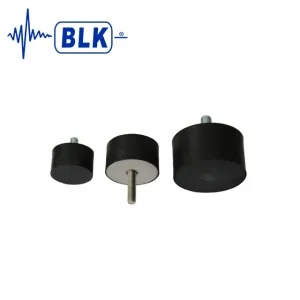
| Polymer Damping Pads (BK-PM Type) | 7.0 Hz – 10.0 Hz | Up to 180 PSI (1.24 MPa) | 3.0 mm – 8.0 mm | Acoustic retrofit, floor floating systems, machinery pads | Low-Mid |
Industrial Deployment & Regional Localized Use Cases
From commercial skyscraper mechanical rooms to semiconductor cleanroom sub-fabs and power distribution grids.
Rooftop & Upper-Floor HVAC Plants
Modern luxury hotels, hospitals, and office towers locate massive chillers and condenser pumps on elevated roof slabs. Unattended structural vibrations travel through concrete columns into lower occupied spaces. Placing Mason-style waffle pads beneath inertia bases effectively breaks acoustic bridges, ensuring compliance with local ambient sound ordinances (NC-30 to NC-35 rating limits).
Power Transformers & Electrical Substations
Electrical transformers emit persistent magnetostrictive hum at 100 Hz and 120 Hz harmonics. Because this frequency range is high, elastomeric Mason pads offer exceptional isolation performance. Specially compounded Neoprene pads placed beneath transformer support rails prevent core vibration from magnetizing adjacent structural steelwork.
Semiconductor Sub-Fab Infrastructure
Photolithography scanners and atomic force microscopes are hypersensitive to micro-vibrations (VC-D and VC-E velocity criteria). While the tool itself sits on precision air platforms, surrounding auxiliary equipment like vacuum pumps, scrubbers, and DI water chillers are decoupled using high-density polymer elastomeric pads to isolate background ambient noise.
ISO 9001 Factory Quality Controls & OEM Value Economics
How direct B2B factory manufacturing reduces procurement costs while upgrading raw material standards.
When sourcing low price Mason vibration isolation pads, procurement officers must avoid short-sighted compromises on raw rubber quality. Unscrupulous suppliers frequently blend high percentages of reclaimed rubber filler or calcium carbonate powder into elastomeric compounds. While this significantly lowers initial manufacturing costs, it severely compromises tensile strength, accelerates rubber aging under UV exposure, and causes catastrophic pad flattening (high compression set) within 12 to 24 months of operation.
Essential Quality Standards for Commercial Procurement
- ASTM D395 (Compression Set Testing): Premium elastomeric pads must demonstrate a compression set under 20% after 22 hours at 70°C, ensuring long-term elasticity under constant static machinery dead loads.
- ASTM D412 (Tensile Strength & Elongation): Pure Chloroprene (Neoprene) compounds must exceed 12 MPa tensile strength with elongation at break greater than 350%.
- Corrosion Protection for Steel Inserts: Interleaved steel plates must undergo Dacromet coating or heavy galvanization, enduring over 900 hours of continuous salt spray testing according to ASTM B117 standards.
- Ozone & Oil Resistance (ASTM D1149): Essential for outdoor chillers and hydraulic power units where oily runoff and ambient ozone would rapidly crack standard natural rubber.
Future Outlook: Next-Generation Damping Materials (2026–2035)
Emerging materials science, smart IoT vibration monitoring, and green elastomeric synthesis.
IoT-Embedded Smart Damping Pads
Future iterations of Mason-type pads integrate thin-film piezoelectric sensors directly between elastomeric layers. These smart pads wirelessly stream real-time static load changes, dynamic displacement, and degradation metrics to facility management software, alerting engineers to machinery misalignment before catastrophic bearing failure occurs.
Bio-Based & Recyclable Viscoelastic Polymers
Aligning with global carbon-neutral mandates, R&D teams are engineering bio-derived chloroprene equivalents synthesized from renewable plant oils and silica fillers. These eco-elastomers provide identical loss factors ($\eta \approx 0.15 - 0.25$) and fatigue resistance while drastically cutting embodied carbon emissions.
Metamaterial Structural Profiles
By replacing uniform waffle grids with algorithmically optimized cellular metamaterial topologies, next-generation pads achieve multi-frequency bandgaps. This custom structural profile selectively blocks specific target motor frequencies (e.g., 29 Hz or 59 Hz) while maintaining high static load resistance.
Frequently Asked Questions by MEP Engineers & Buyers
Direct answers to crucial questions regarding sizing, load calculation, installation, and factory lead times.
How do I accurately size Mason-style vibration isolation pads for an industrial pump?
To accurately size a Mason pad, calculate the total operating weight of the pump (including fluid weight, motor, and inertia base). Divide the total weight by the number of support points to find the static load per pad ($P$). Next, select a pad area based on the manufacturer's recommended load rating—typically 50 to 100 PSI (0.35 to 0.70 N/mm²) for standard 50-durometer waffle pads. Ensure that the equipment operating speed ($RPM$) divided by 60 gives an excitation frequency ($f_d$) at least 3 times higher than the pad's natural frequency ($f_n$).
What is the functional difference between 40, 50, 60, and 70 Durometer Shore A rubber?
Durometer measures the hardness and shear modulus of the elastomer. Soft elastomers (40 Shore A) compress more under light loads, providing lower natural frequencies (better isolation for lightweight machinery). Harder compounds (60-70 Shore A) carry vastly higher static loads without excessive deformation, making them ideal for heavy chillers, structural inertia blocks, and high-pressure industrial equipment. Selecting the incorrect durometer results in either under-deflection (zero isolation) or over-deflection (pad lockup and tearing).
Why choose Neoprene (Chloroprene) over standard Natural Rubber for HVAC pads?
While Natural Rubber exhibits high resilience, it deteriorates rapidly when exposed to oil, grease, ozone, and outdoor weather conditions. Neoprene provides superior resistance to hydrocarbons, UV light, atmospheric aging, and elevated temperatures (up to 100°C). Additionally, Neoprene possesses inherent flame-retardant characteristics, satisfying building code fire safety requirements for air plenum mechanical spaces.
Can Mason vibration pads be stacked to increase static deflection?
Yes. Stacking multiple layers of waffle pads increases total static deflection, which lowers the system natural frequency and improves isolation efficiency for slower-speed machinery. However, stacked pads MUST be separated by galvanized or stainless steel shims (interleaved construction). Direct rubber-on-rubber stacking causes rib alignment lockup and lateral instability, creating a tip-over hazard under dynamic startup forces.
What lead time and factory documentation are provided for wholesale overseas orders?
Standard model orders ship within 24 to 48 hours directly from factory inventory. Custom molded shapes, specific shore hardnesses, or steel-interleaved custom dimensions require 3 to 7 working days. Every shipment includes ISO 9001 quality certificates, material mill test reports (MTRs), ASTM compliance test data, and a standard 1-year performance guarantee.
High-Performance Industrial Mounts & Custom Platforms
Explore specialized anti-vibration spring hangers, pneumatic platforms, and heavy-duty rubber isolators.