
High-Performance Suspended Dampers & Isolators (Part 1)
Explore engineered suspended vibration control products manufactured to international structural acoustic standards.
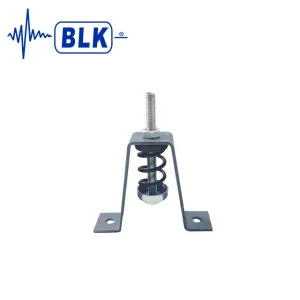



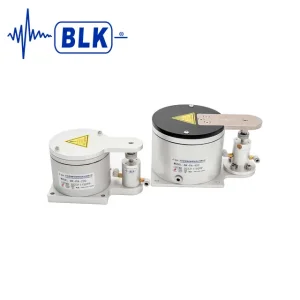
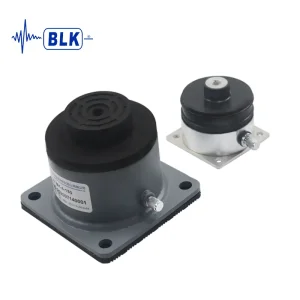


Architectural Acoustics & Mechanical Vibration Dynamics
A comprehensive analysis of structure-borne noise attenuation, dynamic deflection physics, and suspended vibration isolation mechanisms.
In modern industrial facilities, commercial skyscrapers, healthcare centers, and high-tech manufacturing plants, mechanical equipment operating suspended overhead—such as Air Handling Units (AHUs), inline centrifugal fans, chilled water suspended piping, and exhaust ductwork—presents a complex engineering challenge. Unattenuated low-frequency vibrations generated by rotating shafts, compressors, and fluid turbulence propagate directly through steel hangers and concrete slab ceilings into the primary building structure. This phenomenon, known as structure-borne acoustic transmission, degrades building structural integrity, violates municipal noise ordinances, and disrupts sensitive optical or electronic instrumentation.
To systematically suppress structure-borne vibration, engineering procurement mandates the integration of specialized suspended vibration dampers and anti-vibration spring hangers. The governing physics relies on establishing a strategic ratio between the disturbing frequency of the mechanical equipment ($f_d$) and the natural frequency of the vibration isolator ($f_n$). According to classical structural dynamics, vibration isolation only occurs when the frequency ratio exceeds $\sqrt{2}$ (approximately 1.41). To achieve high-efficiency attenuation exceeding 95%, engineering guidelines specified by ASHRAE and ISO 2017 dictate targeting a frequency ratio ($f_d / f_n$) equal to or greater than 3.0.
Fundamental Isolation Formula & Transmissibility Equation
The theoretical efficiency ($E$) and transmissibility ($T$) of a suspended damper are determined by:
Where natural frequency ($f_n$) is linked directly to static deflection ($\delta$, in millimeters) via Hooke's Law: $f_n = \frac{15.8}{\sqrt{\delta}} \text{ Hz}$. Consequently, achieving low natural frequencies (e.g., 3.0 Hz to 5.0 Hz) requires precise spring static deflections between 10mm and 25mm under full rated mechanical load.
Harmonic Resonance Dampening
Incorporates specialized elastomeric dynamic stops and viscous damping channels that suppress transitional amplification during equipment startup and shutdown phases.
Wide Load Deflection Range
Engineered to handle individual suspension point loads from 15 kg to over 3,500 kg with linear spring rates and a minimum 50% overload reserve capability.
Acoustic High-Frequency Cut-off
Employs dual-stage isolation pads (molded neoprene/CR elastomer coupled with steel coil springs) to prevent sound bridging across upper audible frequencies (100 Hz - 10 kHz).
China Supply Chain Synergy & "Low Price" Value Realization
Demystifying cost optimization: How advanced automation, raw material integration, and industrial clustering yield global price advantages without compromising engineering performance.
The term "Low Price" in international engineering procurement is frequently misunderstood as a compromise on material quality. However, in the context of China’s leading vibration control manufacturing hubs—such as the Yangtze River Delta cluster centered in Kunshan and Jiangsu—cost optimization is driven by structural efficiency, raw material vertical integration, and advanced manufacturing automation rather than quality degradation.
Chinese OEM/ODM manufacturers leverage an unparalleled industrial ecosystem. High-grade spring steel (such as 60Si2Mn and 65Mn silicon-manganese alloys) and high-purity natural rubber compounds are sourced directly from domestic primary steel mills and polymer synthesizers at wholesale scale. By integrating automated spring coiling, continuous tempering furnaces, robotic MIG welding, and automated powder coating/Dacromet lines within a single localized perimeter, logistical friction is minimized, reducing factory overhead by up to 35% compared to Western counterparts.
| Evaluation Parameter | Western OEM Brands | Tier-1 China Factory Direct (e.g., Bellking) | Engineering Value Gain |
|---|---|---|---|
| Raw Material Sourcing | Multi-tiered global supply chains; high transport premiums. | Direct steel mill & rubber refining integration (GB/T standards). | 25–30% initial material cost reduction. |
| Manufacturing Automation | Partial automation; high labor and overhead costs. | Fully automated CNC spring coiling, robotic welding, laser cutting. | Sub-millimeter tolerance & faster batch output. |
| Surface Protection | Standard zinc plating (120–240 h salt spray standard). | Advanced Dacromet & electro-coating (900+ h salt spray test passed). | Superior corrosion resistance in humid HVAC/marine sites. |
| Lead Time for Custom R&D | 8 to 14 weeks for non-standard spring rates. | 3 to 7 working days for CAD/BIM modification & prototyping. | Reduces site downtime and project delivery risk. |
| Total Cost of Ownership (TCO) | High capital cost ($$$); premium brand markup. | Optimized factory-direct pricing ($); zero intermediary margins. | Up to 45% CAPEX savings on HVAC isolation hardware. |
Global Enterprise Procurement & Regulatory Compliance
Aligning manufacturing output with international building codes, environmental certifications, and rigorous quality assurance frameworks.
ISO 9001:2015 Quality Systems
Every manufacturing step—from raw coil wire inspection to dynamic load testing—is executed under certified Quality Management Systems. Factory Inspection Reports (FIR) and material traceability certificates accompany every export shipment.
ASHRAE & IBC Seismic Restraint
Suspended vibration dampers are optioned with multi-directional seismic housing cages tested to International Building Code (IBC) and ASCE 7 standards, preventing catastrophic equipment drop during seismic events or severe wind uplift.
RoHS & REACH Eco Compliance
Elastomeric components utilize non-toxic, halogen-free rubber formulations that comply strictly with European REACH and RoHS regulations, guaranteeing zero hazardous off-gassing in sterile cleanroom or healthcare ventilation systems.
Enterprise buyers from North America, Europe, the Middle East, and Southeast Asia require robust supply chain verification. Leading Chinese manufacturers now offer full BIM (Building Information Modeling) objects and REVIT family files for mechanical engineers. This allows seamless drag-and-drop integration into 3D building designs, enabling virtual collision detection and precise static load calculation prior to physical procurement.
Localized Engineering Application Scenarios
Real-world deployment examples across commercial, industrial, transit, and cleanroom environments.
High-Rise HVAC Piping & AHU Suspension
In 40+ story commercial towers, long vertical chilled water risers expand thermally while generating fluid vibration. High-deflection spring hangers absorb both axial pipe growth and high-amplitude pump vibration, protecting ceiling anchors from shear failure.
Semiconductor Cleanroom Overhead Ducting
Sub-micron lithography processes require VC-E or VC-G micro-vibration criteria. Precision air-mounts and low-stiffness polymer hangers isolate suspended Fan Filter Units (FFUs) to prevent airborne structure vibration from compromising wafer exposure accuracy.
Subway & Rail Transit Ventilation Systems
Underground metro station jet fans encounter violent airflow pressure pulses and severe humidity. High-capacity, Dacromet-coated spring dampers with anti-drop safety rods maintain structural security under constant cyclic load reversals.
High-Performance Suspended Dampers & Isolators (Part 2)
Explore our complete range of specialized elastomeric, pneumatic, and spring-damped anti-vibration mounts.








Industry Trends & Technological Innovations (2025–2030)
Exploring smart active damping, eco-friendly polymers, and modular off-site prefabrication in modern vibration engineering.
The global vibration control industry is undergoing a paradigm shift driven by smart building automation, sustainability directives, and off-site modular construction trends. Next-generation suspended vibration dampers are incorporating IoT-enabled micro-sensors that record real-time vibration spectral signatures and static deflection creep over time. This data feeds into Building Management Systems (BMS) to trigger predictive maintenance warnings before mechanical fatigue occurs.
Simultaneously, environmental regulations are pushing manufacturers to replace traditional synthetic oil-based elastomers with recyclable bio-polymers and eco-compliant natural rubber compounds. Tier-1 Chinese factories lead this transition by investing heavily in advanced dynamic fatigue testing rigs and finite element analysis (FEA) software, ensuring lighter damper bodies with higher ultimate tensile strength.
Frequently Asked Questions (FAQ)
In-depth technical answers from senior structural acoustic engineers to assist procurement managers and mechanical designers.
How do I calculate the required static deflection for a suspended vibration damper?
What is the difference between rubber/elastomeric hangers and coil spring hangers?
Why are China factory direct prices significantly lower than Western OEM brands?
How do suspended vibration dampers perform under seismic and wind load conditions?
What surface anti-corrosion treatments are available for outdoor or coastal deployments?
Can Bellking manufacture custom non-standard suspended dampers according to project drawings?
Request Custom Sizing & Engineering Quotation
Submit your equipment operating parameters (RPM, total weight, support point count, ceiling clearance) to receive an optimized vibration isolation calculation plan and factory-direct price quotation within 24 hours.
Contact Our Application Engineers